Features / Review
Talk01 : 70th Anniversary of Liberation: the Great Journey with the Citizens Uproarious, Heated, Inundated
posted 24 Sep 2015The National Museum of Modern and Contemporary Art, Seoul, hosted an exhibition (8.4–10.11) that captured the course of modern art in Korea after the nation's liberation from Japan. Comprising 270 pieces, the exhibition provided an in-depth portrayal of modern and contemporary Korea through the three themes of ‘uproarious’, ‘heated’, and ‘inundated’. The exhibition spans a period of over 70 years, but instead of presenting art in a simple chronological formation, pieces have been placed according to the social and cultural atmosphere they represent. The objective was to honor the true meaning of liberation by focusing not on a closed past but an open present.
Unsettled Labels, Open Conclusion
The National Museum of Modern and Contemporary Art, Seoul, hosted an exhibition (8.4–10.11) that captured the course of modern art in Korea after the nation's liberation from Japan. Comprising 270 pieces, the exhibition provided an in-depth portrayal of modern and contemporary Korea through the three themes of "uproarious," "heated," and "inundated." The exhibition spans a period of over 70 years, but instead of presenting art in a simple chronological formation, pieces have been placed according to the social and cultural atmosphere they represent. The objective was to honor the true meaning of liberation by focusing not on a closed past but an open present.
‘Uproarious, Heated, Inundated,’ hosted by the National Museum of Modern and Contemporary Art, Seoul, was a grand celebratory event highlighting the course of modern art in Korea after liberation from Japan. Although there's no clear reason why people insist on celebrating 70 years of Korean liberation as opposed to 69, we tend to arrange time into neat units such as 10, 50, or 100 years. Our perception of time is susceptible phenomenological disruptions, as past events are continually reinterpreted according to present conditions. Thus, a celebration of 70 years of liberation is more a reflection of the historical lens of the present.
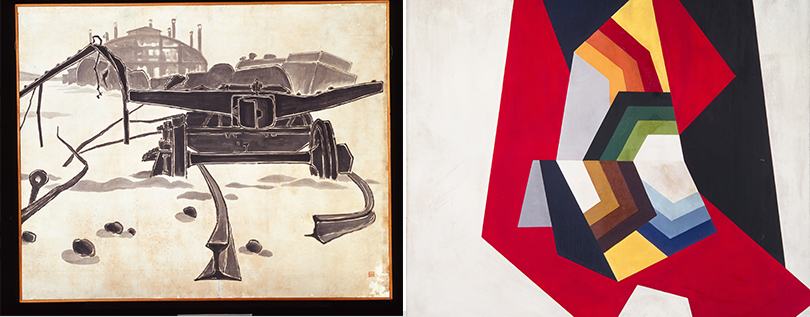 Left) Kwon Yeong-woo, After the Bombardment, Ink on Paper, 146x183cm, 1957
Right ) Ha Jong-hyeon, Encyclopedia of Urban Planning, Oil on Canvas, 80x80cm, 1970
Korea's modern history is filled with unresolved issues. Just as some insisted on referring to Japanese colonialism as the period of "forced occupation," recent voices are calling to have it renamed as the "era of resistance." The Japan–Korea Treaty of 1905, or the Eulsa Treaty, is now called the Eulsa Restriction Treaty, a designation that emphasizes the treaty's unlawfulness. On a similar note, Korea's "emancipation" is now being called its "liberation." Today, the field of history is awash with continually disputed labels. Thus, the words "uproarious," "heated," and "inundated" befit an exhibition that commemorates 70 years of Korean liberation.
Reforming Memories
This exhibition comprised 270 pieces from 110 artists, the majority of them featured in the National Museum of Modern and Contemporary Art, Seoul. It featured a diverse range of mediums, including painting, drawing, photography, sculpture, installation, and media art. Particularly worth noting is the amount of focus placed calligraphy, a genre that has been neglected over the years, which reflects an experimental tough. The visual art not only spanned a variety of mediums but were presented in bold ways. Instead of forming a fixed narrative by adhering to chronological order, pieces were arranged according to the more subtle themes of "liberation and war," "period of condensed growth," and "today's global era." Older works mingled with newer ones, and renowned figures were mixed indiscriminately with up-and-coming names. In an era that lacks common labels, the exhibition aimed to portray the diverse versions of a historical narrative that was once considered closed.
The first uproarious chapter of Korea was marked by the liberation and war. Thus, the exhibition's initial galleries were filled with art from the Korean War era as well as later works based on the theme of the war. The disastrous effects of Korea's unprecedented internal conflict were depicted through the existential viewpoint of Korea's modern art, including the wartime drawings of Lee Jung-seop and Park Go-seok and the postwar informalism of Park Seo-bo and Kim Tschang-yeul. Korea's abstract informalism, once an exuberant movement in modern art, has an aura reminiscent of oil paintings, as seen in the work of Kim Whanki and Park Su-geun. Surprisingly, however, the artists who aggressively tackled the subject of Korean division came from a younger generation. Although there are individual differences between them, Jo Seub and Jeon Jun-ho attempted to approach the topic of war from an objective stance, while Kim Hye-ryeon's seemingly serene work reached out to those who have been scarred by catastrophe.
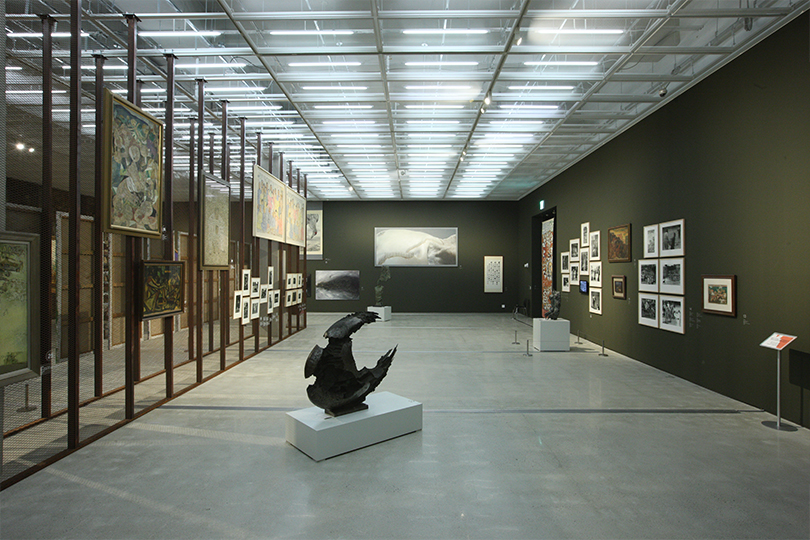 Installatin view of Uproarious, Heated, Inundated, National Museum of Modern and Contemporary Art, Seoul
The second chapter of Korea's modern development was mass industrialization. Given that condensed development and its subsequent underbelly comprise the most heated period of Korea's modern history, this portion of the exhibition came equipped with its own level of spectacle. This era produced a plethora of forms, including geometrical visions of abstract art, industrial photography, and government contract paintings of important historical events. Although all these forms differed from one another, they were united by a common era of condensed mass industrialization. It was a time when Jeong Chang-seob's government contract paintings Ulsan Oil Refinery and Monochrome (not shown in the exhibition) were produced in the same year, 1977, despite being fundamentally contradictory. The contrasting shades of this era were most dramatically portrayed in the section featuring Kim Gu-rim's video The Meaning of 1/24 of a Second and Park Gyeong-geun's Age of Steel, a video made in 2013. The grave audio streaming from the dark screening room of Park's piece, layered with the fragmentary background noise of Kim's screening -- such an exquisite juxtaposition!
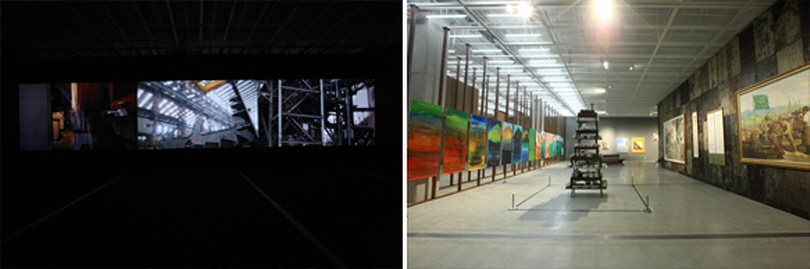 Installatin view of Uproarious, Heated, Inundated, National Museum of Modern and Contemporary Art, Seoul
Bae Yeong-hwan's Hit Tune: Crazy Love captured memories of Korea's transitional age, tracking the course of passionate modernization as it settles into bittersweet reminiscence. Bae's artistic rumination of his father's generation stood opposite the long sprawl of Lee Jong-gu's Mother Earth: Rice Fields, Summer, Fall, Winter, thus creating a fuller, more complete experience that forced viewers to consider the benefits and costs that accompany rapid development. The reflective questions posed by Oh Yun Shin and Hak-cheol, figures of the so-called realist movement, still remain relevant today. .
The exhibition's third chapter, "Inundated," lampooned contemporary Korea society amid today's global era. This section was mainly propelled by the work of Hwang Gyu-tae, Bahc Yi-so, and Choi Jeong-hwa, starting with Hwang's 2010 piece Copy, which depicted a landscape of simulacra in an age when appearances and even ambitions are mass-produced, and concluding with Choi's recent piece Flower of the Future, which looked like an omen of ominous events. Bahc Yi-so's vision, which appeared amid a cloud of controversy during the postmodernism of 1990s Korea, appeared even more poignant than even before. Her work Your Bright Future, the title piece of the Los Angeles County Museum of Art's 2009 exhibition 12 Contemporary Artists from Korea, seemed to act as a poetic embodiment of the exhibition's overall theme, celebrating 70 years of Korean liberation.
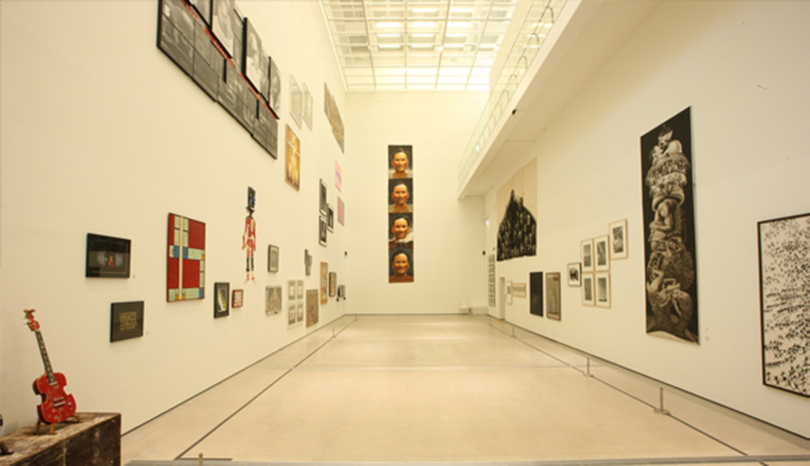 Installatin view of Uproarious, Heated, Inundated, National Museum of Modern and Contemporary Art, Seoul
A Storyless Narrative: Two Methods of Foreshadowing
This exhibition featured a great number of works. At first, one seems to have multiple memories of the same method, but the narrative of the exhibition, from start to finish, employed two methods of foreshadowing: One is a strand of hope, the other is an uneasy foreboding. This double-pronged narrative was told by the visual reality portrayed by the installations of Bahc Yi-so and Choi Jeong-hwa, and by the works of calligraphy that accompanied each piece. Realistically, after Korea's 20th-century industrialization, the traditional visual form of calligraphy has largely been excluded from the modern art scene. Featured in the exhibition was the work of Kim Gi-seung, also known as Won-gok, who has helped modernized a once traditional medium by creating vibrant new styles for Hangeul characters. However, the exhibition's incorporation of calligraphy wasn't for the sake of diversity or tradition. Starting with Pi Cheon-deuk's Love, and concluding with Are You the Hero? by Ahn Changho, also known as Dosan, all of the exhibition's calligraphic works contained a specific message; the moment their words become a guideline for the exhibition, however, the unresolved issues of Korea's modern history risk becoming smothered under a singular narrative of enlightenment.
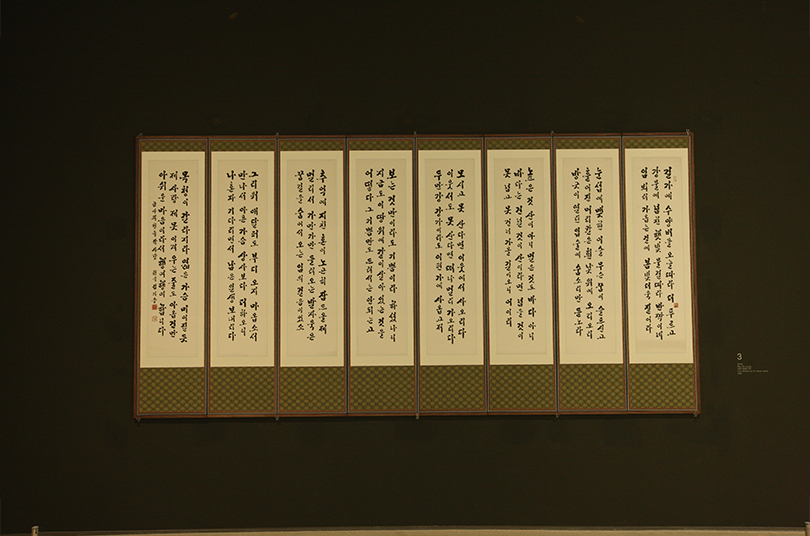 Installatin view of Uproarious, Heated, Inundated, National Museum of Modern and Contemporary Art, Seoul
Visual metaphors and the tension held by calls for awakening. The contrast of light and dark. The struggle between optimism and pessimism. In some ways, maintaining such a balance can be the most difficult task in preparing a public exhibition. An exhibition without any proper labels. Yet most visitors likely followed one of the exhibition's two strands of narrative foreshadowing in their own way.
The art scene that has flourished during the 70 years following liberation has been a series of reactions to Korea's modernization. Artists express their respective eras through direct expressions, metaphors, and omens. Sometimes, they've remained passive and contemplative, while directly involving themselves at other times. The course of modern art in Korea has been as violently "uproarious," "heated," and "inundated" as the country's 20th century. Is there another country besides Korea that contains such stark juxtapositions? As I was able to temporarily shut down my critical senses during my review, occasionally overwhelmed with emotion, the exhibition's planners seemed to have succeeded in their goal to celebrate 70 years of Korean liberation with the public.

Kim Mi-jung / Historian of Contemporary Korean Art
Kim Mi-jung earned a doctoral degree in art history from Hongik University in 2010 with the dissertation Public Art of Korea in 1960-70s, On Public Monuments in the Park Jung Hee Years. Today, she lectures on Korean modern and contemporary art at the same university. Her focus has been on analyzing Korean postwar art from a political and social perspective, including such topics as remembrance and commemoration of the Korean War, Korean Informel art under the Park Chung-hee regime, and “Korean” modernism and nationalism. In 2007 and 2011, she took part in the painting and sculpture sections of the Cultural Heritage Administration's Basic Research on Modern Culture project, and in 2008 she participated in a study of Korean War art by the Korean War Commemoration Committee. She is currently involved in further research on public monuments as historical remembrance.
-

-
 Review / Features - 31 May 2017
“2 or 3 Tigers”: Asian new media artists at Berlin’s Haus der Kulturen der Welt

