Features / Review
Talk02 : 70th Anniversary of Liberation: the Great Journey with the Citizens Uproarious, Heated, Inundated
posted 24 Sep 2015The National Museum of Modern and Contemporary Art, Seoul, hosted an exhibition (8.4–10.11) that captured the course of modern art in Korea after the nation's liberation from Japan. Comprising 270 pieces, the exhibition provided an in-depth portrayal of modern and contemporary Korea through the three themes of ‘uproarious’, ‘heated’, and ‘inundated’. The exhibition spans a period of over 70 years, but instead of presenting art in a simple chronological formation, pieces have been placed according to the social and cultural atmosphere they represent. The objective was to honor the true meaning of liberation by focusing not on a closed past but an open present.
Parallel Exhibition of Korean Modern History and Contemporary Art
The official title of the new exhibition at the National Museum of Modern and Contemporary Art in Seoul (MMCA Seoul), Uproarious, Heated, Inundated, is Commemorative Exhibition of the 70th Anniversary of Liberation: the Great Journey with the Citizens Uproarious, Heated, Inundated. I did not feel sympathetic about the exhibition since its name gives the feeling that it would be one of those bureaucratic festivals to celebrate the 70th anniversary of liberation of Korea. Most of those kind of exhibitions tend to have conventional roster with obvious "players" from each of the given time periods, so there is not usually anything out of the ordinary to excite an art specialist audience. However, I could find an unexpected pleasure and reward in this one. Even the 3 adjective words, which are used for the abbreviation of the exhibition title, felt fresh in the manner in which it implied the subject of the exhibition.
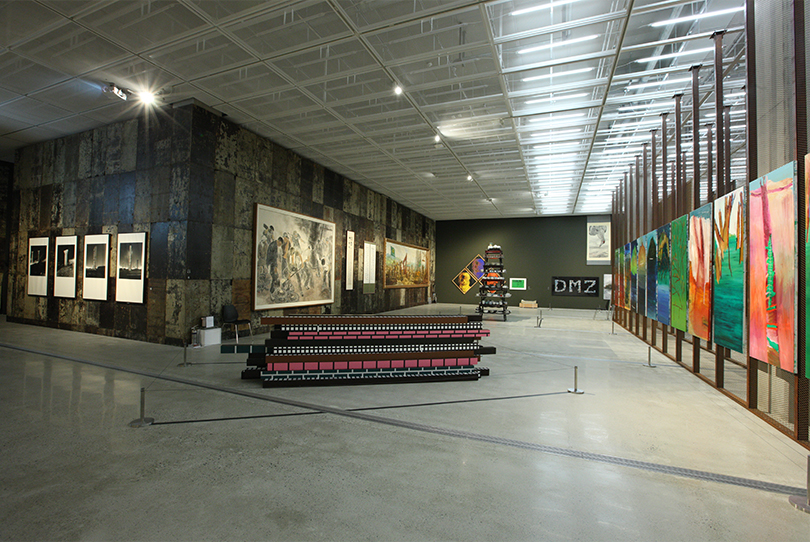 Installatin view of Uproarious, Heated, Inundated, National Museum of Modern and Contemporary Art, Seoul
Three Adjectives to Modern History
Each of the 3 adjectives corresponds to the 3 time periods of Korean Modern history. Following the listed order, Uproarious would be the expression of the chaotic social aspect around the liberation period. Heated must be the parallel progress of the military dictatorship and modernization, as well as the concentrated industrialization of the time. Inundated would be the implication of the power of consumerism and pop culture after the partial overcome of the autocracy, which also caused the emotional disparity between the age groups.
If we consider the points that to divide the exhibition in 3 parts and to assign the modifier on each part, and that the division generally follows the time line of the Korean modern history, we may assume that the participating artists of the each part are also lined up in the order of seniority, but it is not. Exhibitions that are focusing on a certain time typically end up presenting a lifeless scene. Uproarious, Heated, Inundated did not arrange the artists by the generation but rather assign the artists across the time periods - divided into 3 parts - if their artwork matches to the subject of the part. This approach creates the present feeling.
For example, in part II, Heated, cover the Korean industrial revolution period, and may remind the viewer of the factory equipment and geometric structures. Thus in this section, the geometric abstraction painting of the first generation abstractionist, the cubic structure of Hong Seung-Hye and the film, A Dream of Iron, by Park Kyung-Kun, who was just born in industrialization period in 1979 coexist.
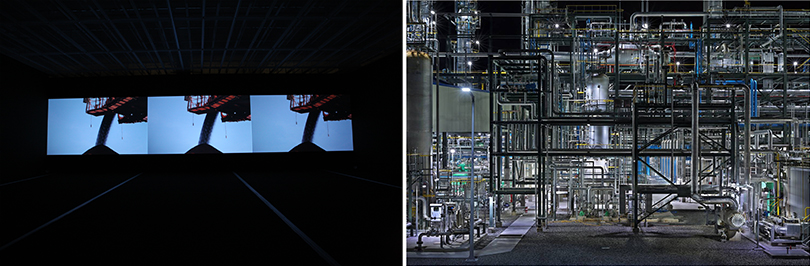 Left) Installatin view of Uproarious, Heated, Inundated, National Museum of Modern and Contemporary Art, Seoul
Right) Jo Chun-man, Industry Korea(IK150312-petrochemistry), 110x165cm, 2015
After viewing the whole exhibition, I read the introduction, which states, "The intention isn‘t to just chronologically outline Korean modern history through art." Still, the very attraction of the exhibition is to confirm the development of history through the visual art. That is one of the functions of visual art, to be a historical resource, as well as the verification of the original form of the visual art. Often the audience meets an individual artwork at a certain exhibition and subjugates the impression to the artwork, but the exhibition like this, which traces the journey of Korean modern history through the records of visual art, combines different artworks and makes the audience to feel the various phases of the time periods.
Culture Shift and Art around 2000s
Owing to the framework of the exhibition, which is chronologically composed, we can identify the definite changes of the look of artworks and communication method in part III, Inundated. Although the fact we are living in the multicultural society, individual more than communal culture, as well as the strong influence of the media does not surprises us any more. However, it is interesting to find out there were artworks on these new trends even before we were familiar to them. Through this we can see the historical value of art.
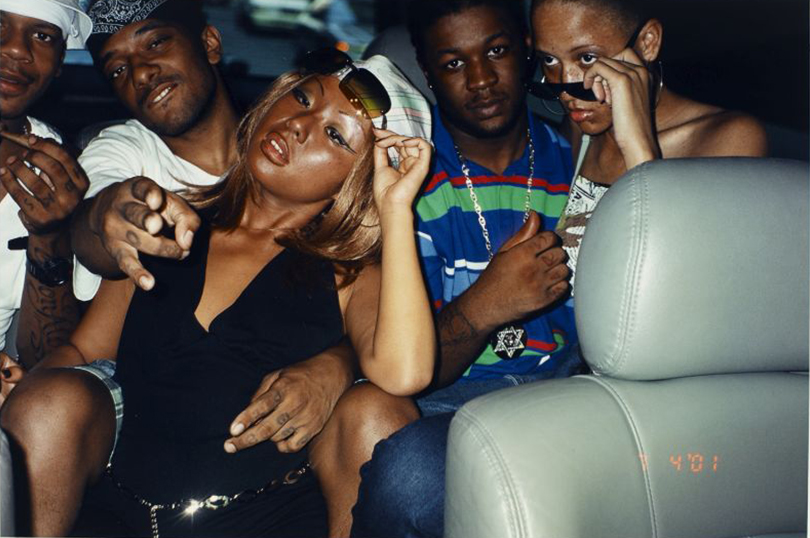 Nikki S. Lee, The Hip Hop Project 1, Digital C-Print, 76.2x101.6cm, 2001
The concept of being a nation-state has been faded because of the rapid increase in the number of multicultural families, and this unprecedented phenomenon is recorded by Kim Ok-Sun's photograph. Also, a culture that emphasizes individual values over community ones is represented by the transforming multiplex character of Nikki Lee's staged photograph. Zin Ki-Jong's media art shows the reality, where the idea of creation is inseparable from the mess media. In Ham Kyung-Ah, we can see the emergence of new artists who focus on directing rather than making the piece by own hands. So the artworks in the part III inclusively cover the aesthetic changes around 2000s and the related changes in the social aspects. Considering the condition that contemporary art is less favorable to the general public, Kim Beom's Yellow Scream, which is intended to make the audience laugh out loud, is worth a look. The reason why this work is the most popular pieces in the exhibition, may relate to the works concern with conventional art education and the public misunderstanding on art in the society. As such TV entertainment became the platform of communication, and Kim directed the piece in comic way with the hired actor.
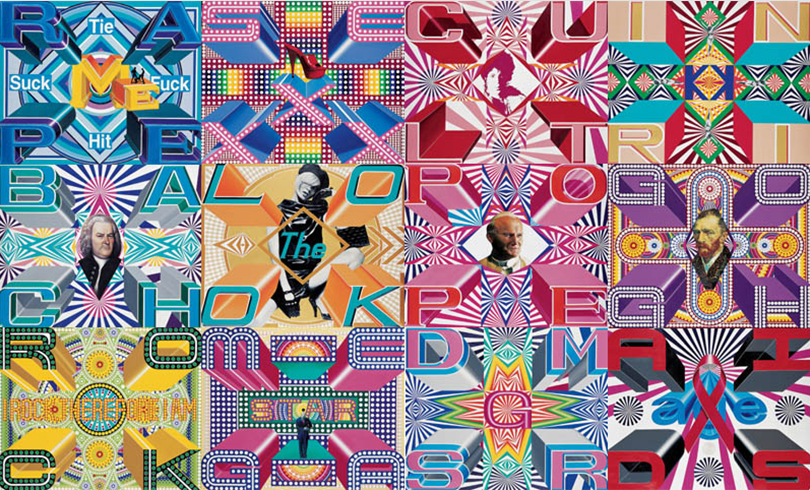 Kyoung Tack Hong, funkestra, 130X163X(12)cm, 2001-2005
Apart from the exhibition‘s educational virtue, which illustrates Korean modern history since the national liberation, Uproarious, Heated, Inundated also becomes the assembly of the prominent artists and artworks in each time period of Korean art scene. So this exhibition would be an opportunity to see the development of Korean contemporary art in a compressive and not tiresome way for the people who seldom visit the museum.
As an art specialist, I wish to highlight some observations and refection from the exhibition: the hyper-realistic early works of Ko Young-hoon in 1974; Yeo Un‘s Work 74 shows the pop artistic touch, although it did not become a trend and the artist failed to make his name; the sprout of Korean pop art is seen in Jeon Jun-yeup‘s Game Over, which placed one of the original video games, Galaga, over the night view of the busy street of Myung-dong in 1980s, when the trend of brand goods was started. These are so important that I feel the need to rewrite Korean contemporary art history. In addition, it was very meaningful to appreciate some of the artworks in person, which they were only able to see in the art magazines from 1980s like Art Quarterly.
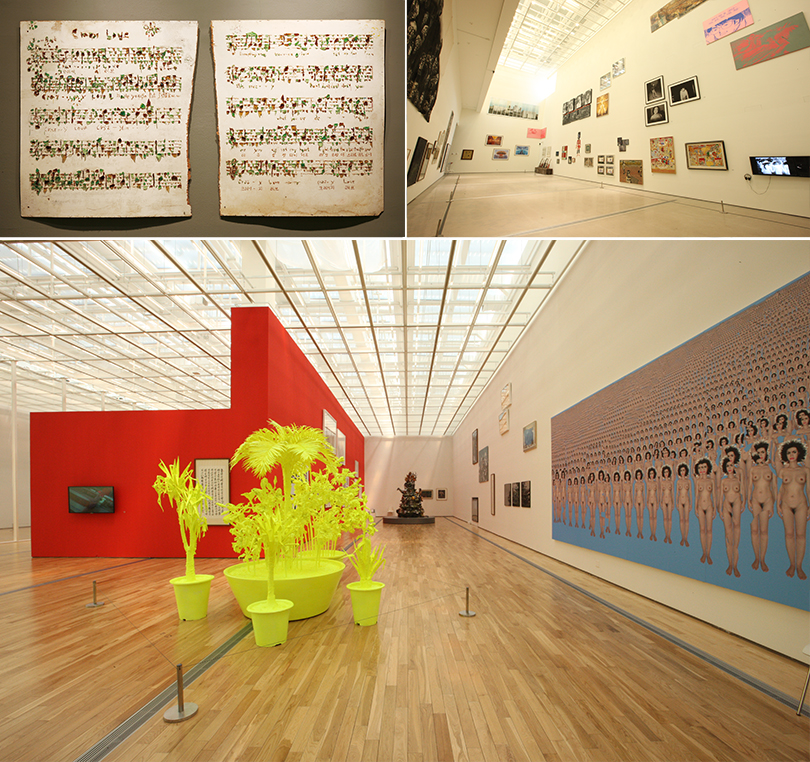 Above left) Bae Young-whan, Pop Song-Crazy Love, 121x110x107cm, 2006
Right, Below) Installatin view of Uproarious, Heated, Inundated, National Museum of Modern and Contemporary Art, Seoul
To Represent Reality through Art
To emphasize the exhibition's composition, which follows the time frame of the Korean reality from the liberation to present, the background music covered the hit songs of 1970s to the rap of 2NE1. It is to give a stereoscopic feeling of Korean culture and life after the nation‘s independence, and the supplement for the contemporary audience, who is used to the multi-sensory stimulation. The difference in how the exhibition was curated may be the reason that this exhibition gives the impression, which the art, the people who deal with art and the audience are facing the great change.
PS. Uproarious, Heated, Inundated also has some blind spots, but I am not sure who to blame for this shortcoming. If the exhibition intended to concentrate on the modern history of Korea after the liberation, it should have featured the dictatorship, considering more than a half of Korean modern history was actually under an autocracy. Even if the facts were rather familiar, the exhibition had to present how visual art in the shadow of Korean history was, and maintain that balance. However, the only counterweight that the exhibition featured was the well-known Minjung Art, which emerged under the new military regime in 1980s. Maybe this deficiency came from the past creation culture, which was hesitant to represent the social irrationalities, or maybe from the practice of the today‘s curator, who is reluctant to recreate the ideological conflict at the exhibition.

Ban Ejung / Art Critic
Ban Ejung is an art critic, who originally wanted to be an actor. He has been writing columns about the art and current affairs on newspapers including Joongang Ilbo, the Hankyoreh and the Kyunghyang Shinmun, and magazines including SisaIN, Cine21 and Hankyoreh21. He was the mentor and judge at the first Korean art survival program, Art Star Korea. Ban was also a regular art panel at TBS, EBS and KBS Radio. He was the judge and committee of Joongang Fine Arts Prize, Dong-A Art Festival, Song-Eun Art Award and Hermes Foundation Missulsang. Ban teaches at Seoul National University and Sejong University. He published various books including Object Reader.
-

-
 Review / Features - 31 May 2017
“2 or 3 Tigers”: Asian new media artists at Berlin’s Haus der Kulturen der Welt

