
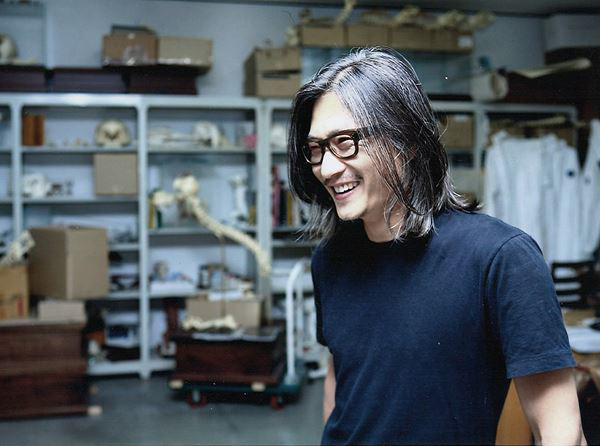
Hyungkoo Lee. ⓒthe artist.
Korean artist Hyungkoo Lee's exhibitions evoke a scientist's lab or an archaeologist's workshop, often equipped with outlandish gadgets, skeletal or anatomical models in vitrines, or a desk with incomplete skulls, brushes, and notes. Yet his wearable devices, drawings, and sculptures hardly depict real-life subjects—they are chimeras borne out of scientific research and the artist's imagination. 〈ANIMATUS〉 (2005–2007), for example, is a series of cast resin sculptures that depict the skeletons of widely beloved cartoon characters. Though the long ears are missing, the distinctly huge buck teeth of 〈Lepus Animatus〉 (2005–2015) belong to Bugs Bunny, while Donald Duck's skeleton struts about as 〈Anas Animatus〉 (2006).
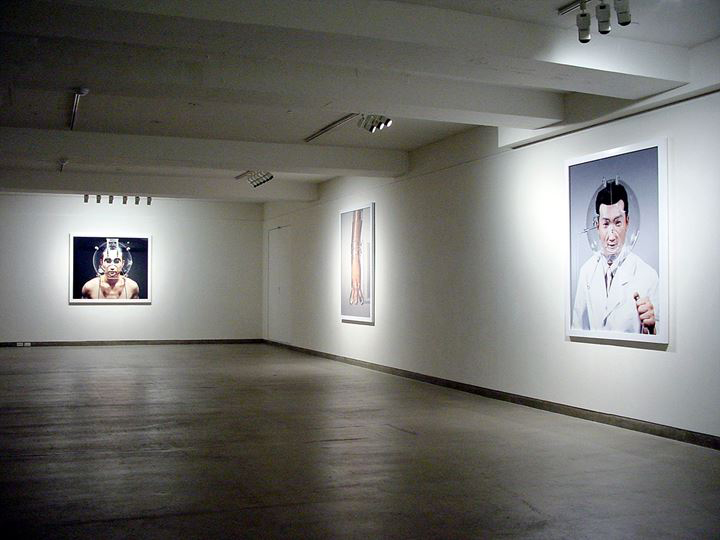
Exhibition view of 《The Objectuals》, Sungkok Art Museum, Seoul, 2004. ⓒthe artist.
The uncanny, sometimes startling aesthetic that defines Lee's practice was on full view in 《The Objectuals》, his first major solo exhibition at Sungkok Art Museum, Seoul, in 2004. Among the works on view was 〈A Device (Gauntlet1) that Makes My Hand Bigger〉 (1999), a wearable arm fashioned from plastic bottles that resembles a detached robot limb with three bulky sockets at one end for placing fingers. The C-print 〈Enlarging My Right Hand with Gauntlet 1〉 (2002) shows Lee's invention at work: when one puts it on and pours water inside, the right hand appears larger, the fingers thicker. Other works included portraits of people wearing helmets that magnify their facial features. 〈Altering Facial Features with Device-H5〉 (2003) zooms in on the eyes, while 〈Altering Features with BH3〉 (2003) focuses on the mouth to the point it becomes abnormally big, treading a fine line between humorous exaggeration and nightmarish visualisation. The exhibition set aside a space for Lee's laboratory, complete with a white lab coat and a display box for gadgets—the workplace of a mad scientist, obsessed with strange optical instruments.
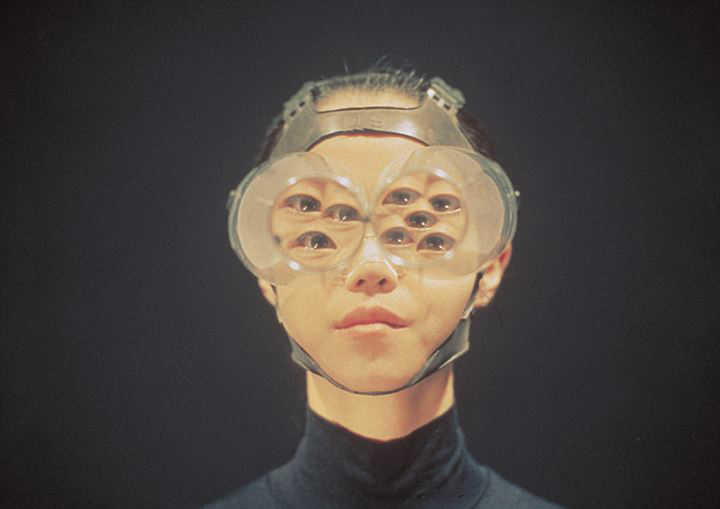
Hyungkoo Lee, 〈8E-P〉, 2002. ⓒthe artist.
Lee's concern with body enhancement partially rose out of his experiences of living abroad. After completing his undergraduate studies at Seoul's Hongik University in 1998, he relocated to the U.S. to pursue a master's degree at Yale University. In his new environment, the artist felt that he, as an East Asian man, was physically smaller than the men around him, with works like 〈Satisfaction Device〉 (2001)—a leather belt with a tube that makes the penis look bigger—pointing to his inferiority complex. Around this time, Lee also created the contraption he titled 〈A Device for Walking Backwards〉 (2001), which helped him to learn to walk backwards; a work that was borne out of his desire to reorient himself to unfamiliar environments.
Lee's exploration of the human body also concerns its mechanisms, with works that involve experimentation with movement. 〈Creeper〉 (2010), for example, brings the artist down to ground level, making him lay face down on a longboard with handles at the front to navigate. Aside from physical mechanisms that define how bodies move and perceive space, the artist is also interested in subverting how bodies are classified. 《Face Trace》, which was also the title of his solo exhibition at Gallery Skape, Seoul, in 2012, consists of 12 busts depicting different facial types. Lee began with constructing them according to existing racial categories, but completed them by inserting fragments based on the moulds of his own face—thus creating entirely new hybrids.
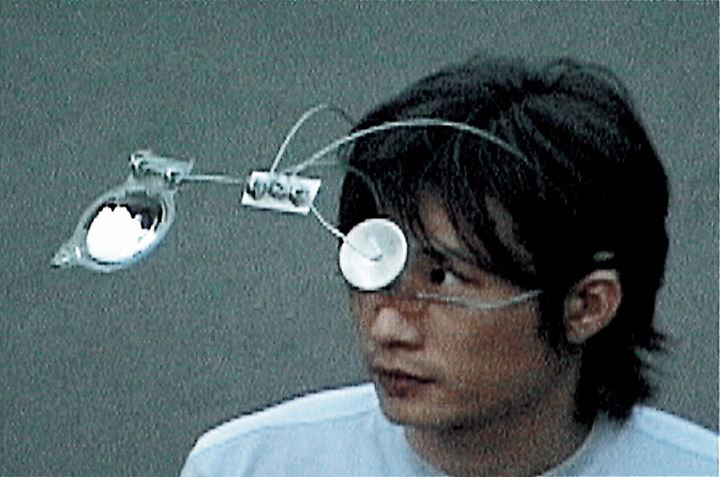
Hyungkoo Lee, 〈8E-P〉, 2002. ⓒthe artist.
In his upcoming solo exhibition 《PENETRALE》 at P21 in Seoul (16 October–30 November 2019), Lee is to showcase some of his recent and new works. One is 〈X〉 (2019), an installation featuring what resemble bone fragments, spheres, and arrows on a three-dimensional grid. The artist is also currently participating in the group exhibition 《Show Me Your Selfie》 at Aram Art Museum in Goyang (17 July–6 October 2019). In the conversation that follows, Lee discusses the inspiration behind some of his works, the processes he employs, and his interest in the human body.
※ Click to Read the Full Article on OCULA: Hyungkoo Lee: Seriously Fake Science (https://ocula.com/magazine/conversations/hyungkoo-lee/)
※ This article was originally published in OCULA(https://ocula.com) on 4 OCT 2019 and reposted under authority of a partnership between KAMS and OCULA.

Sherry Paik
Editorial Assistant, [Ocula]
-

-
 Interview / People - 03 Jan 2017
Jun Sojung

