The collaborative work of Yang Chul-mo and Cho Ji-eun
Placid expressions of life through “migration, community, development, and the different memories and senses that build up within individuals”
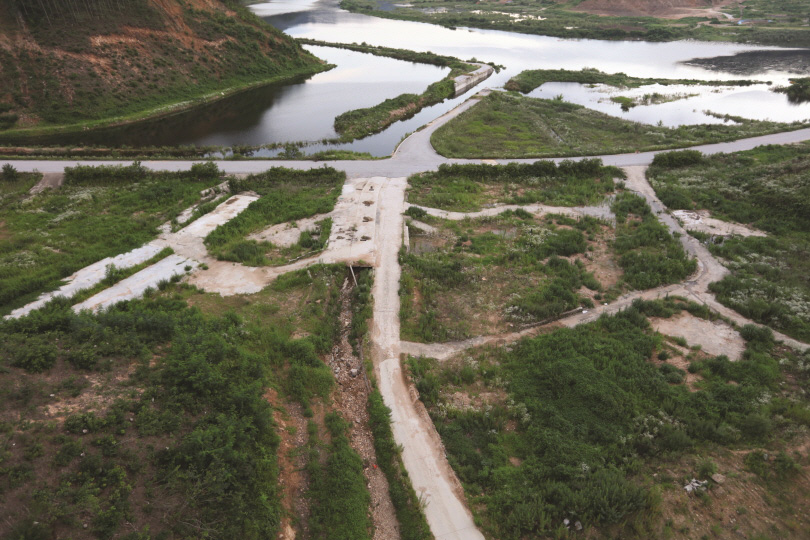
Mixrice, 〈Vine Chronicle project〉, 2016.
“What’s your story? It’s all in the telling. . . . Not a few stories are sinking ships, and many of us go down with these ships even when the lifeboats are bobbing all around us.” - Rebecca Solnit, 『The Faraway Nearby』 (Korean translation by Kim Hyeon-woo, published by Banbi, 2016, p. 211)
What we call a story demands that we roam about here and there. There’s an old saying: when a story sits for too long without circulating, it becomes a ghost. — Mixrice
Where do they come from, these different stories that serve as subject matter for works of art and so much else in the world? Most start from the mouth of a person telling of his or her experience, or from the ear of someone who heard indirectly of another’s experience. Beginning from someone’s lips or ears and becoming jumbled in the telling, stories have grown alongside us for a tremendously long time. We live our lives with stories—whether the world changes or not, whether the day is warm or cold. In a sense, then, stories are our lives, and all things related to lives the stuff of stories. Because life is so diverse, there are all the more stories to tell. The tiny clinging clumps of meaning encompassed within the word “life” may have started out as very small stories told by someone, doubling and tripling until they came to embody large and diverse meanings, like rice paper as it takes up water. The telling of such a difficult thing as life in story form may have long been our way of withstanding all the different events of life and the accompanying emotions of joy and anger, sorrow and pleasure.
Since life conveys different meanings and stories to each different agent, the methods of storytelling must also be great in number, as Rebecca Solnit notes. The interesting thing, however, is the way in which all of our stories all end up mixed together, like a wave that sweeps over all things leaving some of them distant and bringing others closer by. In other words, the beauty of our lives and stories is that we cannot conclude for certain that the things close by are close and the distant things far away, that all of them may mix together, and that this mixture may mean that some things go away while other things arrive. Over an unimaginably long period of time, that is to say, our lives are constantly flowing, just as human stories, rootless and incoherent, become transmitted, mistransmitted, and organized.
This flow of our lives and stories is something I discovered in the work of mixrice. A duo consisting of artists Yang Chul-mo and Cho Ji-eun, mixrice first started working together in 2002. The name was a reference to the mixing of different cereal grains. It also refers to the fact that most of the migrant workers who have already been part of their works come from Asian countries where rice is a staple crop.1) Their work has been rooted in questions about the community and in the phenomena and questions of migration as it exists in modern society.2) If we set off the stories connected with the migrants/migrant workers who have long been associated with the duo’s work into a small category and view the pieces from a bit of a distance, we may sense that mixrice’s work is a collection of stories about people’s lives flowing. In an interview with Cho Ji-eun on July 24, 2018, I suggested that we should adopt a somewhat careful and broader approach to viewing the character of mixrice’s work—like trying to pry apart sheets of moistened rice paper that have stuck together.
Viewed in terms of their individual layers, the stories of different people’s lives shown in the work of mixrice start closest to us with ourselves, extending at some times to people we know and at other times to Koreans in general or to foreigners. But the mere fact that mixrice are telling foreigners’ stories with its work does not mean we can conclude the story is not our own—nor can we conclude that people who have lived different lives will not understand our own story. Through its art, mixrice are ultimately alluding to the connection between our individual stories and the stories of others, or the stories of society. Like unrecognizable chunks of carrot or potato in a cooled curry, the duo seems to be using its work to “mix” (as in their name) different aspect of people’s lives that cannot be reduced to any one word.
In these pages, I will be examining the ways in which mixrice have artistically expressed the different forms of migration found in contemporary society—a longstanding interest and theme for the pair—and the different outcomes of personal and social migration and its attendant side effects, while also looking at what stories of life they have focused their attention upon.
About migration and flowing lives
“Migration does not simply refer to movement between spaces. In addition to the crossing of borders between countries, it refers to movements in political and economic terms—even historical time between a country of origin and destination. If South Korea in the 1960s was Bangladesh, this means a time gap of 40 years between Bangladesh and South Korea. Just as they talked in Nepal for a time about South Korea being ‘the Japan of the future,’ South Korea is also some place’s past, and another place’s future.” — Mixrice, 20063)
The dictionary definition of “migration” is “relocation from an original home to a different home.” The Korean translation iju consists of two parts, the first of which—i (移), meaning “to move”—connotes a sense of “changing” or “transforming” in addition to its original sense. The second part—ju (住), meaning “to live” or “to reside”—also carries different senses including “to rest” and “residents.” If we consider the different meanings of these components, we can see that the word iju, or “migration,” possesses not only the sense of changing locations, but also a different sense referring to a “state of suspension in the changes and transformations experienced by a person as a result of changing locations.”
When the place we once lived has changed, this means that we have to adjust to an environment, and that there are more new things for us to adapt to. To differing degrees, the people who are forced to endure everything changing around them may briefly experience a loss of identity, or they may silently transform their identity to suit the new environment. When the environment surrounding us changes, we as people experience bigger and smaller changes in emotion, leaving aside the emotions we once felt as a way of accustoming ourselves to it. Organisms are not that simple, however, and as we trace back memories of memories, there remain feelings we have been unable to relate to anyone.
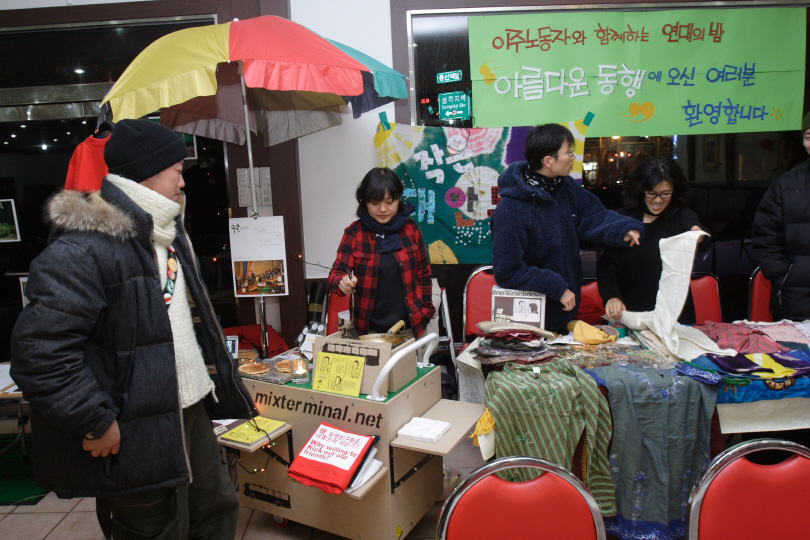
Mixrice, 〈Migrantcart〉, 2015. A “migrant cart” is a form of cart built to allow ease of movement to assemblies, festivals, and important meetings. The carts can be used to cook hotcakes, hold simple exhibitions, show videos, and numerous other things. Migrant Workers’ Day (Dec. 18, 2005) at Cheoldo Wedding Hall, Seoul; Anyang Nepal Hill Festival (Jan. 1, 2006) at Anyang Central Cathedral.
Beyond their work in connection with “migration” in its dictionary sense, mixrice have done work incorporating the different situations derived within the word “migration,” as well as the untold stories and emotions of individual people. They captured the stories of migrants as part of a mixrice video class held at a migrant workers’ center for a two-and-a-half year period starting in 2002.4) In a past interview with The [Hankyoreh] newspaper, Cho Ji-eun related the origins of the pair’s work with migrants. “It started with three other young artists and me giving lectures to workers at a migrant center on how to use a video camera, based on the belief that simply holding up a camcorder and filming might be a way of changing the world,” she explained.5) From these beginnings, the duo enabled migrants to express their stories to the outside world through works such as 〈mixrice channel〉 (2002–2004), 〈Migrantcart〉 (2005), and 〈Hotcake〉 (2005). The works created by mixrice from the stories of migrant workers and layoff victims represent a broad spectrum, ranging from the serious and weighty to things in a more satirical or comical vein. They share stories about migrants’ human rights with society in a quiet yet witty way, helping the topics get talked about in the world by adopting an approach of calmly relating the subjects’ situation rather than trying to persuade the viewer to reach a certain outcome.
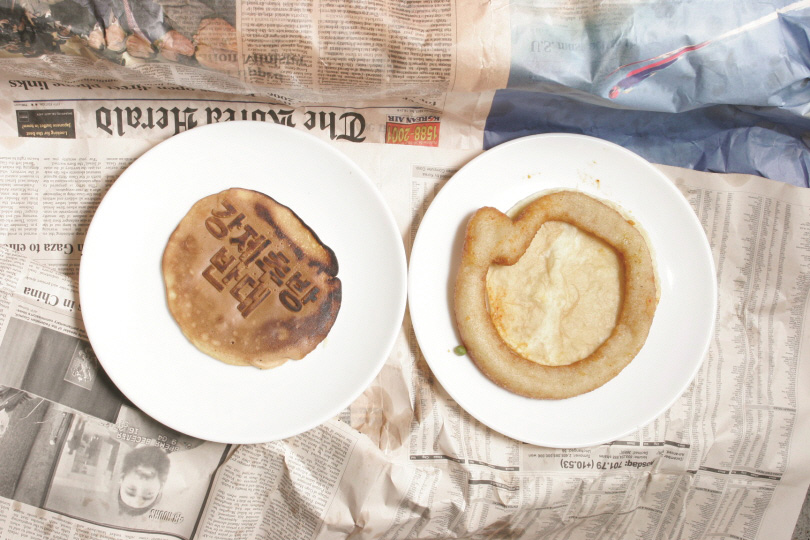
Mixrice, 〈Hotcake〉, 2005. Wheat, frying pan, oil.
About unforgettable senses and memories
Beyond simply creating a platform to share the situation in migrant lives today and the stories they harbor, mixrice have also used their work to capture different feelings and memories that migrants had never been able to express before. Because mixrice deal with the life stories of different people, a large portion of their work consists of people’s memories and feelings with regard to certain objects. When allowed to flow within the mind according to the pull of time, our memories and feelings about something that changes over time begin to escape our control. While time may continue to flow, we can organize our valued memories to allow ourselves to look back on our life at times when our situation becomes difficult in the future. What is interesting about this, however, is the way that these memories within people can be expressed through “stories.”
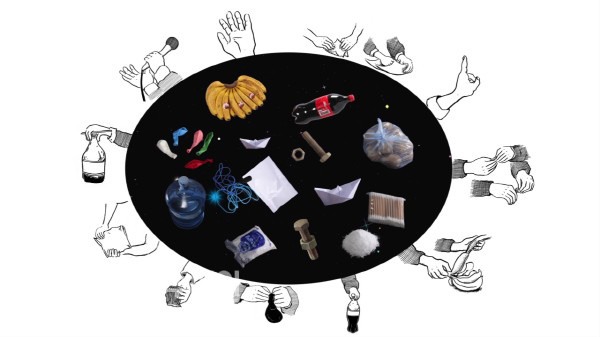
Mixrice, 〈500 Men, Games and Free Gifts: 1 Pack of Q-tips, 1 Pack of Napkins, 1 Pen, 1 kg Sack of Sugar, 1 kg Sack of Salt, 1 Frame and 1 Pack of Potatoes〉, 2018.
〈A song connected from A stage〉 (2009-2014) was developed by mixrice after receiving a funding proposal, and it was also intended to commemorate performances at the Maseok Migrant Theater, such as the ongoing 〈The Illegal Life〉. The artists created miniatures at one-tenth the actual stage scale to allow the play to be seen on a small monitor. Mixrice described the pieces as “commemorating the theater that has been carried on for so long in Maseok”6) —but it also seemed to play a role in pinning down the inner memories of outsiders who have been utterly denied access within South Korea.
〈The piece 500 Men, Games and Free Gifts: 1 Pack of Q-tips, 1 Pack of Napkins, 1 Pen, 1kg Sack of Sugar, 1 kg Sack of Salt, 1 Frame and 1 Pack of Potatoes〉 (2018), which can be seen in Good Life, originated with a video showing “April 4, 1999,” the day of the first Bangladeshi festival in Maseok. Staged in 1999, the festival was organized by 500 Bangladeshi men with a budget of KRW 100,000. Playing a variety of games that lasted for just one minute each, the Bangladeshi participants were able to temporarily forget all the difficulties of living in another country and share a pleasant time among themselves. As presents, festival attendees were given common everyday items such as sugar, ballpoint pens, napkins, and cotton swabs—yet for the Bangladeshis gathered there that day, those tiny things remained as “memories of an unforgettable day.”7) Projected faintly on a light panel in the gallery, the record of that day seems to show our memories themselves, where some parts are erased over time while others remain behind.
Mixrice’s focus on people’s memories can be seen in other works besides those mentioned above. In an interview, Cho Ji-eun described working with migrants while taking part in a two-and-a-half months residency program in 2010 at Egypt’s Townhouse Gallery of Contemporary Art. “I asked the migrants to think of what they felt they were deprived of, and someone said, ‘Moisture,’” she remembered.
The things we do not understand, the things unknown to us, the stories that hover about within more abstract peripheral domains such as geography, climate, lifestyle, and culture—they are not answers to “what had to be left behind,” but rather “moisture.” What they are ultimately speaking of are not objects, but things that have been lost, things that are absent. This question is a process of laying bare each other’s loss, or sharing memories purely through emotion in a state of mutual unawareness. We are thinking of the halting linguistic dialogue known as “fumbling”—the coarse texture, the shaky understanding. — Mixrice8)
As can be seen in the text quoted here, mixrice calmly observe the lives of people who have experienced migrants, conversing with them and sharing their emotions. These acts of observation can be found in works such as 〈Something That I can’t Leave Behind〉 (2010) and 〈mixfruit〉 (2016–2018).
Carried out in 2010 together with migrants the artists met in Egypt, Something That I can’t Leave Behind involved the participants sharing a photograph record of “something that I couldn’t leave behind,” which mixrice then reconfigured to produce images. For 〈mixfruit〉, migrants used clay to represent the fruits of their hometown as they existed in their memory. These stories of their homes—things that their migration left as part of their individual memory, things they could not take out or share with others—take on a new form through the collaboration with mixrice. In giving artistic shape to their memories, the migrants present stories of the flavors and moments of their hometowns, their places and their people. Mixrice work together to “fumble” with the different stories shared from these people’s lips, watching the tales as they move in and recede like the tides.
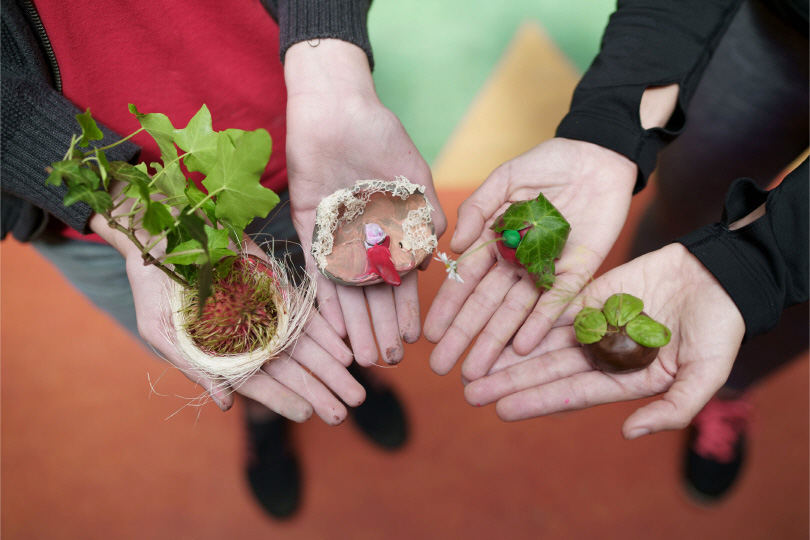
Mixrice, 〈mixfruits〉, 2016–2018. Clay, resin, seeds, photography, text, workshop, and settings: Arnhem (Netherlands), Gimhae (South Korea), and Birmingham (UK).
Cho Ji-eun: The refugee status applicants who took part in mixfruit don’t want their faces shown in the photographs. Toward the end of the workshop, we ended up naturally capturing people’s hands as we were photographing mixfruit. It’s quite awkward to ask people about the circumstances behind their migrant when you’re working together over a short period of time. As they create their own individual pieces of fruit with clay, they naturally end up bringing out their own stories. Refugee applicants are normally very passive people if you encounter them in different spaces, but the mood when they’re meeting in community spaces is quite vibrant. The mixfruit workshop in Birmingham captures some very sincere feelings people had. You don’t see their faces, but from the clay fruit and hand movements expressing their feelings, you can sense how they are talking about their situation at this moment.
On development, moving organisms, and community
Mixrice have broadened their scope to produce work incorporating the small “migrations” connected with people’s lives. Specifically, they focus on the stories that arise—and the communities that appear and vanish—in cases of movement that involve the transformation of places where human beings and other organisms once existed. In a broad sense, “migration” may be seen as movement between countries, but changes in an organism’s environment also represent a small form of migration. In that sense, the work of mixrice may be seen as drawing out and capturing our own stories amid our own unique processes of migration.
Cho Ji-eun: The landscapes of development are something very familiar, something I have witnessed since I was a child. It isn’t just me—I think most of the generations since Korea’s liberation have grown up seeing landscapes of development. It wouldn’t be exaggerating things to say that all of the stories that have emerged during our work have been tied to development. Even in the works that have to do with plant migration, the content is related to our own “settlement.” The migration of plants is itself connected to development. As tunnels and power plants and highways are built, villages are torn down and communities disappear.
In Korea, nearly all movements by the public are tied to development. The main reasons we change our place of residence has to do with the development that has been taking place nonstop here since the end of the war. While mixrice have continued to meet with migrants, they have also been interested in the rootless way in which people live amidst development. They have captured the way we live today: wandering rootless, “basing their movements on apartment and real estate prices rather than staying in a given place because of something about that location.”9)
With their work, mixrice are saying that the thing that persuades us to make the decision to live a rootless life lies ultimately in standards created by someone else—such as real estate developers. This is shown in their stories of plants, another focus of their interest. In their work, mixrice have followed trees whose migration was determined by development, or which were otherwise transplanted to a different place from the one where they were initially rooted. 〈The Vine Chronicle〉 (2016) captures the development-based relocation or neglect of trees that long served as neighborhood patron saints or performed other important roles in communities such as Nansan-ri village (Seongsan-eup), LH apartment complexes in Seoul’s Godeok-dong and Gaepo-dong neighborhoods, a New City development site, and the Seoul neighborhood of Susaek-dong. Having long served to watch over a certain space, the trees were uprooted by development and transplanted somewhere else to start their lives anew, disconnected from the spatial and temporal memories of their past existence. How are those plants any different from us? With their work, mixrice seem to be representing our own stories, stories of lives where development leaves us with fragmented memories, unable to find our roots. At the same time, they also watch us living with our fragmented stories, focusing their attention on the stories of new communities formed over time in a world where original communities have largely vanished.
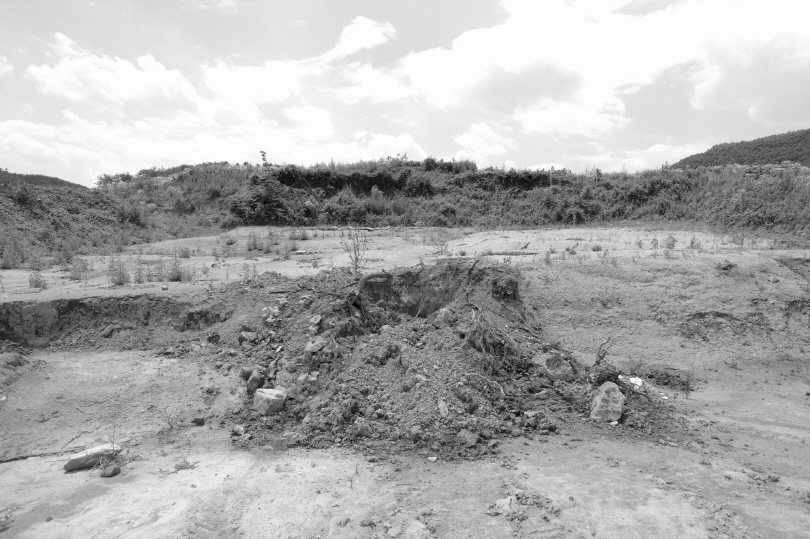
Mixrice, 〈Vine Chronicle project〉, 2016.
Cho Ji-eun: We’ve joined other artists in the “Tapgol Comic Library” as an alternative to life in this sort of city. It’s a space that is closer to life than art. We eat and rest, we talk, we teach and learn from each other, we play together. It’s a place for shaking off rigid forms and just meeting together. Going back and forth between Goesan and Seoul, we started to learn about the different trees in the region, and as we saw them more and more often, we began doing work on the migration of plants. The community in Maseok—local communities in general—is frail and fragile. It’s increasingly becoming the kind of situation where it’s hard for people to just “gather” or “meet” without some visible gain. It’s to the point where we seem to be caught in a structure of mutual isolation, where we express our isolation through anger and end up isolated once more. Mixrice are constantly thinking about what community means. We consider things like spending time together, the ways that time accumulates and is communicated, the sharing of time. The word “connect” refers to relationships, but we kind of see it as a “relationship” of building up and sharing time. A lot of things are encompassed within that time. And it’s not just a continuous stretch of time, but one that is intermittently interrupted and starts over again. To mixrice, “community” is akin to a journey in search of that.10)
In this way, mixrice focus their attention on and find the meaning of community within our individual lives and the stories—tiny yet huge—that emerge in the fragile communities of people who have met by chance. At certain moments in the rootless flow of life, our times spent together with unexpected others build up to become memories. Individually, we are fragile, and so our communities are weak, but as people spend time together, they come to share the same memories, and to build the recollections that allow them to survive a different tomorrow.
In other words, the stories of mixrice are oriented toward people. Just as the tide from the distant sea brings shells, seaweed, and other things with it as it rolls back toward land, our own stories are tied to those of the people next to us, and those of others in different lands. This is because we are in the midst of life, and because we are connected to others. The images of life that mixrice capture possess such resonance because they capture this essential aspect of people. And this may explain why we empathize with the stories of all the many people who appear in mixrice’s work. I look forward to the next work by mixrice, imbued with different scenes showing our rootlessly flowing lives.

* This piece is part of a series focusing on four artists for a visual arts criticism/medium matching support program by the Korean Arts Management Service.
1)Baek A-young, “Does It Resonate in the Heart?,” Noblesse, Dec. 9, 2016. (http://www.noblesse.com/home/news/magazine/detail.php?no=2184)
2)Mixrice, Mixrice 2002–2016 Portfolio, p. 350.
3)Mixrice, Mixrice 2002–2016 Portfolio, p. 258.
4)Mixrice, Mixrice 2002–2016 Portfolio, p. 350.
5)No Hyeong-seok, “‘We’re Artists Who Make Relationships Instead of Artwork,’” The Hankyoreh, Oct. 18, 2016. (http://www.hani.co.kr/arti/culture/music/766224.html)
6)Mixrice, Mixrice 2002–2016 Portfolio, p. 164.
7)“Mixrice,” 『Seoul Media City Biennale 2018 leaflet』, p. 55.
8)Mixrice, Mixrice 2002–2016 Portfolio, p. 198.
9)Interview with the artist, July 24, 2018.
10)Email interview with the artist, Aug. 26, 2018.

Juwon Park
Art Critic
-

-
 Critic / People - 11 Dec 2017
Koo Jeong A: Stories of an Ambiguous World Transforming

