Using photography to record the divisions and incidents within Korean society; “hairlike” images offer clues toward the forces behind the events

“What is it that made me unable to turn my eyes away from such a situation or scene? Why could I not stop staring? Did it lead me to some unanswerable question or thought? It was childish, foolish. And so I always wondered—what was the meaning of what I had seen?”1)
The images that Noh Suntag has recorded in his photography are the slices of life that South Korean society wishes not to speak of. Through the photographic medium, he captures incidents that were only possible because those who held the power looked the other way. What people see are nothing more than the artist’s individual photographs, wreathed in silence—yet within those images are stories that belong to South Korean society, things that hover behind people’s lips, unspoken by those who live within the country. Witnessing in Noh’s photography all these different incidents and places that exist within the name “Korea” while laying bare a cross-section of that society—the real catastrophe of division, memories of Gwangju, the Yongsan tragedy, a radome in Daechu-ri village, scenes from candlelight demonstrations and flag-waving rallies—we gain a newfound, keen sense of the violent “problem-solving” methods imbued in society. In this way, Noh uses photography to find and state the meaning of things seen.
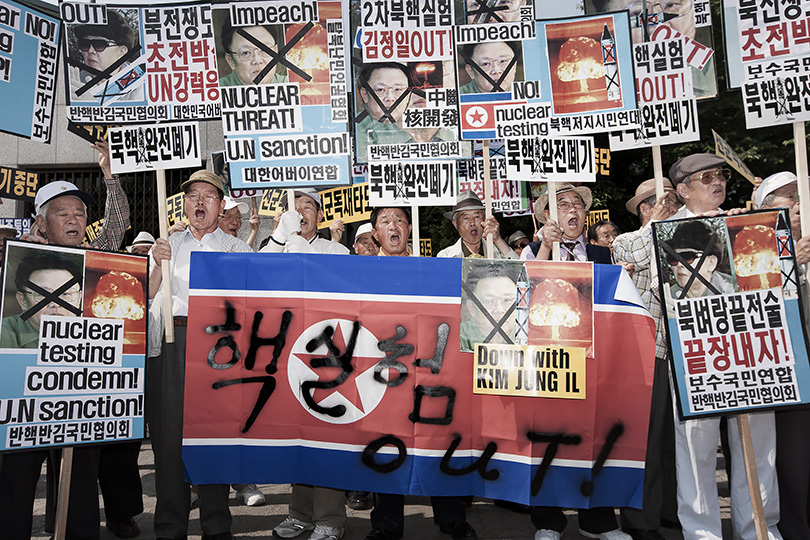
Noh Suntag, 〈Red House III #BJF2501〉, 2009. long-term preservation inkjet pigment printing, variable size.
Art starting from questions about reality
“In the ‘today’s reality’ the newspapers tried to show, what I saw was ‘today’s surreality.’ When reality operates surrealistically in this kind of way, I gained a vague awareness of how photography represents surrealism without relying on any great manipulation, technique, or staging (indeed, because it does not depend on it).”2)
Noh Suntag: They always say, “It’s darkest just before the dawn.” The time when I reached adulthood was a period of conflict for South Korean society, which was at the crossroads of prolonging or ending its long military dictatorship. The spring of 1991 in particular was dark enough to earn the nickname “May of death” or “immolation crisis.” A university freshman named Kang Gyeong-dae was beaten to death during a demonstration by a squad of plainclothes police officers, and this led to protest demonstrations, outcries, and death. Around the same time, the head of the Hanjin Heavy Industries labor union committee, a man named Park Chang-su, died under suspicious circumstances after being taken by the Agency for National Security Planning (ANSP). The really astonishing thing wasn’t his death per se, but the state’s attitude toward it. The state was so worried about the cause of death coming out that they sent plainclothes police to the funeral home to bust the walls down and take away the body. I was at [The Hankyoreh] newspaper when I saw the images of the authorities snatching his body and the family members howling in astonishment. I thought, can this be for real? It was the most shocking image I’d seen in my life—even today, it’s like a bruise I can never erase. To me, the photograph didn’t capture “reality,” but rather “unreality” or “surreality.” It was my first experience with questioning photography and considering its nature as a medium.
In 1992, a woman named Yoon Geum-yi who worked in a military camp in Dongducheon was savagely murdered by a US Forces Korea private named Kenneth Marckle. There was a gruesome photograph showing her naked corpse with an umbrella stuck in her anus and laundry detergent poured on her body, and those images were blown-up and posted around universities as posters. I can clearly remember standing in front of that photograph and being frozen to the spot, unable to move. These were incidents and scenes you couldn’t understand, and shouldn’t understand. I came to harbor questions about society as a matter of course, as well as a sense of questioning and curiosity about the scenes that society had allowed to leak out.
I’ve had a pretty longstanding interest in mass media. I wrote for the school newspaper in high school and did a school paper in college. My involvement in making newspapers instilled a sense in me of what you can do with photographs and the dual allure they possess. Photographs seem to speak to things straightforwardly, but they don’t say things exactly as they are. They deal in facts, but they are not “the facts” as such. Photographs are used as “honest evidence” of things that have happened, but they are actually a slippery medium that is adept at lying. I was fascinated by this dual quality of photographs. After graduating from university, I did both photography and writing while working as a reporter. My hunger for photography was so great that I ended up entering graduate school, and I finally left my workplace to devote myself to personal work.
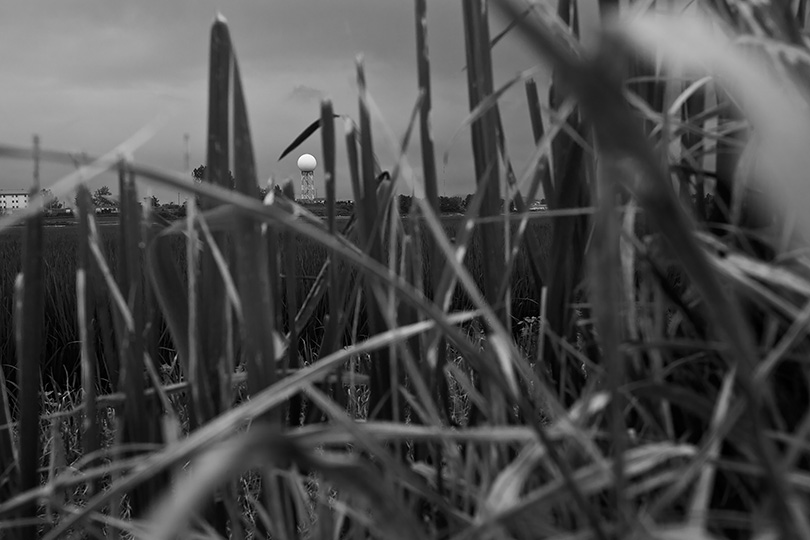
Noh Suntag, 〈the strAnge ball #BFH0901〉, 2004–2007, long-term preservation inkjet pigment printing, variable size.
In this way, the artist’s curiosity about the reality he questioned has served as an underpinning for his work, which involves using photography to the state the meaning of things he has seen as a witness to a given situation. The series 〈the strAnge ball〉 (2004–2007) is a series based on his observations of a US military radome (radar dome) present in the village of Daechu-ri. To Daechu-ri residents, the radome was merely a presence that “existed”—as one resident said, “I was glad to see that ball because it was like our neighborhood had emerged.”3) Seeing the situation in Daechu-ri at the time, the artist became a resident himself, operating a photography studio in the village. What he learned, however, was that while everyone in the neighborhood knew about the ever-visible “ball,” no one knew what it meant. People had no idea for whose sake it had been made or for what reason it was standing there. Delving into the question of the ball’s identity, the artist learned that it housed US military radar used to monitor the Korean Peninsula. In 2006, during its relocation of the US military base to Pyeongtaek (Daechu-ri) from Seoul’s Yongsan neighborhood, the South Korean government embarked on a large-scale administrative enforcement action code-named “Hwangsaeul at Dawn,”4) in which the original residents of Daechu-ri were driven out.
The “strange ball” simply stared out at all the things happening in Daechu-ri. Mutely watching over the events, it was reminiscent of the US, which seemed to meditate over the Korean Peninsula situation; the South Korean government, which claimed it was “unable to do anything” as it observed the situation for Daechu-ri residents; and the people of South Korea, who blithely treated the story as just another news item. For the artist, the “ball” is a focal point around which he relates the situation in Daechu-ri, metaphorically expressing a scene of violence inflicted under government direction on the village’s people for the sake of a US military base construction effort. A US military surveillance network resembling a golf ball to some and the moon to others, the radome posed as question to the artist who witnessed it, and it asks us also as additional witnesses to the reality by means of the photograph: Is this reality truly progressing in a positive way?
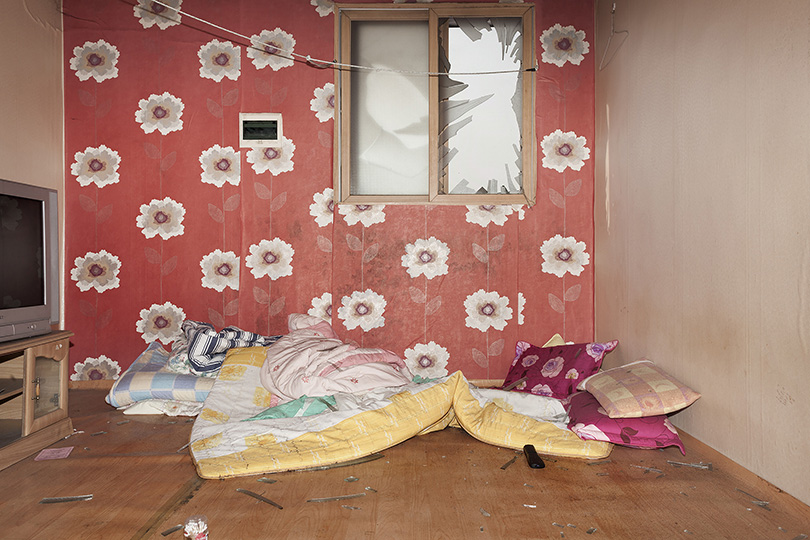
Noh Suntag, 〈In search of lost thermos bottles #CAL2701〉, 2010–2011. long-term preservation inkjet pigment printing, variable size.
Korea’s immanent division
“Since I began my work, my interest has always been in the ways in which national division operates—in the functioning and malfunctioning of division, and in the sophistication and sloppiness of the division system. When you live in South Korean society, ‘what is division?’ may be as existential a question as asking ‘who am I?’ and ‘who are you?’ Some landscapes in division are visible, while others are invisible. Division has concealed some things by showing others. A legitimate sense of curiosity and questioning has been dismissed as useless—go and look at the things we show you, they tell us. It has also taught the harsh lesson that there’s a price to be paid for questioning—in South and North alike.”5)
Noh Suntag: Division functions by malfunctioning. The very method in which it operates is through malfunctioning. Not only do you see images of that malfunctioning in division itself, but I also developed an interest in the different incidents and situations spawned by division, and the way that things we are supposed to regard as separate from division become connected with that division, twisting together in odd ways. Division has had the effect of compressing the different contradictions inherent to South Korean society in the queerest of ways. From a “South Korean conservative” standpoint, even things like #MeToo, which has to do with sexual violence, gets tied into arguments about “communists” and “ppalgaengi trash.” The term ppalgaengi is ostensibly talking about actual believers in socialism or communism, but within the division system they’ve basically come to been “pro-Pyongyang” or “loyal to North Korea.” In South Korean society, there has been a bizarre dichotomy operating where one side is automatically classed as “pro-North” and the other as “patriotic” depending on what positions they hold on all sorts of social issues such as education, healthcare, and housing. In this really comical way, it has collapsed together all these issues that require a rich societal debate.
The division that Noh saw misting over South Korea was a landscape of malfunctioning. As the artist noted in the interview quoted above, the Korean word ppalgaengi (“red”) is used as a disparaging term for communists. But the meaning the word possesses in Korea does not refer solely to people who truly hold communist beliefs and wish for communist outcomes. At times, it is a word that contributes to creating the systems through which the country operates. It is used to denote something you cannot see that serves to amplify our fears—like the bogeyman parents invoke to a whining child, threatening that he will “snatch you away if you keep ignoring what I say!” From a conservative perspective, the concept of “division” has been used to reinforce their side’s logic, misleading a public whose only awareness of information comes in filtered form.
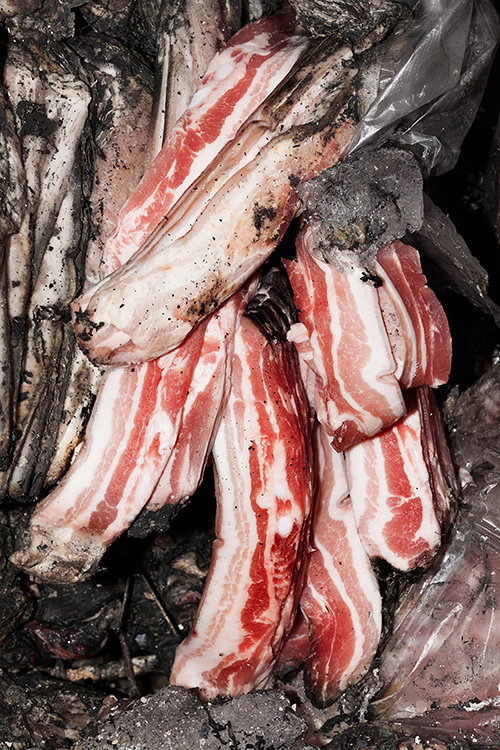
Noh Suntag, 〈In search of lost thermos bottles #CAL2601〉, 2010–2011. long-term preservation inkjet pigment printing, variable size.
The series 〈In search of lost thermos bottles〉 shows images from Yeonpyeongdo Island after an artillery attack in 2010. After seeing Hannara Party leader (and current Mayor of Changwon) Ahn Sang-soo on the news holding up a thermos bottle and claiming it was a “North Korean shell,” Noh began to track the bottle that had been misidentified as a bomb. Within his photographic frame, he calmly captured images of Yeonpyeongdo Island as it was in the shelling’s wake, the evidence of that day present in its collapsed buildings and cars lying on their sides. The village presented by the artist was one where many things had been blackened by flames as a result of the artillery; there was no sign of any people present. The image of a National Assembly politician holding up a thermos and confidently declaring it a “shell” before the media—as if to inflict one more scratch against a government that had been aware of signs of an impending North Korean provocation, soldiers and members of the public who suffered damages and even loss of life as a result, and the people who had managed to escape with their lives—represented the reality of Korea’s division in a way that clearly showed the kind of “malfunctioning” described by the artist.
In the work 〈In search of lost thermos bottles #CAL2601〉 (2010–2011), we see grilled pork belly that has been scorched on the outside by the shelling, while its inside remains unburnt. The artist found it in the refrigerator of a Yeonpyeongdo home; the marks left upon it seemed to testify vividly to the events of that day—as though using the wounds on its body to share everything with someone who has come in search of evidence of the incident. Noh described the image of pork belly captured in his camera as resembling “a person’s burnt skin”7) —is that why it feels so difficult to look at the powerful image of flesh for very long? Having narrowly survived the tragic incident, the pork belly seems to show us the image of someone going about his or her businesses on Yeonpyeongdo Island that day.
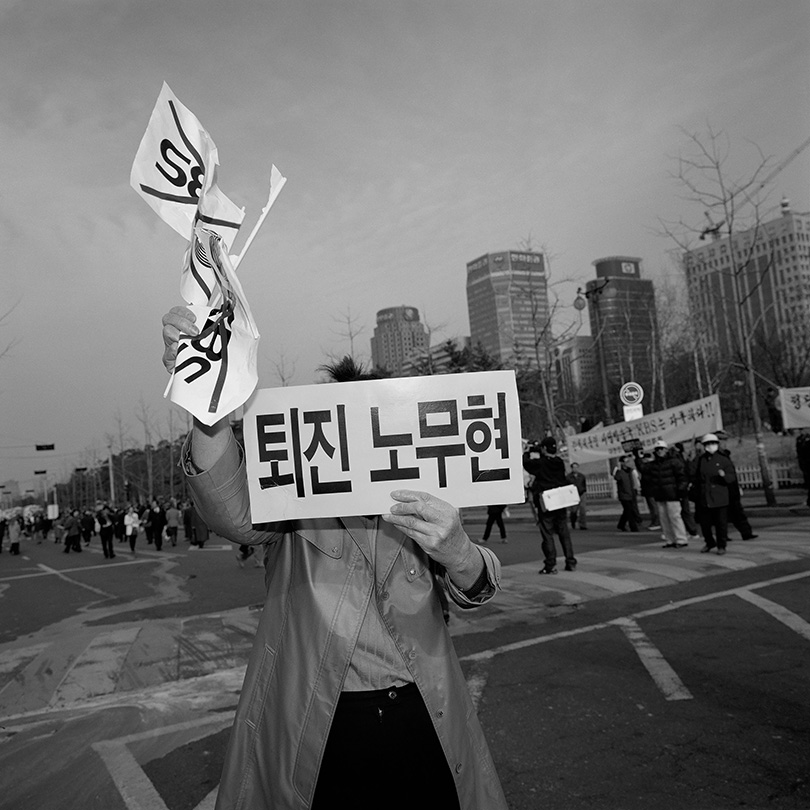
Noh Suntag, 〈Paths of Patriot #BED1901〉, 2004. long-term preservation inkjet pigment printing, variable size.
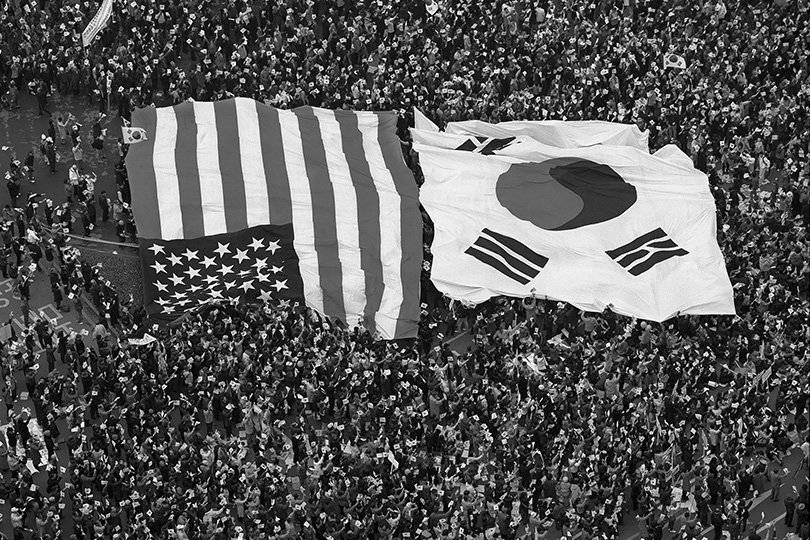
Noh Suntag, 〈Paths of Patriot #BDD0101〉, 2003. long-term preservation inkjet pigment printing, variable size.
The logic of South Korean conservatives and the ways in which division operates in South Korea appear in a direct way in the series Red House III and Paths of Patriot. In South Korean society, the presence of “North Korea” and “reds” (ppalgaengi) has served to bring together many people; conservative logic has manifested an even greater might as it feeds off of that energy. A photograph in which a South Korean flag meets a sign reading “Resign Roh Moo-hyun” also seems to resemble featureless sand shifting in the wind.
Gwangju: History and Reality
As a place, Gwangju holds many meanings in Korea. In the past, the events that unfolded there were referred to in modern and contemporary history books as the “Gwangju incident”; these days, its meaning has been reclaimed as the “May 18 Gwangju Democratization Movement.” Before, the events were thought to have occurred because of people infiltrating from North Korea, and those who sought to learn the facts about what happened in Gwangju on May 18, 1980, would find themselves facing trial before the law. The meanings of the space changed from one administration to the next; these days, many contemporary studies contemplate its significance through the medium of film. What South Koreans have learned over time is that the things that happened in Gwangju were not the result of “North Korean infiltrators” but came at the orders of the very President who led the country, and that many innocent Gwangju residents were killed. The President at the time justified his own actions by exploiting the fog of fear surrounding North Korea. Noh Suntag referred to the events in Gwangju as “both an ineradicable lump for my generation and the starting point for my perspective on society.”8) 〈Forgetting Machines I〉 shows faded old funeral portraits from the old cemetery in Gwangju’s Mangwon-dong neighborhood. Begun in 2006, the series lasted for six years before its completion. The images captured in the artist’s cameras are photographs of the slain, images that have changed and lost their original detail over time. Noh Suntag’s used his own camera to capture these time-damaged photographs, describing how the “natural wearing felt like a metaphor for their deaths.”9) The small funeral portraits placed before the cemetery, showing people who would not have lost their lives had they not been living in that particular time and place, are captured once again by the artist’s camera, reminding the viewer once again of Gwangju’s past.
The interesting thing about Noh’s work is how it captures the ways in which the Gwangju Democratization Movement and the events of that day are remembered in Gwangju today. In 〈Forgetting Machines II〉, he shows today’s different ways of honoring the May 18 Movement: people photographing their friends in militia garb in a militia experience event, reporters snapping their shutters at weeping visitors to the May 18th National Cemetery, events to remember the spirit of the Democratization Movement. Noh referred to this as “a landscape of life remembering death—one that can be neither utterly beautiful nor utterly hideous.”10)
Even today, as the events in Gwangju have been historically acknowledged and those once-festering perspectives have returned to their proper place, Noh described feeling “as though something is being forgetting, something is still being distorted, something remains as just an empty shell,” and sensing that “that day in May is still happening.”11) Through this series, the artist speaks to an unreal reality—one where the story of Gwangju has gained new recognition as part of history, but where the same politicians who worked to attain democracy in the past through the Gwangju Democratization Movement are now becoming agents of violence in their own right. He also interrogates memories of that May in Gwangju that remain undisclosed or live on in distorted form.
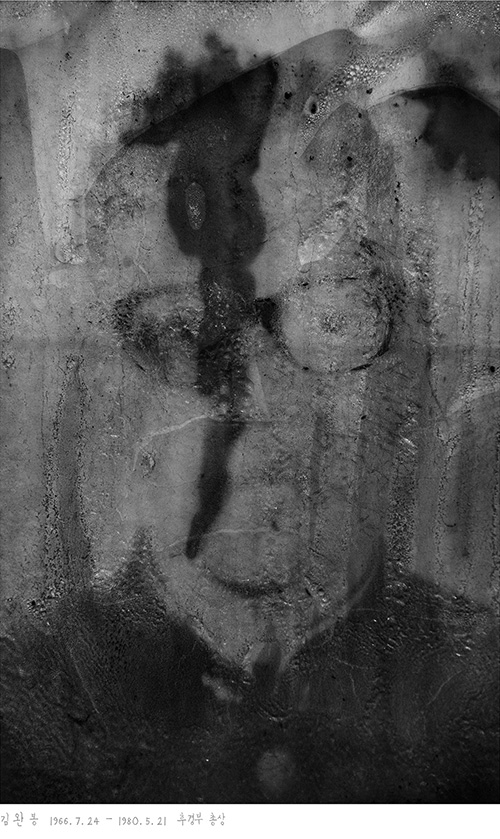
Noh Suntag, 〈Forgetting Machines II #CAF1711〉, 2010. long-term preservation inkjet pigment printing, variable size.
Evidence of Incident and Photography as a Clue
Noh Suntag: In terms of punctuation marks, journalism is usually like a period. It tells you, “Such and such incident occurred today.” Very rarely, there are question marks and exclamation points. I don’t think of myself as having strayed completely from journalistic photography, but what I’m aiming for is a question mark rather than a full stop—it’s work that shows you the questions I’m asking, rather than a period or exclamation point that declares “This happens.” Obviously, I also see exclamation points as being important in the field of art. But if it’s something you’ve been harboring for a long time, something that you’re going to continue asking, that’s a question mark. Within question marks, there’s the power of continuity. Where an exclamation point is like an artist one-sidedly “communicating” something, I see a question mark as perhaps demanding that viewers and readers make something “their own.” I don’t want the viewer to simply look at the work I’m presenting him or her with, but to think about the things I’m not showing. It’s something I see as a key role and function of contemporary art: producing cracks in the order of the world and posing questions.
I don’t think I need to repeat the same “height of incident” that journalistic photography focuses and dwells on. In addition to the evidence and the lingering aspects, what I want my camera to capture is the moment that comes just shy of the height—not the head-on view, but the side and rear views. In other words, I want to pay attention to the frontal aspect of the incident, but to examine it from the side, from back, and from within.
With photography, there’s inevitably an element of superficiality. It’s ultimate a medium that deals with surfaces. The interior is not the only important part; surfaces can capture as much or more meaning than interiors. Photography is not a suitable medium to address everything in the world, or to address the truth. Since photography represents clear evidence of something, I don’t think it needs to be packaged as “truth.”
If the truth is the “body,” then photography is like a tuft of hair. Where does that hair come from? It comes from the body. So photography becomes a clue toward that body. Clues like that seem to provide a way of tracking down the body, so to speak. The incidents and situations that I’ve witnessed to date have stemmed from serious societal conflicts. They aren’t tiny stories—they’re large ones. I don’t want to jump to any conclusions about the scenes I’ve witnessed. By rearranging the fragments, I’m trying to get at the body behind them. That’s what I’m attempting to do, and it’s what I ask people to do when they view my work.
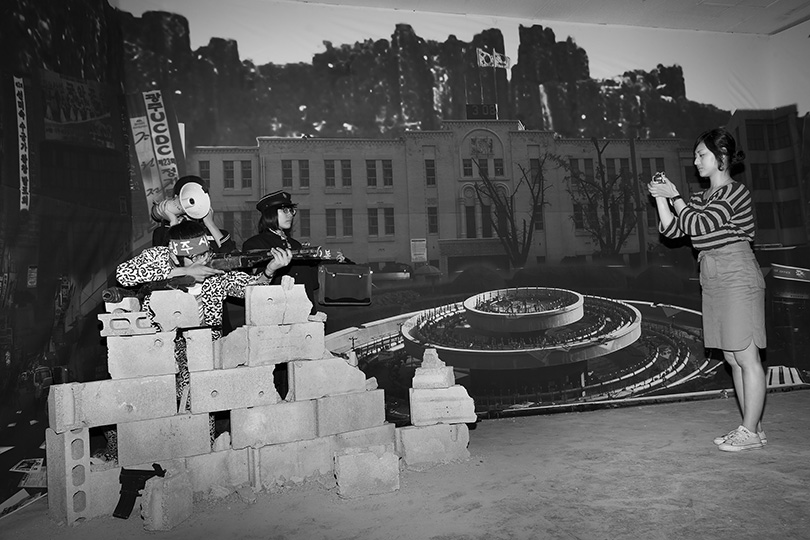
Noh Suntag, 〈Forgetting Machines I_Kim Wan-bong〉, 2007. long-term preservation inkjet pigment printing, variable size.
As one looks at the work of Noh Suntag, one feels as though the figures in the photograph have become frozen in that moment forever. They may appear taxidermized in a sense, or give a cold impression. “I’m deliberately trying to create a disconnect between the emotional temperature and the temperature of the work,” the artist has said.
Noh Suntag: The coordinates for my work are situated in three axes. The first axis is the axis of activity on the ground. The things I do with the people who appear in my photographs could be described as “solidarity,” or it could be called “activism.” The second axis is within and outside the field of journalism. The places I occupy are typically the settings of urgent complaints or outcries. I see it as being of paramount importance to let more and more people know about the things that are happening here and now. The third axis has to do completely with my own work as an artist. It’s something that demands a long-term perspective and objectivity. I try to distance myself from methodologies involving appeals, emotions, rage, or persuasion. Each one of these three axes is very important to me. The first two of them have become something like alibis or nutrients that enable the third. There’s an expression in Korean, bulgageun bulgawon, which means, “You shouldn’t get too close, but don’t stand too far away.” It’s a really great saying, but not a principle that I wish to obey.
Noh Suntag has described himself as a “witness who accepts a witness’s responsibility to testify, but to give testimony that is inevitably flawed in some way.” In this way, he uses his own unique methods to quietly share his own story about the reality he witnesses. The many accounts he has left behind with his photographs will provide viewers with an opportunity to develop their own different interpretations. The interpretations they sense as they see his work may or may not be the ones the artist intended—but each one will be a “hair” unto itself, a different kind of witness to record the reality.
*This piece is part of a series focusing on four artists for a visual arts criticism/medium matching support program by the Korean Arts Management Service.
1)Noh Suntag, “The Meaning I Saw Then,” Hwanghae Culture Vol. 81, 2013, p. 450.
2)Noh, ibid., p. 448.
3)“So it must have been about seven or eight years. What do they take us for? It was a round thing placed way up high, so we figured it was a water tank or something. Later on, people said it was an oil tank or some kind of antenna. We just come up with our things about it. It’s comforting to think it’s just a big ball, you know? There were even times when I’d look at that ball from a distance and feel pleased about it, thinking, ‘That’s our neighborhood.’” Noh Suntag, "the strAnge ball," Shinhan Gallery, 2006, p. 2.
4)“For the operation that day, the government mobilized around 12,000 police officers from 115 squadrons, 2,800 people from the capital corps and the 700th Special Assault Regiment, and 700 employees from private security companies. The tiny farming village was transformed instantly into a battlefield.” Noh Suntag, “Daechu-ri, 36.5°C,” Hwanghae Culture Vol. 52, 2006, pp. 273–274.
5)Noh Suntag, “Bloody Bundan Blues,” Gwangju Museum of Photography, Bloody Bundan Blues, Gwangju Museum of Art, 2018, p. 18.
6)“Evidence indicates that at the time of the North Korean artillery attack on Yeonpyeongdo Island on Nov. 23, 2010, military intelligence organizations detected signs of the attack ahead of time and alerted over 20 agencies including the Blue House and Ministry of National Defense, but were ignored by the administration and military command. The Ministry of National Defense was also found to have concealed the preliminary intelligence about the attack in a meeting of the National Assembly National Defense Committee the day after it occurred.” The Hankyoreh, December 14, 2012.(http://www.hani.co.kr/arti/politics/politics_general/565396.html#csidxcb519cbbdcdcf5790c350ed663d3130; accessed on October 15, 2018.)
7)Noh, “Bloody Bundan Blues,” p. 19.
8)Atsumi Tanabe & Noh Suntag, “I Am a Living You, and You Are a Dead Me,” Noh, Forgetting Machines, Chungaram Media, 2012, p. 205.
9)Tanabe & Noh, p. 210.
10)Tanabe & Noh, p. 218.
11)Tanabe & Noh, p. 207.

Juwon Park
Art Critic
-

-
 Critic / People - 11 Dec 2017
Koo Jeong A: Stories of an Ambiguous World Transforming

