Juliet Jacques considers the legacy of Nam June Paik’s utopian experiments in global broadcasting
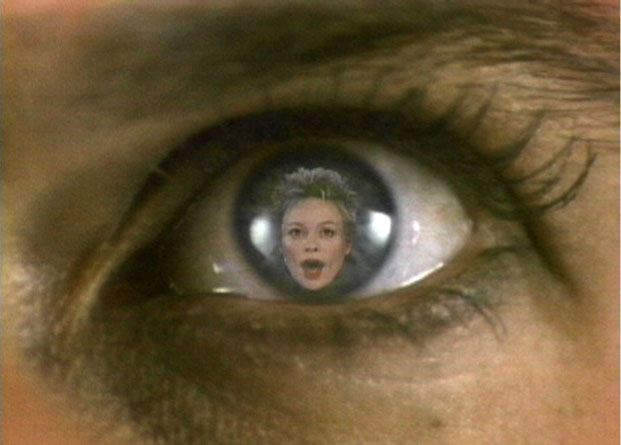
Nam June Paik, 〈Good Morning Mr. Orwell〉 (still), 1984. single-channel video, colour, sound, 30min. ©the estate of the artist and Electronic Arts Intermix (EAI), New York.
On New Year’s Day 1984, using a conference link between a PBS station in New York and the Centre Pompidou in Paris, and in collaboration with broadcasters in Germany and Korea, Nam June Paik broadcast 〈Good Morning Mr. Orwell〉 to 25 million people across the world. Now accessible via YouTube, the hourlong television program was, in the artist’s own words, a compilation of ‘positive and interactive uses of global media, which Mr. Orwell, the first media prophet, could never have predicted’. Testament to Paik’s belief (contra Orwell’s 1984, 1949) that art could break down geographical and cultural barriers, this variety show combined live and recorded sections and showcased musicians such as Laurie Anderson and Peter Gabriel alongside Salvador Dalí, Joseph Beuys and Paik’s mentor, John Cage. The effect was to take the avant-garde out of the gallery and onto a medium more commonly associated with mass entertainment, the revolutionary potential of which was dismissed by social theorists including Guy Debord, who, in 『Panegyric』 (1989), called television a weapon for the ‘constant reinforcement of the conditions of isolation of “lonely crowds”’.
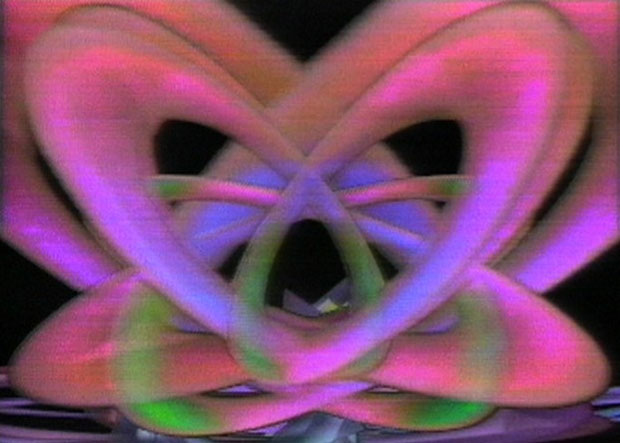
Nam June Paik, 〈Good Morning Mr. Orwell〉 (still), 1984. single-channel video, colour, sound, 30min. ©the estate of the artist and Electronic Arts Intermix (EAI), New York.
Televisions had featured heavily in Paik’s work since the beginning of his career as part of the Fluxus movement in West Germany (to which he had moved from Tokyo, the city to which his family had emigrated during the Korean War, to study music history) alongside Wolf Vostell, another pioneer of the medium. In 〈Exposition of Music – Electronic Television〉 (1963), he laid 13 ‘prepared’ TVs on their sides, their reception detuned so that the static was presented as a constantly shifting work of audiovisual art. The work displayed the influence of Cage in encouraging its audience to attend to images and sounds that they would normally disregard, while the composer’s advice that Paik explore Buddhist philosophies in his work can be identified in 〈Zen for TV〉 (1963), which reduced the TV picture to a wavering vertical line. 〈Participation TV〉 (1963/98), meanwhile, made the medium interactive, allowing viewers to modify a set of lines that appeared on the screen by speaking into an attached microphone, the signals from which were turned into visual line formations by an integrated sound-frequency amplifier.
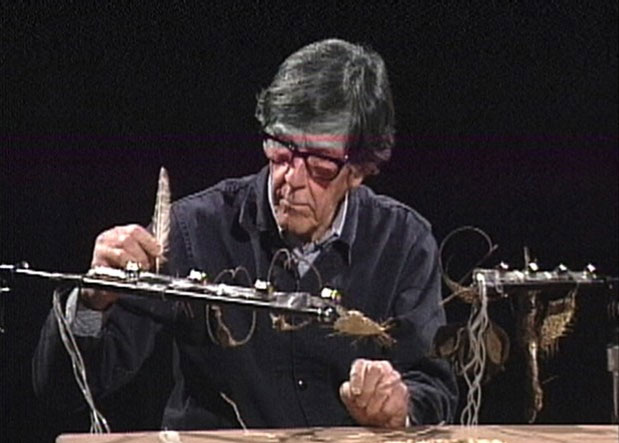
Nam June Paik, 〈Good Morning Mr. Orwell〉 (still), 1984. single-channel video, colour, sound, 30min. ©the estate of the artist and Electronic Arts Intermix (EAI), New York.
Paik was a craftsman in his medium – during the late 1960s he built a video synthesiser with TV technician Shuya Abe that allowed him to mix seven different colours received from seven cameras into a single image – as much as a media theorist, famously coining the phrase ‘electronic superhighway’ in 1974. These experiments advanced the potential of telecommunications as a two-way system and challenged the top-down, one-to-many structures of cinema and television.
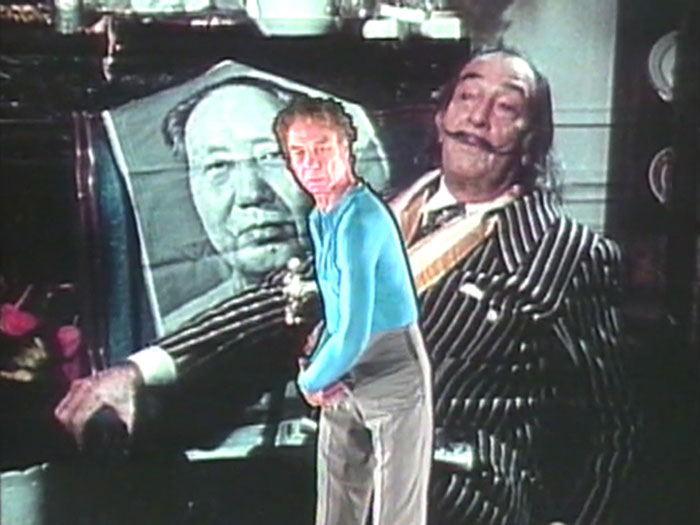
Nam June Paik, 〈Good Morning Mr. Orwell〉 (still), 1984. single-channel video, colour, sound, 30min. ©the estate of the artist and Electronic Arts Intermix (EAI), New York.
The Korean artist, who died in 2006 (after having moved to New York in 1964), lived to witness the invention of the Internet and the rise of broadband, but never made work specifically for distribution via digital networks. Still, it feels appropriate that his videos have been made easily available on a platform like YouTube, as well as downloadable via UbuWeb – the avant-garde repository started by Kenneth Goldsmith in 1996 in response to the marginal distribution of experimental and underground art, films and texts. But the potential for television to deliver art to a mass audience that Paik identified has remained largely unrealised. In the UK, Channel 4 continues to commission approximately 50 short artist films each year through their Random Acts strand, and artists including Grayson Perry and Jeremy Deller have recently presented documentary series on the subjects of, respectively, the British class structure and rave culture. Yayoi Kusama designed T-shirts for Nippon TV’s annual 24-hour charity fundraiser in 2013, and also participated in Peter Gabriel’s music and art videogame experiment 〈EVE〉 (1996). But these initiatives invite artists to work within existing televisual formats rather than invent new ones, as Paik and his contemporaries Laurie Anderson and Robert Ashley, with his 1984 TV opera Perfect Lives, strove to do; they do not aim to jolt the viewer with any formal strangeness like the brief, unannounced microdramas that Stan Douglas inserted between programmes on Canadian television between 1987 and 88.

※ Click to Read the Full Article on ArtReview: Good Morning, Mr Orwell(https://artreview.com/features/ara_autumn_2019_nam_june_paik/)
※ This article was originally published in the Autumn 2019 issue of ArtReview Asia(https://www.artreview.com), by Juliet Jacques.
※ Read this Article: Nam June Paik today – part I, Nam June Paik today – part II

Juliet Jacques
Writer, Filmmaker
-

-
 Critic / People - 11 Dec 2017
Koo Jeong A: Stories of an Ambiguous World Transforming

