
Gemini Kim’s work is a texture of overlapping narratives, ranging from the personal and psychological to the historical and post-colonial. In Gemini’s work, narrative functions both as a departure point and as an ongoing site of exploration, and is in some senses both an unfolding and a reflection of his own evolving identity construct.
One layer of this overlapping narrative is immigration and relocation. We find Gemini in Incheon in 2014 in the city where his father arrived as an immigrant from North Korea during the Korean War. This initial narrative acts as a point of expansion for the multiple narratives of other immigrants that we hear in the series of around ten videos, in which the stories of immigrants are retold by other immigrants. In this series, we hear the stories of Indonesian immigrants in Malaysia, together with the stories of immigrants living in Korea, Japan and the UK amongst others. Although the starting point for the initial interviews was a discussion of food, it is clear Gemini took a hands-off approach, remaining open to the direction that the stories, and the lives, have taken. Although these stories sometimes mention climactic events of our time, such as Brexit, the Rohingya genocide and climate change, these elements are never explicitly foregrounded. Although we may get a sense that, as James Baldwin says: “people are trapped in history and history is trapped in them,” this is not at the expense of the everyday and the ordinary. We see that there is not necessarily anything special about the life of an immigrant - their lives are often just as much a continuation of and an attachment to a pre-established everyday habit pattern as our own lives are. And yet, another narrative is at work here: though not clearly present in the interviews himself, Gemini’s own story - that of a semi-nomadic traveler existing in the spaces and interpretive gaps between the immigrants’ own stories - is somehow also present.
In 〈My Body Belongs to Me〉, Gemini has now assumed a role in front of the camera and the story is indeed more explicitly about him. In this work, we see him exercising on a high bar just as an immigrant worker had done in a previous work. The title of the work references his experience of military service, the result of which was that he felt that he had lost control over his own body to an outside agency. As his body swings tentatively on the high bar, we get a simultaneous sense that his fixed sense of self - and the narrative inscribed in his consciousness by a regime of military power - is somehow unwinding, unfolding and unspooling in this simple gesture of reclamation: reclaiming his own body in autonomous, self-directed action, though the process is stuttering and awkward, reflected in his lack of gymnastic grace.
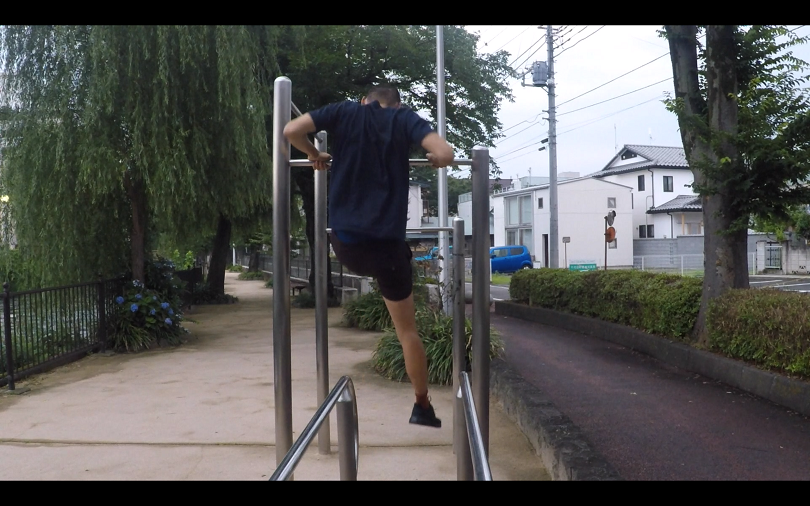
Gemini Kim, 〈My body belongs to me〉, 2019, video, 8min. 9sec.
This work also moves from the vocal reenactments of the earlier works to a physical performance and is an attempt to find a personal connection to the experience of the immigrants and to use their experiences as a site for exploration and personal growth. This might have resulted from his sense of frustration at the inability of his narrators to empathize with the parallel experiences of their immigrant counterparts. And as the immigrants’ own experiences are now being used to decenter his own fixed concept of self, there is therapeutic play or expansion at work here, touching upon the therapeutic aspects found earlier works: in the deep listening to the stories of immigrants, in the questioning of the construction of his identity in relation to his father, in the therapeutic sounds and in the sudden eruptions of colour - presentiments of a more expansive, and perhaps even an emergent transpersonal self - that breakthrough in some video works. The work reflects not just an exploration of personal growth, but a deeper attempt to find a natural mechanism for living, like the sculptures part organic, part mechanism: portraits of modern people existing in a bind between nature and the logic of machines.
The interviews with immigrants also seem to have been the departure point for the recent works which investigate the everyday as the site of post-colonialism and cultural hybridity. In his recent residency in Maebashi, Japan, Gemini invited local artists to a meal to celebrate the end of hostilities between Japan and Korea. However, after talking to these artists he again realises -as with the previous stories of the immigrant narrators - that the simple act of eating food can be the departure point for an entirely new narrative. The story of the origins of Nikujaga - a Japanese stew consisting of meat and potatoes - is bound up with the lives of sailors in the Japanese navy, and another complex narrative begins to unfold from an apparently trivial event. This narrative opens up further in 〈My Nikujaga Belongs to Me〉, in which a history of Japanese factories being used to manufacture noodles, then weapons of war and then noodles again is enfolded in the simple act of cooking a meal.
Ultimately we are forced to ask the question and to explore as he does: what is there to life that transcends the narratives that we construct? For when we try to escape one narrative, we merely get caught up inside another, simultaneously opening up - and yet somehow also circumscribing and artificially delimiting - a simple sense of being in the complex boundaries of language and narrative.
※ This content was first published in 『2019 MMCA Residency Goyang: A Collection of Critical Reviews』, and re-published here with the consent of MMCA Goyang Residency

Russel Mason
Householder
-

-
 Critic / People - 11 Dec 2017
Koo Jeong A: Stories of an Ambiguous World Transforming

