
Some Thoughts on the Works by Hyeki Min
𝟭. The medium is not any more important in a work of art. Different materialities that have long been staying in the states of weightiness or lightness, sinking or floating, or moving or often hesitating – they are drifting in space, deprived of their existence by themselves. However, that attitude implies that something has been changed, not that has completely disappeared. The so-called mediality (Medialität) takes itself into a new arrangement, redefining the role that it has been initially assigned. Such a change comes back to the issue of what role a medium can perform. The incident, which is the change of mode in how a medium performs its role, leads its performativity to drop (from above to below), transfer (from me to you), or relocate (from here to there) while tracing the identity of a medium. Thus, the border between the primary and the secondary collapses. The distinction between the public and the private is reversed. What remains becomes clear, and what has left soon becomes distant. At this very moment, a work of art presents a meaning of mediating the space between you and me in a more distinctive manner. When a work of art exists without any frame of meaning, or even without any additional meaning, you and I can cast a glow in completion for the first time. As such, a work of art stands by itself as something that is not more and not less than a speech of an individual.
𝟮. A work of art reflects an artistic practice; an artistic practice is constructed by an artist; the artist, the viewer, and the work of art and artistic practice find their places from which they gaze upon each other. It might be evident that the stature of an artwork particularly seems to be in solitude among those within the delicate multilateral setup. However, the way through which the relationship-distance between an artist and an artwork is established is usually based on their intent. Thus, while some people wish to maintain a distance of being unfamiliar to each other, others want to keep mutual intimacy. In the midst of entanglement of such diverse relations, “we1)” encounter an opportunity to come across “ourselves.2)” The level of intimacy or unfamiliarity between an artwork and its artist directly involves the perturbation of the viewer, the third party that (has to) look at it. When the psychological distance between an artwork and its artist is wide, the viewer can experience a perspective that takes a view of oneself from a wider and higher level. In the opposite case, the viewer can progress from a third-party position that drifts between an artwork and an artist to a direction to which they are driven, occupying a kind of position as their partner. Whether to take a step further with them or stop and turn around is completely based on the free decision made by the viewer. If one has to reverse the relationship between them once again, the level of intimacy or unfamiliarity can be substituted with the positiveness or passivity of the will of companionship from an artist and artwork to the viewer. Of course, the ways through which how such positive or passive will of companionship is expressed might differ from different tones of expression.
𝟯. In such a way, Hyeki Min’s work raises awareness of the conditions on which a medium, which is one of the elements that composes a work of art, can stand by itself. In other words, the artist evokes the relationship between the will of delivering a speech by herself as an artist that practices through her work and the way through which it is done. If one considers the gaze, the object of the gaze, and the third perspective that gazes them respectively as an apex on a line that connects the inside and outside of an artwork, the differing length of lines that connect each apex generates different angles and constructs a certain shape. And this is the very critical specificity that stands out in the artist’s oeuvre. In 〈AFTERIMAGE〉 (2004), one of the Hyeki Min’s early works, the artist appears as the only character in the video. She records and edits her repetitive actions from a third-person perspective. At the same time, she functions as the subject of her own performance. At the very moment, the relationship between the artist and her artwork maintains a particular distance. The perspective that penetrates them also moves through between the inside and outside while being accumulated on many layers. Different from her previous work that presented different perspectives through one person, the artist layers two different perspectives on top of each other more evidently in 〈LinkCube〉 (2009), an installation that connects two distant locations. The work projects real-time images of different people in two distant locations in one screen, increasing the distance of the artist’s perspective from the work. At the same time, the work highlights the relationship between those that appear in the work by itself by placing the gazes of the characters, who become the elements and objects of the work at the same time, to face each other.
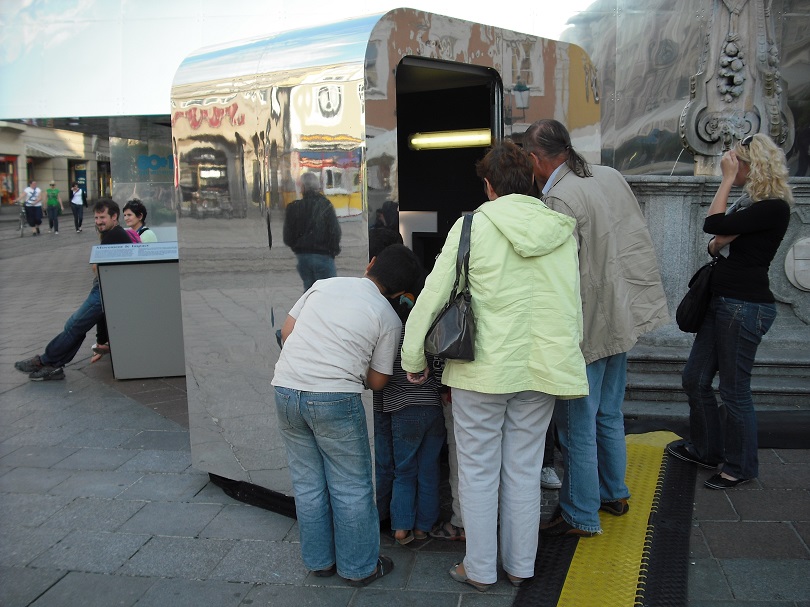
Hyeki Min, 〈LinkCube〉 2009, mixed media, dimensions variable (80+1: A Journey Around the World, Ars Electronica (New York and Linz))
𝟰. In such a way, the artist overlaps different perspectives and lead them to change, delicately coordinating a proper stage of the performativity of a medium between the two ambivalent and contrasting ends of positivity and passivity. Through such a process, the artist leads the artwork, the artist herself, and the viewer to a state of assimilation. In 〈The Moment〉 (2017), visual and aural stimuli sensed by the human body are actively employed in order to draw such assimilation. The work breaks light bulbs against the wall after they slide from above at a quite high speed. It leads a work of art not to remain as an abstract medium marked by metaphysical meanings but to exist as a pure framework that is physical and sensuous and a gaze that is empty. The artist’s recent work, 〈Involuntary Travel〉 (2018), achieves the trinity in a lighter yet deeper dimension through the physical and imaginary movement of the artwork. In the work, the shoes that move at regular speed and pace become the object of the gaze. Moreover, they voluntarily play the role of being a purely intermediary perspective. Through the repetitive action, the representation of the act of walking enables the appreciation and immersion that move across the surface and behind and the internal and external.
𝟱. To me, Hyeki Min’s work comes as a shifting mirror(變鏡) that reverberates with myself. The artist’s aesthetic practice, which emphasizes the purity of a medium, enables her artwork to function as a sphere for active actions of performance. This in turn reflects how the realization of the object, perspective, and gaze can be infinitely expanded within the horizon of art while an artwork, artist, and viewer are complicatedly intertwined with each other. Within the diverse strata of changes that have been constructed by Hyeki Min, I now discover me and you who are constantly projected and covered by the meanings and forms of countless figures of human beings.
1)Here, “we” is used as a plural pronoun of ‘I.’
2)“Ourselves” is used a plural reflexive pronoun that includes ‘I’ and ‘you.’
※ This content was first published in 『2019 MMCA Residency Goyang: A Collection of Critical Reviews』, and re-published here with the consent of MMCA Goyang Residency

Jintaeg Jang
Jintaeg Jang is a curator and a researcher based in Seoul, Korea. Jang received his M.A. in Curating Contemporary Art from the Royal College of Art, London, UK and completed a doctoral program in Art Studies from the Hongik University. He curated numbers of shows working at Ilmin Museum of Art, PLATFORM-L Contemporary Art Center and Insa Art Space, and ran an independent platform for curatorial practice called INTERACTION SEOUL. His position was also a team lead at ZER01NE Creator Studio, a creative division at an open innovation platform operated by Hyundai Motor Company. Currently working as an independent curator, Jang is curating and writing with a research interest in the formation and practices of contemporary curating in South Korea.
-

-
 Critic / People - 11 Dec 2017
Koo Jeong A: Stories of an Ambiguous World Transforming

