
In 2017 I met Jihye Park for the first time.
She asked me for help with her novel 『An Ordinary Failure』 – which was to be part of her exhibition – and I accepted, although I was not very helpful in the end. The following year her exhibition opened and we had a few more chances to have conversations in preparation of an MMCA Residency Seminar this year.
I have had the impression that Park is very sensitive to language. She is not interested in verbose, pedantic or abstract language. Rather she always focuses on using the language accurately and effectively and puts more effort into managing it more easily and simply. Perhaps it is the result of considering the very small meanings attached to the words and the areas in which they are accessible, beyond the single meaning of the word or sentence.
Then where has she got this language sensitivity from?
Perhaps it is just her own personality and taste. In fact, there are a few of her installations that have titles that suggest a word or sentence itself. But words and sentences included in some of her work such as 〈You Got the Wrong One〉, 〈useless〉, 〈I am Sorry I was Born〉, 〈some-thing〉, 〈One Day〉, and 〈Nothing Has Happened〉 never just mean their dictionary definitions. In the artworks, those words overlap with social context and connotations and bring different meanings and effects. And when you realize that they are the artist’s questions about institutions, regulations, or standards, it becomes rather difficult to say that her sensitivity to language is just her own taste.

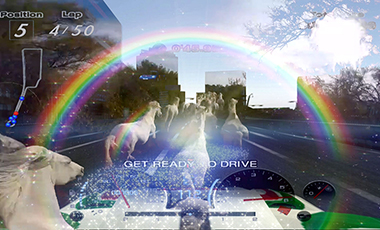
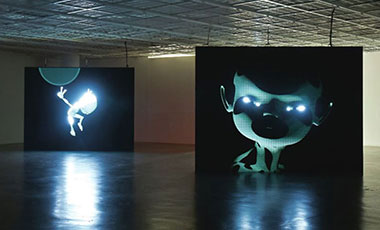
Jihye Park, 〈A position only permitted for today〉, 2020, video and installation, 7min. 50sec.+ dimensions variable
Once Park mentioned the inconvenience of the language used in the art world. The language here refers to wall text, reviews, artist's notes, proposals or artwork descriptions. She seemed to be sensitive to the abstraction, ambiguity, and unfriendliness which were either consciously or unconsciously shared by these texts.
Any work of art inevitably involves language to understand, appreciate, and interpret it. Of course, language cannot explain artworks perfectly. Language never corresponds exactly, and most writers are either so distant or so close to the work that they cannot help but cause some misunderstanding. Therefore, it might be unnecessary and also impossible.
Nevertheless, artists have to consider it carefully; what they should say about their work and how they can say it; how to design the slender bridge that might connect the artist or artwork with the audience (or reader for writers). That is always a difficult and delicate matter for creators. Anyway, it seems obvious that Park is looking for another language that is different from what we already have.
And that is connected closely to the question which she poses. Perhaps she feels some frustration and discomfort about the need to express her work, which questions the institution, the rules, the universality and the system in the existing language.
But on the other hand, Park's work is not expressed in a way that antagonizes or attempts to overthrow the existing system. Rather, it is done in careful ways, such as posing questions and offering suggestions, and instead of minimizing her individual position or opinion, it is always left for the audience to ponder.
Therefore – if it’s okay to put it this way – Jihye Park is questioning standards that we take for granted. She is someone who carefully observes and presents elements that consist of and sustain them, and who finds her own language to express them.
Having written this, I'm slightly concerned that I may have over-simplified her work. In particular, finding a language that can properly describe the world of one's work may seem natural and simple, but in reality, it might be more difficult. What is called convention or practice is usually long-term security and has its own power, so great courage is inevitable in not following the existing order. In some cases, it may be necessary to be prepared for fear that one's work may not be well interpreted or mentioned in the existing system and therefore not be well known.
Park has repeatedly said that her raison d'etre as an artist is to provide a platform for dialogue. I think the words are the core, essence, and power of her artistic world that she has been working on. That's why Park's work should be talked about and discussed in a richer way than it is now.
※ This content was first published in 『2019 MMCA Residency Goyang: A Collection of Critical Reviews』, and re-published here with the consent of MMCA Goyang Residency

Hyejin Kim
Author
-

-
 Critic / People - 11 Dec 2017
Koo Jeong A: Stories of an Ambiguous World Transforming

