People / Critic
Daham Yo : Overdetailed Review of 〈Tomb That Will be Broken Tomorrow〉
posted 20 July 2020
I once read a Calvin Tomkins’ review of a Nam June Paik performance. It was more a paranoid record of someone obsessed with the impossible desire to linguisticize every moment of the performance than a review. The scenes of the performance recorded in text, not in pictures, were naturally low-definition. But the more I read the weirder it felt. I could feel Tomkins' desire not to miss a scene, and as it was not fully verbalized it stimulated my imagination even more. The record, which depicts the tension and anxiety of the audience and even the feel of the air, seemed to be the homage of someone most willing to engage in the sensible violence intended by the artist. I wanted to do the same for 〈Tomb That Will be Broken Tomorrow〉, a performance by Daham Yo. He once said he wanted all the materials that consist of the place where the performance takes place to function as the score of the performance. If space, light, sound, temperature, and even people are all part of the score, the details below will be the score as well as the review of the performance.
Chilly darkness began to fall in late summer at the Art Space Pool. It is located in the alley of a residential district in Gugi-dong that is quite narrow, which seems to cause a lot of arguments about parking. When the square green neon sign on the gallery’s roof was switched on, red cigarette lights gathered near the smoky spiral designed to repel mosquitoes in the backyard. The tired L-shaped single-story house, which was built around 1980, was covered with ivy, the root of which cannot be found. Rumors abounded that buses were not running as conservative groups were holding rallies near Gyeongbokgung Station, and someone cupped a hand to their mouth and lightly sprayed into the air that they would open the gallery at 8pm, just a little later than scheduled.
The audience began to queue alongside the building. They took off their shoes in front of the old door facing the backyard, stepping on to a white cloth-lined stone and entering the room. The old house, which is usually used as an exhibition hall, had a lot of nail marks and dark mold stains on the inside of its cement walls. The ceiling was low and the beams of the roof were exposed like white bones. The windows at the end of the long room were made of frosted glass with tacky patterns that you didn’t know still existed.
In the room, which smelled of dust and mysterious pungent chemicals, a huge ivory quilt stretched to every corner. A performer with tanned skin embracing their knees with both arms sat in one corner. They were covering their knees with the quilt. When they made eye contact there was the suspicion of a smile in their eyes but you were not sure. There was a seemingly softer little white cotton duvet laid in the middle of the ivory quilt. People started coming in one by one and sitting with their backs to the wall. They greeted one another or spoke to the artist with hand-knitted hat and long beards. When about 20 people put their legs under one duvet an awkward silence made the air heavier. The lights outside the building and the room opposite were switched off. Yo quietly sat on his knees and said: “The performance will soon begin. Thank you for coming." And he stood up and turned off the light. The last syllable ‘da’ of Kamsahamnida (meaning ‘thank you’ in Korean) sounded like the high musical note ‘La’ – which is even higher than the ‘Sol’ note that department store employees often use to sound more cheerful – and that left a weird aftertaste.
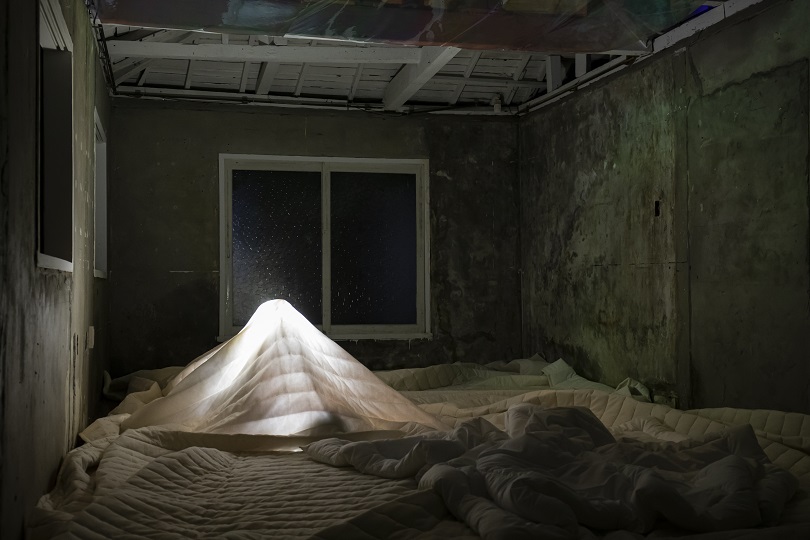
Daham Yo, 〈Tomb That Will Be Broken Tomorrow〉, 2019, performance
As soon as the light was off, there was some kind of noise, like people chatting outside. At first, it sounded like the noise from Gugi-dong, which leaked into the building because of its thin walls. The tanned one sitting in the room stood up at an ordinary speed that was neither slow nor fast and tugged at a corner of the quilt. The dust in the room was shaken. The quilt made a wave, spreading out to the other three corners, and the people covered by the quilt remained sitting still as if they had only been hit by a gentle wave in the shallows. They had to accept waves as they were, high or low. After a few waves struck, the man who caused the waves stepped on the quilt, walked slowly to the little duvet in the middle, and lay down. So many people surrounding a person lying down and watching them would otherwise have only happened at the casketing of a close friend or relation.
They sometimes flipped over or disappeared under the duvet. And the duvet rose and settled as they made their way underneath it as fast as a mole or a dolphin. The aftermath of the moves spread to the people who were sharing the quilt. At one point, the quilt rose in a rectangular shape about the size of a man like a coffin covered with a large cloth before it's lowered down into a grave. Then it rose higher and higher, resembling that moment just before a magician removes a cloth covering a box in a magic show when the one in the box disappears. Anyway, the square-shaped quilt in the air was reminiscent of disappearance, and the people who were sharing the quilt dragged the quilt a little bit to cover themselves up, as if delicately laying turf on a burial mound. When the light was lit inside the heap of duvet it became like a translucent egg. When the light flickers quickly, the tension rose, whether it is just before death or just before birth, but the light soon went off.
Then the performer came out of the middle of the quilt with difficulty holding a mirror – feet first, very slowly, like the difficult birth of a baby upside down in its mother's womb. Soon after, they gathered their strength like a four-legged animal just born and held the top of the mirror with his hands. The bottom of the mirror leaned somewhere on the body and began to move slowly. At that point, a sound in between music and noise began repeating from the speaker on the ceiling, and the light that was slowly spinning around like a lighthouse shone into every corner of the room. They approached the audience and leaned the top of the mirror forward. The audience, forced to look into the mirror, saw themselves buried between the white bone-like rafters. They carried the mirror with both hands and balanced it on their feet, moving cautiously and slowly as if they were leading a shorter partner in a waltz. When they returned to their original spot, they wore a blank expression, and then suddenly let go of their expression. Only then did the people under the same quilt applaud.
I hope that this overdetailed review with its abuse of similes will not be skipped over in any sense. May all languages disappear tomorrow and leave the feeling of that strange evening intact. May they take root in the lowest cells like turf perfectly laid onto a burial mound.
※ This content was first published in 『2019 MMCA Residency Goyang: A Collection of Critical Reviews』, and re-published here with the consent of MMCA Goyang Residency

Ahn Sohyun
Ahn Sohyun is a curator and writer. She strives to broaden the possibility of criticism while avoiding impactless writing. She is interested in forms that are in the process of becoming political.
-

-
 Critic / People - 11 Dec 2017
Koo Jeong A: Stories of an Ambiguous World Transforming

