
In early September, I received an email from artist Won-woo Lee. As I write, he is staying at an art institute in Montreal, Canada, called Darling Foundry. This place is linked to MMCA Goyang Residency, where he is an artist-in-residence this year. It hasn’t been common for an artist to stay abroad while preparing for an exhibition or having an interview, but it has happened sometimes.
'Hello!' His email begins with a lively opening and, with two attached documents, was quite detailed content-wise yet friendly. But some of the sentences that contained his examination of the current situation and awareness of reality in the art world have a hint of bitterness and a faint impetuousness delivered from afar. In the course of discussing the deadline and direction of the article, I have given him the impression that I was more interested in what he's indulged in recently or what his plans for the future are rather than direct explanations about his work. I looked at some of the reviews written by others for reference but I did not want to repeat what they said nor did I have the confidence to write something completely different from them. Anyway, as a person who has been watching his artistic evolution for quite a while from a distance, what I am curious about is not the beautiful end of a coming-of-age novel that he has written, but somewhere in between the development and crisis in the epic novel that has just begun to be really interesting.
The first time I met him was about 12 years ago when he was one of the members of 'Joketta Project' that he established with his friends. It was when both of us were kind of in-between things – student and artist for him and assistant and curator for me. Both of us were interested in site-specific multi-disciplinary art rather than traditional media. Maybe the reason why I remembered him so well as a young man is because I saw a hodge-podge mixture of optimism and anxiety, and the typical vividness felt from youth in him.
Through the occasional encounters we came closer and drifted away roughly every five years, I could only guess the signs of happiness and depression within him as an artist dealing with the changes in life and work. Of course there seems to be nothing to worry about when you see the list of shows he's participated in and the frequency of his creative projects is well above average. Lee's work makes a favorable impression with artistic humor that does not harm anyone and a balanced mixture of hipster codes and aesthetics. That he is not easily shaken by major artistic discourse or market trends, and displays a trademark free-spirit with his unconventional attempts and jokes exposed via sculpture, installation and performance and fundamentally integrated into conceptual art differentiate him from the visuality created by his peers or sculptors from earlier generations.
Sometimes I felt the energy that Lee's projects have laid out seem to miss that so-called ‘sense of urgency’, which appeals to the excess of intelligence and the politics of strategy. For example, his work does not attractively reproduce something or bring it down uglily. It does not use materials that are too special, nor does it deal with strange materials. It does not rely on overly complex manufacturing processes, theoretical contextualization, or large-scale technical collaboration to complete the work. There is a childlike aspect in his drawing, painting, and making things with his hands as he likes to do. It's an attitude of doing nothing and intended amateurism. It makes us laugh and feel bitter for a moment. Rather than talking combatively about forms, concepts, circumstances, and how to deploy objects in his art, he furtively encourages the audience to contemplate them.
'Joketta!’ (meaning 'It'll be nice' in Korean) is how I felt about his work. Not 'It was nice' or 'It is nice', but the expression 'It'll be nice!' that is in between future progressive form and future perfect form pinpoints ambiguous subjects and objects. It can mean 'his artistic work will be nice', 'it would be nice if so', or 'it'd be nice for the audience'. Perhaps the person who would enjoy it the most might be the artist himself. The work produced by him, who is still like a young man, seems to be interesting. It can be hard to answer if someone asked me what it means by 'interesting' but it is fun that it is not mean nor did he try too hard to be humorous.
Throughout this year we have shared a common experience that a project both of us were involved in was cancelled. Consequently we could not participate in an exhibition due to practical reasons. Through the process, I could patiently look at small fragments of shadows between his crisis and reactions, and agony and solutions. At any given moment, you get to look at the opposite sides of where everything you've defined easily is. Maybe it was because of that. The two pieces of writing he sent me from Montreal are as sincere as always but I interpreted them somewhat differently. Although the titles were 'My recent interest' and 'It's not too late' respectively, I voluntarily misinterpreted them as 'My recent interest' = 'It's not too late' from even before I opened those files. With the bias, I started reading his updates and a new interest.
He said it was ‘anxiety’. It is what Lee has been seriously into and the theme reflects his real life. It is an acceptable keyword considering the sincere attitude of the artist – who shared his interest and plans in an essay format – and the precarious situation in which contemporary artists are working in. Generally it is the anxious emotions that encourage artists to create new work rather than a feeling of comfort. Because Lee faces a crisis that he needs to react to when he needs to, I am not going to be anxious about the anxiety. In one of his essays, he wrote about how he deals with anxiety: first, depend on your own luck; second, dance; third, become a giant; and fourth, travel to the future. It is rather whimsical but quite a clear and interlinked manual in its own way. I am not going to explain further details one by one, but the points where each reaction links to his recent work individually are logical and eye-opening in various ways. Among some expressions he gave me, format-wise words like abstraction and ‘sonmat’ – a Korean compound of ‘hand’ and ‘taste’ which is used in various situations – and content-wise concepts like disappear, deficiency, and fun stand out.
‘It is never too late to say sorry.’ The title of public artwork by Elmgreen & Dragset opens Lee’s second essay. It was written in tone with unspecified readers in mind, but is still voluntary writing with an unclear purpose. It contains confused feelings about contemporary art and the distinct characteristics of the Korean art world, the relationship between art and society, and public art that goes back and forth between morality and commerciality. To me, the direction of sorriness is interpreted and imagined on many levels, just as the original story was. Primarily it can be a message of apology from art – more specifically false art produced as ceremonial products – to the audience and spaces that live today. To project the meaning more actively, I would interpret it as a form of self-expression to think about art and act more for art that doesn't need to feel sorry for people, and a pledge to laugh at the crises that hinder it to overcome.
The idea of the artist, who becomes a giant depending on his luck, dancing together with various people in a time machine he created in a sham, and goes into the future. Where yesterday, today, and the future are mixed, adverbs of time like already, still, and yet would be a useless borderline language. Today, with the anxiety so deeply ingrained, I feel alerted as he did not grieve that it was too late, but rather said it was not too late. Tonight, I am going to reply to express how grateful I am.
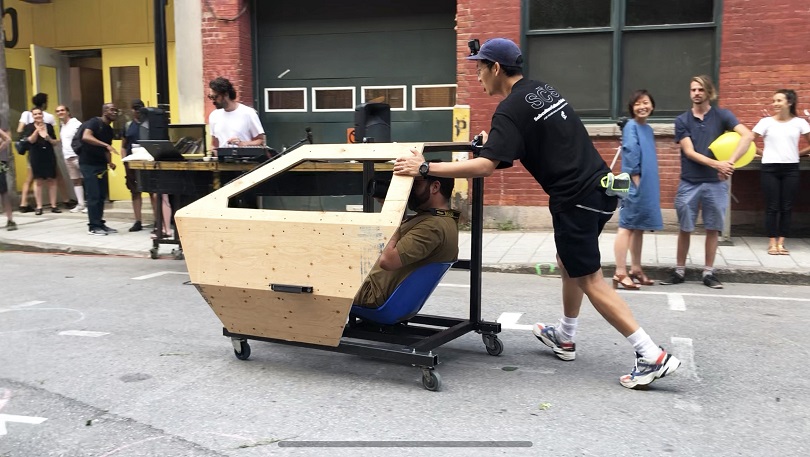
Won-woo Lee, 〈Very futuristic place〉, 2019, steel, wood, wheels, chair, 120 x 138 x 97 cm
※ This content was first published in 『2019 MMCA Residency Goyang: A Collection of Critical Reviews』, and re-published here with the consent of MMCA Goyang Residency

Juri Cho
Curator and Researcher
-

-
 Critic / People - 11 Dec 2017
Koo Jeong A: Stories of an Ambiguous World Transforming

