
〈A Village〉 by Jaekyung Jung is a special film and book project that revolves around a longer re-search period in the past year. One aspect of the final piece is a film that captures the artist’s en-counters during his stay in Heonin village, a suburb of Seoul. Jung shows us the state of the village while focusing on a special breed of inhabitant, the abandoned dogs, to tell the story of this marvel of failed urban planning.
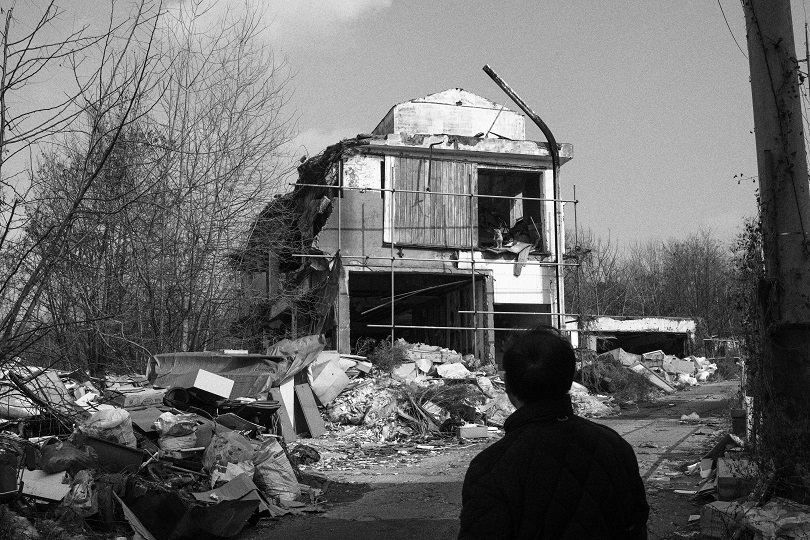
〈A House 〉, 2020, 4K, 15min.
The village was established in 1964, and over the years has become a symbol for exclusion and gen-trification. This settlement for Hansenites developed slowly with the production of furniture. By the 1990s it was one of the main producers of furniture in the country, and its inhabitants had be-come mildly successful. The following years would be marked by a slow increase in real estate specula-tion, which reached its peak in the early 2000s, when real estate development companies were al-lowed to turn the rudimentary housing and factory sites into a luxury living area. During this time, most of the village inhabitants were pushed out by political lobbyists, which led to the de-struction of a majority of the village by the development companies. Not everyone left, though. The popula-tion shrank from 300 people around the year 2000 to 60-70 currently, with only 20 remaining inhab-itable houses and factories. Shortly after the initial destruction of approximately 80% of the village, its developer went bankrupt in 2011, leaving the village in a state of ruin. The project continued on a political level, but has slowed to a standstill as of late.
When Jung started his year-long research into the village’s origin and progression in 2018, not much had changed since the project was firmly abandoned in 2011. Very few people lived there, most of the factories and houses were in a ruinous state, and trash— consisting mainly of old furni-ture and household products —had piled up in several areas. In this quiet but rundown atmosphere, the artist found the protagonists that would be able to tell the story of the village from a different angle. His choice for the unlikely non-speaking heroes fell to the pack of wild dogs living there. The animals, left behind by their former owners when they sold their properties and moved away, are a short-legged fluffy breed that appeared during the past decade. These abandoned animals guide us through the artists’ chosen sceneries. Jung chose to film them in their slightly post-apoca - lyptic set-ting, where each scene of the film is comprised of disused, human-built structures, some abandoned objects, or even piles of trash—in addition to the dogs. These scenes are slow and at a first glance appear like still images. Only the slow-moving flora, some rain, and the animals break the silence created by the scenery. While we follow the dogs through certain sets, a voice from the of com-ments on their situation. This voice belongs to one of the inhabitants still living in the vil - lage. The narrator is a homeless person who makes his living by collecting and selling trash. He made it his mission in life to tenderly care for the animals and ensure they have the freedom to roam what is left of Heonin village. His poor economical power often makes this task a moral burden. As he himself often struggles for resources, he also has to face harsh decisions when one of the dogs gets in-jured—providing medical treatment for this one dog would expose the rest of the pack to the dan-gers of starvation. The narrator constantly feels torn between the bliss of having a family and the moral dilemma his situation forces onto him. The carefully chosen segments of the interview exem-plify the narrator’s story. In his world, the dogs understand and sympathize with him, they feel for his struggles and forgive him, thus becoming the ethical and moral compass of the film. He is the complete opposite of today’s modern real estate agent or developer; he cares for his community, and is always able to rely on his peers’ understanding and support as he decides between life and death. However, this does not make him feel elevated by his power. Rather, he is skeptical of his own ex-ertion. The interview that narrates the film becomes a loose account of the events that occurred in the village, and thus the story of the dogs becomes the story of the village.
Jaekyung Jung’s observations of Heonin village are of a delicate nature. His sensitivity toward the animals, his seemingly distanced point of view, and the use of a third-party narration evoke a lour-ing but never hopeless atmosphere. A place that might appear abandoned is sprouting with life and reclaimed by nature. The artist’s project becomes a strong but inwardly pointing comment on the social politics of his hometown, and offers the patient beholder bewildering imagery to reflect upon. Jung makes a great point to show the absence of a desire for power through the weakest beings in the village. For his film, he created a gaze that looks at this destroyed landscape through a different perspective, one beyond the political, economic, or historical point of views on the matter. In the end, it is the narrator's point of view that fantastically sees the dogs slowly disappearing to show their sympathy with him in the ruined cityscape.
※ This content was first published in 『2019 MMCA Residency Goyang: A Collection of Critical Reviews』, and re-published here with the consent of MMCA Goyang Residency

Patrick Constantin Haas
Patrick Constantin Haas has studied Art History, Archaeology, and Psychology at Rheinische Friedrich-Wilhelm University in Bonn. Haas previously worked as Associate Curator at Witte de With Center for Contemporary Art (Netherlands) and for the Kölnischer and Bonner Kunstverein (Germany).. As Co-founder of MÉLANGE, a not-for-profit exhibition space in Cologne, he realized various exhibition projects in Europe with artists like Melike Kara, Jonathan Monk, Ellen Yeon Kim, Gween Thomas, and many others.
-

-
 Critic / People - 11 Dec 2017
Koo Jeong A: Stories of an Ambiguous World Transforming

