
Lee Seung Jio (1941–90) is a representative figure in Korean geometric abstract painting. To Lee, the “cool” abstraction that emerged in the wake of Informel’s “warm” abstraction was the “form of the contemporary era.” He established a reputation for the way he devoted himself to making geometric abstraction his own in his day-to-day life. Parting ways completely with "painterly" art and its swirling brushstrokes, Lee Seung Jio consistently pursued a clear, linear approach to form.. The platforms for his activities were the artist groups Origin and AG; he earned the nickname of “the pipe painter.” The key element in Lee’s art is the 〈nucleus〉. He focused on the original nature and explosive energy possessed within the nucleus as the force behind a revival of new art within the chaotic Korean society that he was faced with. From his early forms emphasizing a pure formative order with clear shapes and primary colors, he proceeded to delve into the nucleus through his repetitions of and variations on pipe shapes, where two-dimensional linearity coexists oddly with the illusion of three-dimensionality. The large-scale retrospective 《Advancing Columns》 (July 1–October 4) is taking place at theNational Museum of Modern and Contemporary Art, Korea’s branch in Gwacheon for the 30th anniversary of Lee’s death. It includes over 90 works, ranging from his 1968 piece 〈Nucleus 10〉-with its motif of cylindrical shapes-to the large works of his later years. Choi Jeong-ju attempts to broaden the critical spectrum regarding the art of Lee Seung Jio-which has chiefly been discussed in terms of its relationships with Korean Monochrome painting and the illusory effects of Op Art-to analyze the influences of direct and indirect experiences with contemporary Western avant-garde art and discourse on Lee’s painting style. In particular, she examines how Lee established independence in his painting by incorporating phenomenological concepts to escape the dichotomy of representation and abstraction in the problem of “seeing,” and how he attained a “space of painting” that was both fundamental and pure. The argument is followed by an archive that looks back on Lee Seung Jio’s life-summoning history back to the present to show how, in his activities spanning the Korean and overseas art worlds, he was able to transcend the established order to become a pioneering artist for his era.
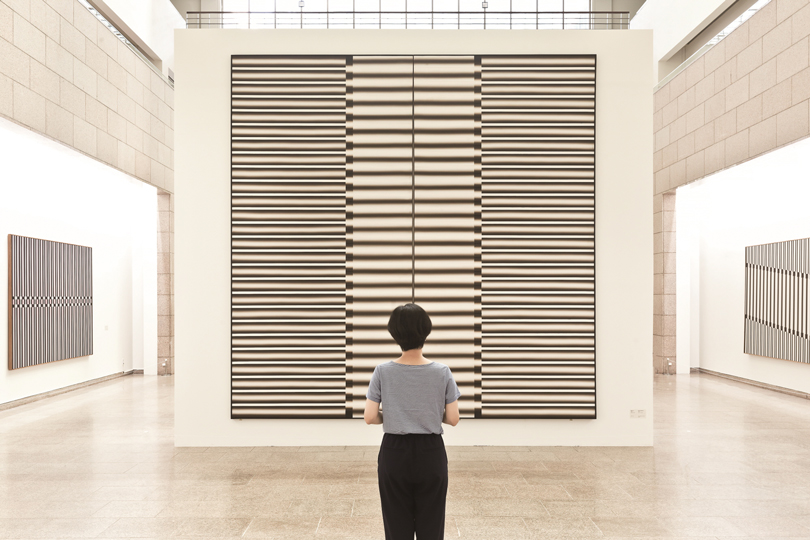
Photo by Jung wook Hwang , Image Courtesy of Art in Culture
Previous
Nucleus: The Origins and Explosive Potential of Art (1)
Pipes: Cold and intellectual geometric abstraction
Four months after the 《Union Exhibition》, Lee Seung Jio’s 〈Nucleus〉 series emerged with an entirely different aesthetic. Among the Nucleus works presented at the 12th Contemporary Artist Invitational Exhibition sponsored by the Chosun Ilbo at the Gyeongbok Palace Museum (now the National Museum of Modern and Contemporary Art, Korea) from April 23 to 29, 1968, his 〈Nucleus 10〉 (167) featured three-dimensional pipe shapes positioned side-by-side like vertically sectioned cylinders against a two-dimensional color plane. With its peculiar combination of the two-dimensional plane with the illusion of three-dimensionality, it immediately captured the viewer’s gaze. This marked the official debut of Lee’s “pipes.”
Remarking on the background behind his creation of the pipe shapes in an interview with Shin Hyung-sub, Lee said, “After experiencing the powerful visual stimuli flashing past by retinas during a journey by train, I stayed up the next two nights manufacturing images.” The younger artist Park Seung-beom also said that he had discovered it by chance while obtaining natural gradations in experiments with repeatedly painting color bands with a flat brush—a tool not used by anyone else in art around 1967—and applying different colors to the center and ends to produce a marked light-dark contrast. Ultimately, the pipes were the result of an intuitive pursuit of internal voice, the choice of a flat brush, and experiments with the material qualities of paints.
To accentuate the sharp sense of pipe shapes, Lee devised an original approach to producing his artwork. He would stretch out his custom-made canvas as tautly as possible and smooth out its surface by 5 to 10 applications of base paints and sanding. Instead of a ruler, he used paper to partition the color plane, attaching paper tape to the surface outside the paint and repeating the process of applying strokes with a flat brush (#5 or so) for whatever the number of color planes happened to be. The result of this long, arduous, unthinking effort was the achievement of a base color that was subtle yet profound, together with elaborate pipe shapes.
The impact of the 〈Nucleus〉 series’s pipe forms was immediate. In late July 1968, three months after the 12th Contemporary Artist Invitational Exhibition, Lee won the top prize in the Western painting division of the inaugural 《Dong-A International Art Fair》 at Dong-A University in Busan with 〈Nucleus 77〉 (1968), which ushered the optical stimulation to a heightened level. His work 〈Nucleus F90〉 (1968) was named as a potential winner of the President ‘s Award at the 《17th Kukjon》 event two months later in September, but it was ultimately awarded third-place “Minister of Culture and Public Information Award” honors after a controversy over “repayment of favors” in the judging process. Lee’s ties with the Kukjon would continue as he produced a dominant performance winning four years in a row, including special selection honors at the 18th event in 1969, the Minister of Culture and Public Information Award at the 19th in 1970, and the special selection again at the 20th in 1971; in 1972, he was selected as a Recommended Artist.
While this was going on, the 〈Nucleus〉 series was developing into something more aesthetically robust, with a refined beauty of moderation and expanded sense of space establishing themselves firmly through the clear sense of volume in its cold silver-gray metallicness and its mechanistic arrangements. The pipes became Lee Seung Jio’s trademark. The unheralded arrival of his optical geometric abstraction would lead to a sudden, visible change in the climate of the Kukjon and the painting world in general. At a time when President’s Award honors at the 1968 Kukjon event were being awarded to the area of calligraphy, his recognition sent the message that “Op Art-style avant-garde artwork that would be have unthinkable with the Kukjon’s physiology up until then” had made its arrival in the Kukjon citadel. His award at the 1969 event established him solidly within the Kukjon firmament as he drew attention with sui generis painting work “powerfully evincing the pipes’ sense of mass through sophisticated rendering emphasizing the intellectual aspect”; together with the Presidential Award honors for Park Seok-won’s abstract sculpture, it placed him at the vanguard of the geometric abstraction trend. Commenting on his dazzling achievements, Park Seo-bo said, “Lee Seung Jio arrived like a comet, his cold visual grammar something unique and incomparable to anyone else’s work.” He also announced that “an art of geometric abstraction that never before existed in our tradition has dawned this very year with the work of Lee Seung Jio.”
Even amid the praise and positive reviews from the painting world, Lee continued to wrestle with issues concerning the illusory effects of his pipe shapes. While his intention had been to present a logic of geometric abstract art, the emphasis on the “nuclear” in the contemporary art climate was rooted in a representational perspective that viewed the pipe as a symbol of industrialization. In other words, his images were understood as “parading a modern sense through the intervention and construction of elements of mechanical civilization and the scientific,” representing “factory-made metal studies” through a sensibility inured to the machine. Lee would comment, “There are people who refer to me as the ‘pipe painter.’ It’s a label I don’t particularly covet or detest. As a name, it may represent the visually deceptive material qualities that arise from a repeated action that does not presume the motif of a concrete object. Obviously, it’s still less a matter of introducing it as a symbol for modern civilization.” As someone practiced enough in realistic representation to declare that there was “nothing left to paint,” Lee had made the decision himself to pivot toward geometric abstraction, which sought its ultimate visual values purely in terms of the basic order of painting and its point, line, plane, and color—yet the matter of representationality remained. What Lee sought with his 〈Nucleus〉 series came down to pure material outcomes based on unthinking repetitions of brushbrokes, abstract painting as the “province of art” with no element of symbolism or referentiality, and issues of the “proper values of painting beyond the act of seeing,” which transcended representationality or fictionality.
With the attention he drew with his three-dimensional pipe shapes, Lee Seung Jio’s aesthetic achievement in geometric abstraction made him aware of both the task of overcoming representationality and its semblance of reality, as well as his own aesthetic deficiency. This sort of introspective stance was not exclusive to Lee. With the new challenges attempted at the 1967《Union Exhibition》 amounting to a one-off formal experiment, matters of the substance of art and the need for aesthetic embodiment had surfaced as issues for the progressive artistic community.
Lee Seung Jio reaffirmed his commitment to the avant-garde with his participation as a founding member of AG in 1969. Formalizing a “strong consciousness toward avant-garde art,” AG brought artists such as Kim Ku-lim, Kim Cha-seop, Park Seok-won, Park Jong-bae, Seo Seung-won, Choi Myoung-young, Ha Jong-hyun, and Lee Seung Jio together with critics like Lee Il, Oh Kwang-su, and Kim In-hwan as they focused their efforts establishing the theoretical grounding they saw as lacking in the small group era of the late 1960s. Between 1969 and 1975, they held four themed exhibitions and published four issues of an eponymous magazine, with Lee participating in shaping the trend through the third exhibition in 1972.
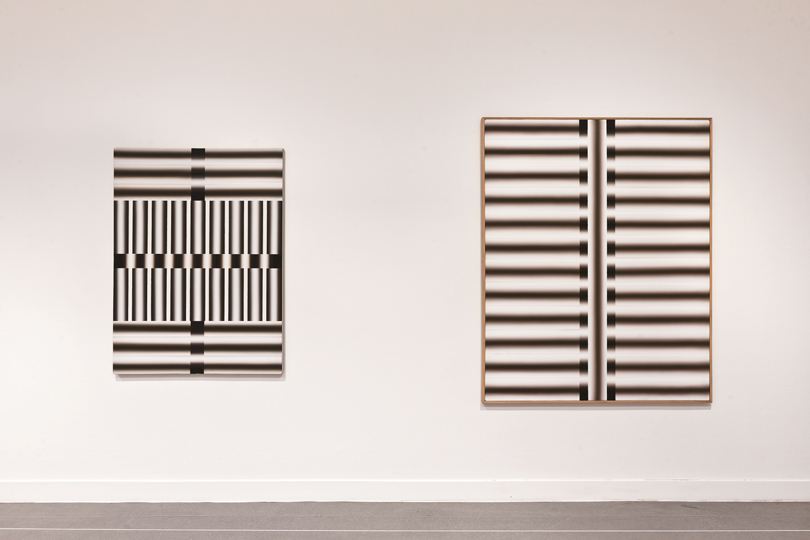
Photo by Jung wook Hwang , Image Courtesy of Art in Culture
Plane as phenomenological space
The magazine 『AG』 focused on different trends in overseas avant-garde art, including Nouveau Réalisme, conceptual art, land art, minimalism, and Mono-ha, while sharing a new creative stance for contemporary art in terms of genres such as installation and art objects. Lee Il’s 「Avant-Garde Art Theory」 in particular referred to Pierre Restany and his discourse on engagement in reality as it spearheaded changes in the creative perspective with its advocacy for the incorporation of Korea’s industrialized, urbanized modern aesthetic and the introduction of everyday materials and technology. It also paved the way for artistic methods comprehensively integrating painting, sculpture, and architecture. Lee Seung Jio likewise pursued forms of creative experimentation that had not been present in earlier periods, including object installations and painting that represented a “return to two-dimensionality.”
In works such as his piece 〈Nucleus G-111 A〉 (c. 1970) from the inaugural AG exhibition in 1970 and his 〈Nucleus F 99〉(year unknown), Lee exhibited a shift toward emphasizing two-dimensional planes over the constructive compositions of his pipe shapes. Lee Il welcomed the return to two-dimensionality in 〈Nucleus〉, declaring that Lee Seung Jio “could be named as without a doubt the artist best suited to the theme of ‘reduction,’ with his compositions of repetitive geometric patterns and his restrained, almost monochrome coloring.” 〈Untitled〉 (1972), which is reputed to be his only art object work, involved a shadow image shown as the light from a projector was shone on crumpled paper. Using the everyday object of a projector as a means of approaching nonmaterial light and shadow, the work showed the artist becoming aware of the characteristics of conceptual art and its metaphorical representation and transposition of spirit and consciousness. His experimentation in this area would carry over into his first solo exhibition at Shinsegae Gallery in 1973. The eight works in his 〈Shape〉 series (1973) were paintings in which faint spreading colors in pastel color were layered against a white background. In the artist’s own words, he had used painting to render the concept of “traces of ‘shapes’ whose essence we are not conscious of, as it has passed on into time and history.” Through his repetition of the act of applying paper, painting the edges white, and then removing the paper, he demonstrated a conceptual form of painting that projected the nonvisible sense of “time and essence” through the empty spaces where time and history had been present and the layers of paint remaining behind as traces. But Lee’s lyrical abstract painting was simply a one-off experiment, and the benefits of his having impressed the importance of “concept” would manifest once again in the form of his 〈Nucleus〉 series.
During his time with AG, Lee Seung Jio appears to have explored the theories of the Mono-ha group and the principles of phenomenology. This seems to have come about naturally as Lee U-fan’s 「Introduction to a Phenomenology of Meeting」 was discussed and propagated among artists with its publication both in the inaugural issue of the 『ST』 journal in October 1970 and again in Vol. 4 of the 『AG』 journal in November 1971. A theory that aspired to triumph over modern ideas in the Western model, Mono-ha theory was influenced by the perspectives of phenomenology, encompassing thinkers such as Edmund Husserl, Martin Heidegger, Maurice Merleau-Ponty, and Nishida Kitaro. It was a position that advocated introducing a sense of being by placing objects just as they were, while revealing the dual aspects of existence (the world) within relationships of space, position, situation, and so forth—using the ‘body’ as a concept implying both consciousness and being to perceive and grasp those encounters, structures, and multidimensional existence.
Through his final days, Lee Seung Jio held on to memos that record 10 notes related to phenomenology, including “begin work while going back and forth between phenomenology of consciousness and phenomenology of action,” “the idea of sensing an object posits an intermediate position between seeing and perceiving,” and “add the minimum action for the empty thing fixed in place.” These were reportedly compiled amid Lee’s close relationship with fellow teacher and AG member Shin Moon-seup during his time working at Sungshin Girls’ High School between 1970 and 1978; they appear to represent things that resonated strongly with Lee in his process of seeking out his own logic. Around this time, he would begin arranging open spaces for the painterly rendering of places and structures of meeting, as in 〈Nucleus G-111 A〉 and 〈Nucleus 71-9〉 (1971); emphasizing the transparency of spaces through gleaming effects like those in 〈Nucleus F475-G777 (1970) and 〈Nucleus F-77〉 (1971); and heightening the sense of spatiality in a transparent intermediate realm by arranging his pipe shapes in a fully two-dimensional manner, as in 〈Nucleus〉 (1973). Lee Il saw this space, with its “visualization of transparent space through the combination of proximity and juxtaposition of pipes,” as something that had been “phenomenologically visualized,” resulting in an “object of direct visual perception” that afforded an “utterly new awareness of space”; he defined it as a “space reduced to its most basic structure within the plane.”
Through the incorporation of phenomenological concepts, the pipes that had remained as aesthetic elements in Lee Seung Jio’s paintings were able to evolve into things that were both visible and invisible entities, mediators that were simultaneously reality and illusion. The conceptual episteme of “pipe as body” leads to an encounter with infinite transparent space, meeting a world that can be seen with the eyes and all relative worlds that can be perceived with the senses. As a progression from this, 〈Nucleus 10-1〉 (1975)—which received the national award at the 1975 International Festival of Painting in Cagnes-sur-Mer—and another work segmented a single pipe across two canvases, while 〈Nucleus 85-1〉 (1985) had reality and illusion coexisting on a single canvas; here, the pipes are both independent phenotypes and conceptual entities symbolizing a relationship of complementarity. In this way, Lee Seung Jio saw the principles of phenomenology as not only affording limitless freedom to the pipes, but also serving as a foundation to allow the endless reduction of the “problem of seeing” in painting, whether material or nonmaterial. In his later years, the artist recalled and blended his different achievements since his early period—it may have been that he had only then “connected” with the “fundamental and pure space of painting” that he had sought, and only then achieved an autonomy to his painting that transcended representation and abstraction.
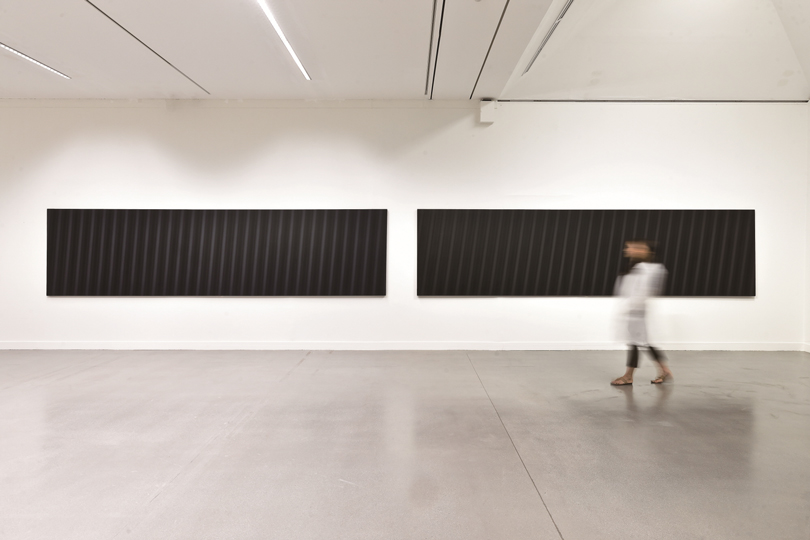
Photo by Jung wook Hwang , Image Courtesy of Art in Culture
Seeking the essence of painting through blending
While this was happening, Lee was also continuing to accompany the Monochrome school on its journey from the mid-1970s through the 1980s. Welcomed since the 1970s as an indigenous aesthetic in Korean art, the Monochrome trend aspired toward a primal returning of art, an overcoming of artificiality through repeated actions of nonaction and a return to artistic basics to achieve a pure art in which “nothing is painted.” Its practitioners sought to achieve a spiritual space where (in the words of Oh Kwang-su) “only a clearly faded transparent consciousness floats”—pursuing this through two-dimensionality as spiritual space, through white and monochrome coloring, through abandonment of form and illusion, and through repetition and material qualities. The context behind Lee Seung Jio’s 〈Nucleus〉 series being understood as part of the Monochrome movement, despite never abandoning its sense of form, can be found in the two-dimensionality acquired by the series during the early 1970s and its transformation toward a subtle achromatism. Lying in a horizontal position, his pipes emanate a sense of vibration as they ripple serenely; in addition to the perspective of “artistic language’s transition toward an internal language” (in the words of Shin Hang-seop) in terms of what is perceived, observers also saw the inherent spirituality of the East and a sense of transcendent communion with the invisible world. Such multifaceted interpretations of Lee’s 〈Nucleus〉 series stem from the fact that the mixture of approaches in the Korean art world of the early to mid-1970s—Western conceptual art, phenomenology, Korean Monochrome, and so forth—shared a common orientation in terms of art’s embodiment of autonomy in the spiritual, internal, and invisible worlds.
With his pipe shapes, Lee Seung Jio created the emergent artistic world that is the 〈Nucleus〉 series, passing through the aesthetics of eras running from the late 1960s through the 1980s. As a standard-bearer for avant-garde consciousness, he contributed a solid pillar to Korean abstract painting with his achievement of a model of optical geometric abstraction; with his creation of spatial structures blending characteristics of conceptual art, phenomenology, and Monochrome, he broadened the scope of the “essence and proper realm of painting” in terms of the act of seeing, realizing a major contribution to the creation of Korean modernism as exemplified by abstract painting. Thirty years after his death, Lee is now reaching the viewers of a new day through the pipes that served as reflections of himself. As if no time has passed at all, his work is taking flight in the contemporary era, stirring up the vibrations of a powerful communion once again. It is as though the artist’s soul has made the choice to live forever.
This piece is a revised version of the author’s doctoral dissertation 「Lee Seung Jio’s Nucleus Series: The Multifaceted Nature of Geometric Abstraction」 (Hongik University Department of Art History, 2018). Reference to previous research and quotes have been removed from the original. Readers may consult the dissertation text for more detailed information.
※ This article was originally published on the SEP 2020 issue ofArt In Culture and is provided by the Korea Art Management Service under a content provision agreement with the magazine.

Choi Jeong Ju
Director of Jeju Museum of Art
-

-
 Critic / People - 11 Dec 2017
Koo Jeong A: Stories of an Ambiguous World Transforming

