
GWON Doyeon has been photographing dogs that have become wild in the Bukhansan area in the last 2 years. The resulting work is neither news photos that shed light on dogs that live there as a social issue, nor scientific photographs that register and measure each dog to establish knowledge about wild dogs. This may sound strange, but the images seem like very carefully captured portraits of the dogs. However, the name the artist has given to these photographs is just Bukhansan. All photographs were in fact taken in Bukhansan, so the dogs stand with the mountain in the background. In some of the photographs, only the mountains are visible without the dogs.
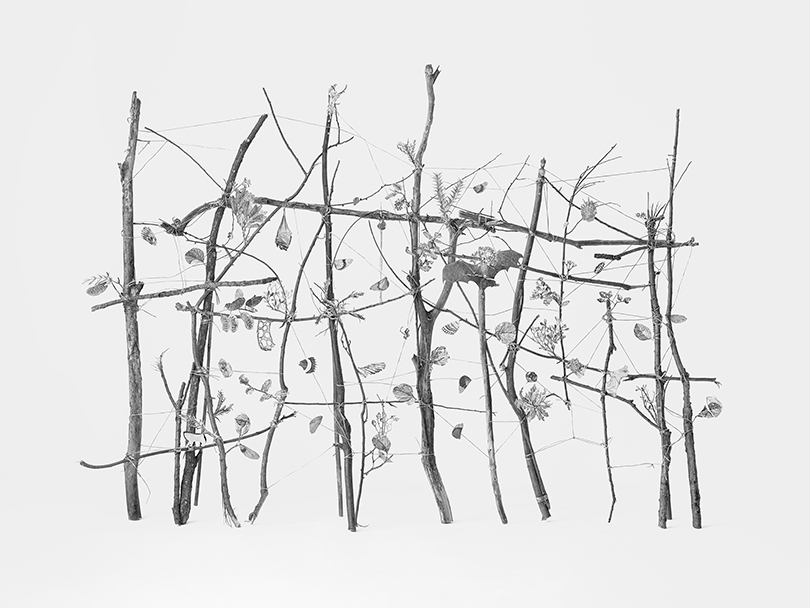
〈Flashbulb Memory #Bean sprouts 1〉, Pigment print, 105×140cm, 2019. Image provided by Incheon Art Platform.
These dogs, however, do not belong in Bukhansan. Obviously, they did not originally live in the mountains. They are dogs that became wild because they were abandoned due to the redevelopment of the surrounding areas in the last few years. Classified as an exotic species which threatens mountain hikers and the natural ecology, most of them have been euthanized after being seized. It’s difficult to actually come across the remaining dogs because they avoid human. Some regard these dogs as a subject of fear akin to wolves, while others may sympathize with them, regarding them as dogs raised domestically. However, these dogs are different from completely wild animals featured in the National Geographic channel, and also dissimilar from the totally tame pets shown on Pet TV channels.
They stand neither in nature nor culture, but somewhere the two realms are hybridized and managed, and this reflects Bukhansan National Park itself as a place. Although it’s a deep mountain, it’s close to the city center, drawing approximately 10 million visitors a year. This means that as many people as the entire population of Seoul visits Bukhansan in a year. If there’s a problem in the natural ecology in Bukahsan, humans would be more of a threatening exotic species than the wild dogs. However, we silently convince ourselves that we’re the masters of nature, and look at Bukhansan as our backyard. And this makes the wild dogs a subject of contempt and elimination from our backyard. The artist began his field research of Bukhansan near his home like a naturalist exploring nature. Through his encounter with the wild dogs, however, he rediscovered this place as an ironic site with a history of heterogenous inter-species exchanges wherein humans and dogs confront each other as threatening exotic species.
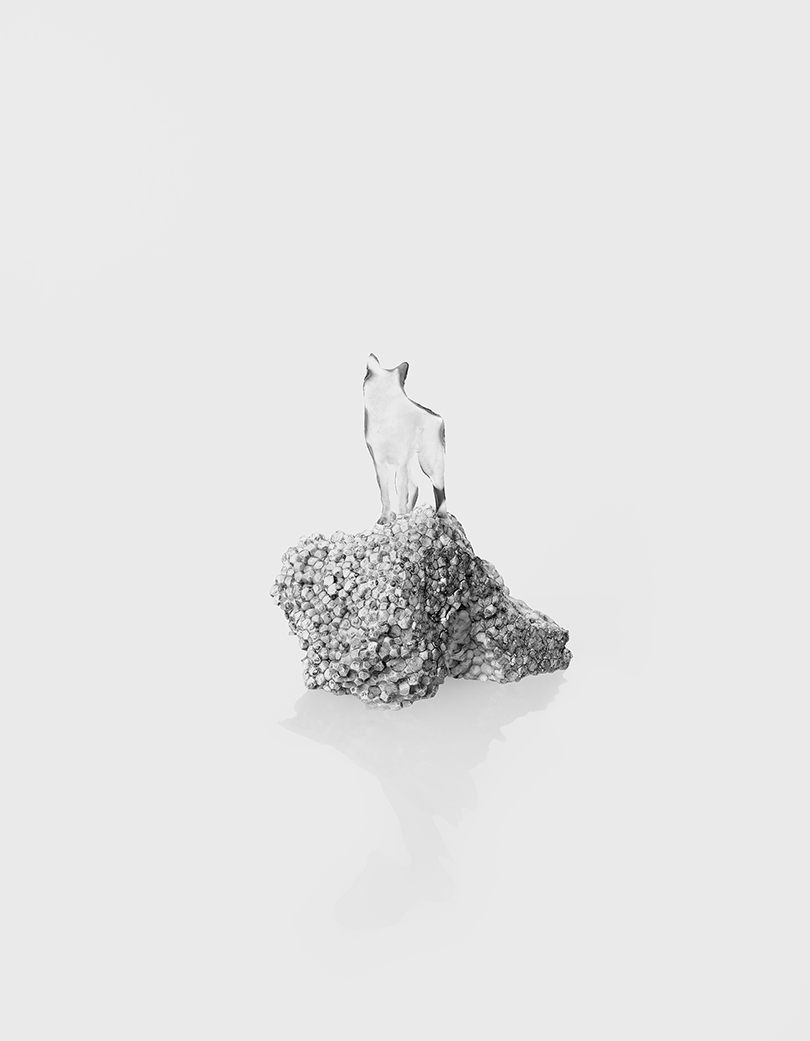
〈Flashbulb Memory #Bean sprouts 2〉, Pigment print, 90×70cm, 2019. Image provided by Incheon Art Platform.
In the same way that dogs are not welcomed in Bukhansan, a terrain marked by humans, humans are not welcomed in Bukhansan, also a terrain marked by dogs. However, as difficult as it is to exterminate the dogs from this mountain, it’s just as unrealistic to prohibit humans from entering it. Like a mirror image of each other, human and dogs have been treading upon the mountain of old boulders, slightly changing what its landscape signifies.
While the artist doesn’t directly expose himself in the photographs, they document the artist’s movement and time taken to roam around in the mountains in search of the dogs. The dogs sometimes appear and sometimes do not appear in front of the camera. The artist continuously climbs the mountain, recording the places where the dogs are sighted, and waits for them to appear in order to grasp their route. As strange as this may sound, it seems as though all photographs were taken with the permission from the dogs. In other words, the dogs in the photographs tolerate the fact that the artist is nearby, although they may not be looking directly at the camera. Such images are established not on the premise of a restored intimate relationship between humans and dogs, but due to a level of distance maintained between dogs and humans, where the two exotic species no longer consider each other predator and prey nor servant and master. In photographing the dogs, there must have been moments when they showed feelings of hostility or friendliness to the artist in front of the camera. If he were trying to make a documentary film, such scenes would have been proactively used as a means to stir up theatrical tension or magical empathy from the audience.
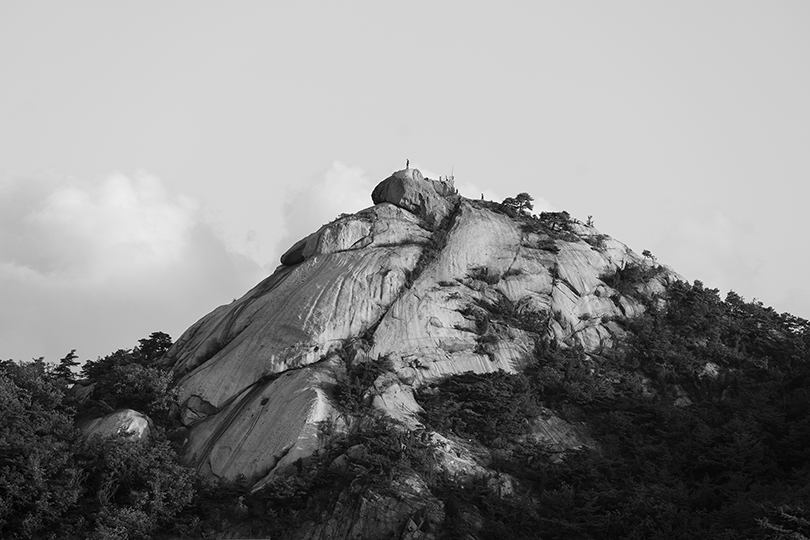
〈Bukhansan #2〉, Pigment print, 90×135cm, 2019. Image provided by Incheon Art Platform.
However, the artist chooses not to reveal the complicated situation these dogs find themselves in, nor all of their diverse expressions. Rather, he takes portraits of the dogs, like a very classic portrait photograph that are different from selfies that follow regulations of reality shows, or ID photos that abide to bureaucratic standards.
The portrait is a very old form of image, which neither belongs to a certain medium, nor is limited strictly to the art field. The Roman naturalist Plinius asserted that the very first image shaped by man was his very own image. It’s said that the origin of painting comes from the potter Dibutades’ work, in which his daughter Kora drew the face of her lover and Dibutades quickly filled the portrait with his clay, fired it and preserved it. There’s a will to visually seize a certain entity, and the desires to replicate and perpetuate the essential aspect of that entity to devise not only a replica of the original but its substitute. The image is driven by a slightly different passion from the perspective or photographic landscape, which attempts to optically capture the accidental arrangement in time in an accurate way.
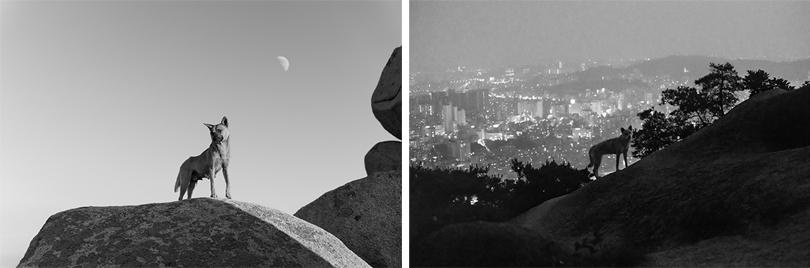
LEFT〈Bukhansan #13〉,Pigment print, 90×135cm, 2019. RIGHT〈Bukhansan #15〉, Pigment print, 90×135cm, 2019. Image provided by Incheon Art Platform.
The landscape is a relatively new form of image. The methodology of observing everything in view as a single entirety, rather than determining and focusing on the important and meaningful subject, is known as a way of seeing which only emerged in the modern time. The indiscriminate and indifferent gaze of mechanical optical devices, from mirrors, lenses and camera obscura to cameras, was one of the main passages through which the landscape was discovered. While the human eye has continued to resemble such mechanical eye on one hand, it hasn’t ceased forming relationships with and endowing meaning upon the mechanicallyproduced image. In other words, we continuously see the portrait of something we wish to see in the landscape. It may be ourselves, the artist, something sacred or sacrilegious that cannot be personified.
Or it may just be the portrait of a dog. The artist attempts to find a proper distance where the images of dogs are not excessively personified to look too human, or inversely, overtly naturalized into something irrelevant to human, because these dogs in fact do not belong to either side. The dogs that stand in the backdrop of the rugged mountain transform a familiar landscape in an unexpected manner. Once seeing them, one begins to look at the mountain in a new and different meaning, such as being a mountain where dogs hide and live somewhere, or a mountain where such dogs are seized one by one and are eliminated. In such way, the dogs infiltrate the eyes of the audience, making slightly different whatever that’s reflected off them.
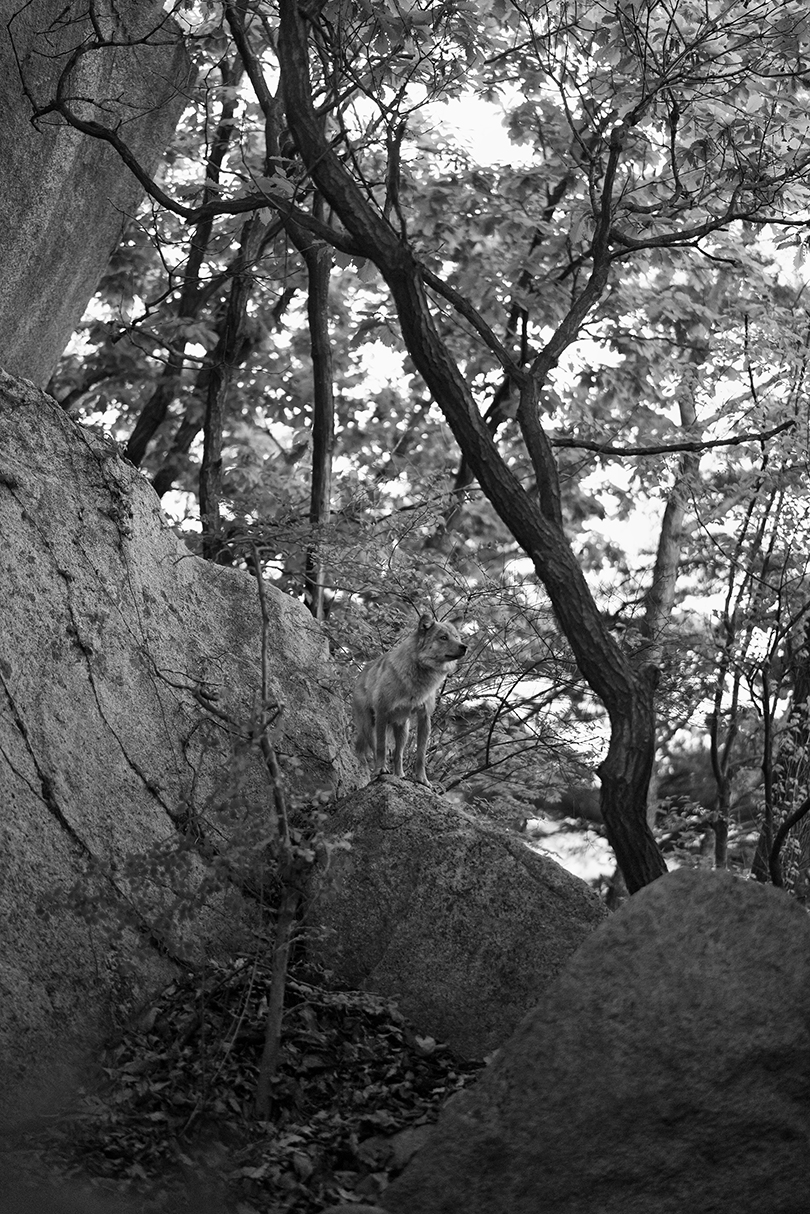
〈Bukhansan #19〉, Pigment print, 90×135cm, 2019. Image provided by Incheon Art Platform.
The artist mentioned that the photographs of these dogs could infiltrate the internet image database permanently. He imagines their images sneaking in between other images, just like how the dogs have penetrated the mountains, and pop on the screen among other images of Bukhansan, sometimes with mountain climbers, or hunters, or with bullfrogs, when some random user searches for ordinary dogs or stray dogs on the internet. It’s not likely to expect such insignificant and heterogenous existence can have any effect on the panorama of digital images. But if they do infiltrate the online space, they would hover in a state of semi-permanent purgatory, neither completely forgotten nor perfectly remembered along with countless other images. Whether that’ a blessing or a curse, these dogs would become our neighbors that way.
※ This content was first published in 『2019 Incheon Art Platform Residency Program Cataloge』, and re-published here with the consent of Incheon Art Platform

Yoon Wonhwa
YOON Wonhwa is a visual culture researcher. She has written Picture Window Mirror: Photographs in art exhibitions (Vostok Press, 2018), 1002th Night: Art in Seoul in the 2010’ (Workroom Press, 2016), and has translated Optical Media: Berliner Vorlesung 1999 (Hyunsilbook, 2011) and Discourse Networks, 1800/1900 (Munhakdongne, 2015). She co-curated Human Scale (Ilmin Museum of Art, 2014), and co-produced Soft Places at the 2018 Seoul Mediacity Biennale.
-

-
 Critic / People - 11 Dec 2017
Koo Jeong A: Stories of an Ambiguous World Transforming

