People / Critic
Yun Sungfeel - But Now I Am Not So Sure I Believe in Beginnings and Endings The title “But Now I Am Not So Sure I Believe in Beginnings and Endings” 1)
posted 29 Dec 2021
“The heptapods are neither free nor bound as we understand those concepts; they don't act according to their will, nor are they helpless automatons. What distinguishes the heptapods’ mode of awareness is not just that their actions coincide with history’s events; it is also that their motives coincide with history’s purposes. They act to create the future, to enact chronology.”2)
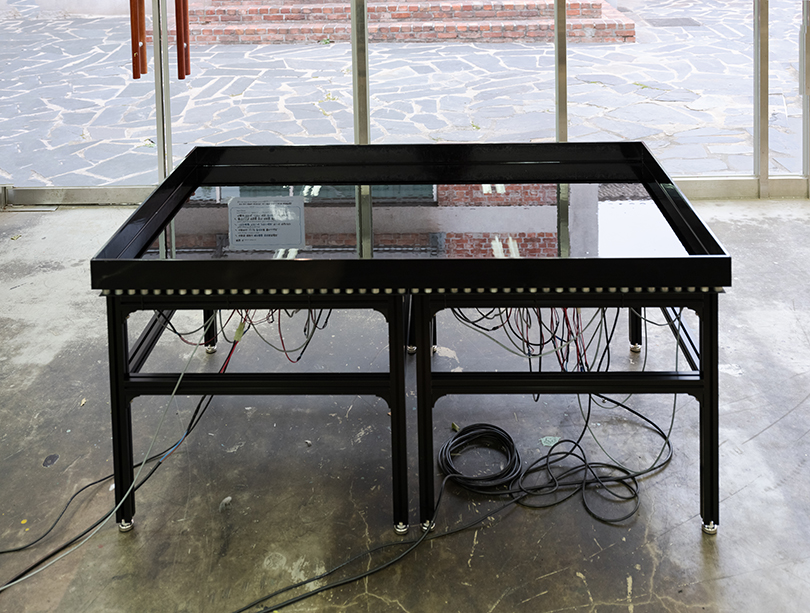
〈Liquid Sculpture Project〉, Electro magnets, liquid magnet, aluminium profiles, action sensor, control box, 170×98×75cm, 2019. Image provided by Incheon Art Platform.
Heptapods, the extraterrestrial species with 7 tentacles, appear in 〈Arrival〉, a film based on the novel 『Story about your life』 by Ted Chiang. The linguist Louise, hired to reach out to them, experience gradual changes in his way of thinking as he communicates with them. There is the past, present and future in the heptapod language. The human language is linear, while theirs is nonlinear.
In their study of the Hopi language where time tense is unclear, as opposed to the European language where time distinction is clear, linguists Edward Sapir and Benjamin Whorf asserted that “language affects how humans think.” Like this ‘Sapir-Whorf hypothesis’ Louise comes to see the past and the future simultaneously as he continues his encounters with the heptapods. The first question that humans threw at the ‘heptapods’ was “why are you here?” Louise shows the heptapods the word ‘Human’ in order to make them aware of the human presence, and the heptapods befriend Louise once aware of his name as opposed to knowing him as just ‘Human’ and they come to recognize the individuality of human.
As Louise becomes aware of the nonlinear time, he sees his future, and realizes that the individual’s life returns to its origin, and that the individual is thrown into this invisible order. Louise says that “Although I know the outcome, and how things will turn out, I will embrace it all…", and that “But now I am not so sure I believe in beginnings and endings” The heptapods’ way of thinking, which cast us a ‘big question’ is to some degree related to the artist’s exploration of the ‘macroscopic rule’ or the notion that ‘the universe is one unit and everything is connected’.
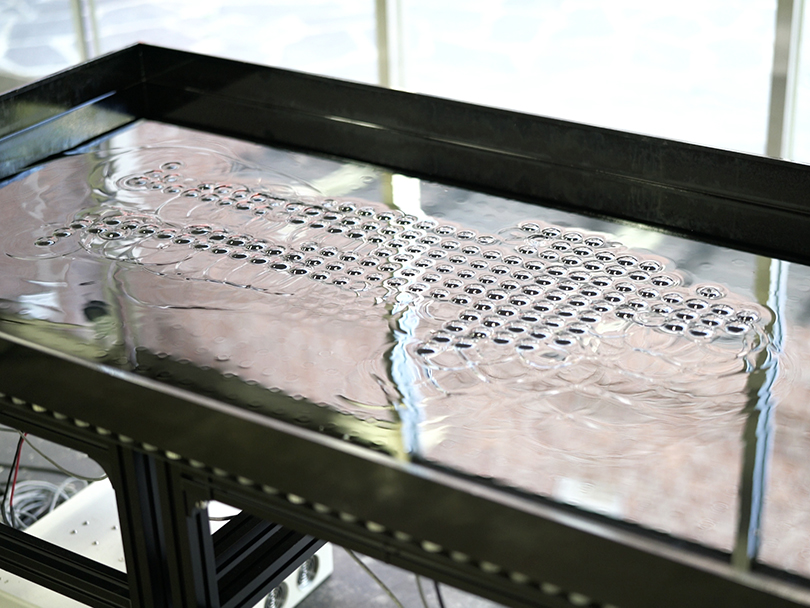
〈Liquid Sculpture Project〉, Electro magnets, liquid magnet, aluminium profiles, action sensor, control box, 170×98×75cm, 2019. Image provided by Incheon Art Platform.
Held at the Warehouse Gallery in Incheon Art Platform, Irrational Recognition (2019) was part of the Incheon Art Platform Project Support Program in 2019. YUN Sungfeel has been showing his vision of the universe and the world through his works in sculpture, installation, kinetic art and painting, etc. The series of works in Irrational Recognition also shows a transition from a macroscopic point of view of the universe and the world, to a microscopic point of view of the specific individual. He added the subtitle Jatabuli (Based on Chinese characters; meaning ‘the self and other are not two’) to Irrational Recognition, visually expressing through the photographic medium that the self and other are not two separate beings. He said that the concept of Jatabuli is a subject of life for the artist. The overlapping of silkscreen on gelatin silver print signifies the idea beyond ‘circulation’, to visualizing Jatabuli, as the process of overlapping, entangling and merging demonstrates the relationship between the self and the other for him. The artist uses various portrait photographs to present mixtures of himself and others. For instance, a black and white printed image is bleached, and an image of another figure is overlapped on silkscreen. As such, silver particles of the object become the background over which the image of another subject is realized, piling up in a double structure, as if to fulfill a sculptural concept without creating a traditional sculpture.
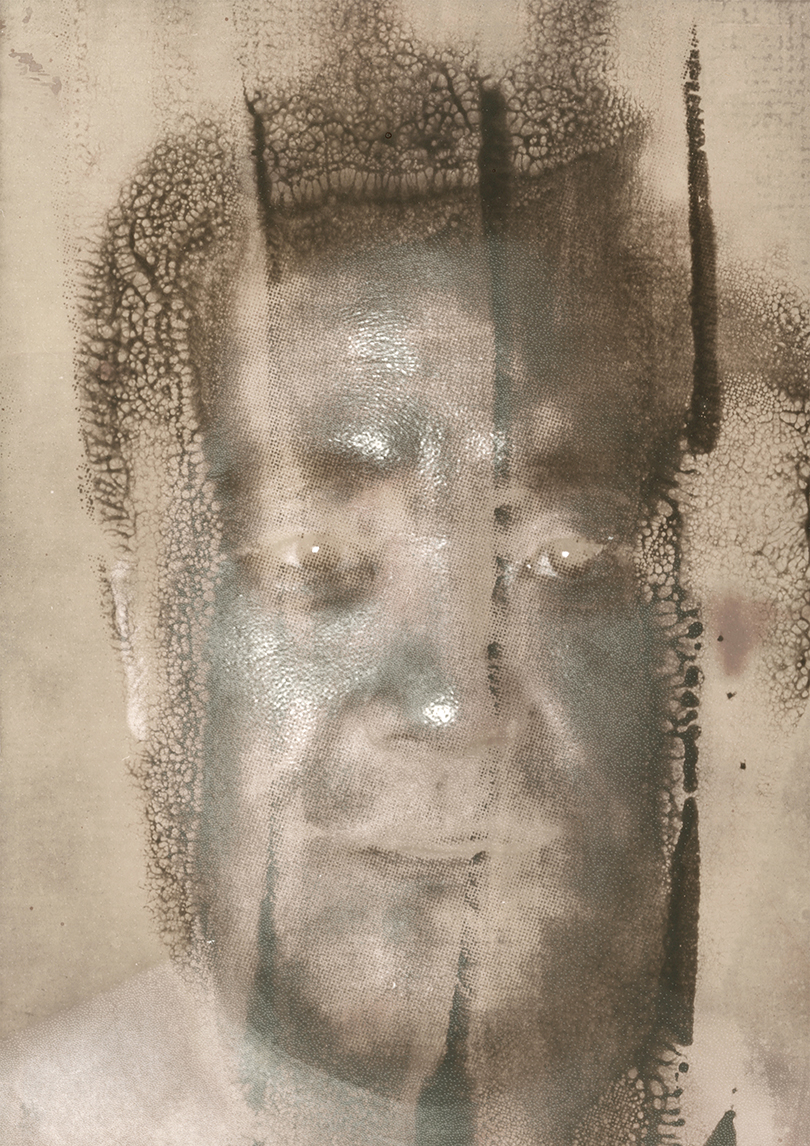
〈Irrational Recognition SG-03〉, Gelatin silver print, silk screen, 17.8×12.7cm, 2019. Image provided by Incheon Art Platform.
The artist’s recent photographic works are on the same trajectory as his previous work Movement in Stillness (2006) series and Chaos, Cosmos and Circulation (2012), which are flat works produced with iron shavings and magnet. In all things, there is movement and set rules, and the starting point of it all is also the principle of the universe. While he focuses on philosophy and physics, his constant interest has always been quantum mechanics. Iron shavings and magnets are applied in his flat series Chaos, Cosmos and Circulation, where a magnet makes circles on the backside of the canvas, and traces of iron shavings following the magnetic force are left on the front side of the canvas. After two hours of rotation, the path of iron shavings is left in a circle on the canvas creating a painting of iron shaving. The idea that ‘everything circulates’ in his work is usually expressed through curved lines and circles. The artist said “Everything moves. I realized that everything circulates, and I saw this as a sphere of reincarnation that circled the universe.” In order to visually express movement, the sensor in the work would be triggered when the audience stands in front of the work, sending the magnet behind the work to rotate around a focus.
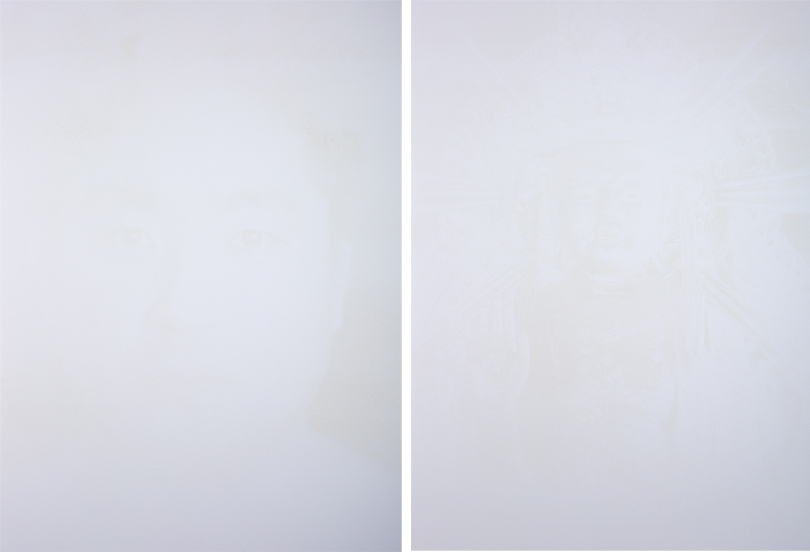
LEFT 〈Irrational Recognition WG-01〉, Gelatin silver Print, 117×85cm, 2019 RIGHT 〈Irrational Recognition WG-02〉, Gelatin silver Print, 117×85cm, 2019. Image provided by Incheon Art Platform.
Irrational Recognition shows figure portraits, and it’s the first work wherein ‘imagination about order’ is pictured through the human figure. It looks like the self-portrait of the artist, but the figure under the overlapping is not him. It’ his own face overlapped on a face the artist randomly searched out on the internet, but we can see that it’ the face of the artist. (Irrational Recognition SG-03). In Irrational Recognition BS-01, which overlaps the faces of figures taken from the internet, the individuality of the figures is lost, leaving us with simple information that it’ ‘human face’. The face of a Buddha is shown in Irrational Recognition WG-02, or the so-called ‘hite portrait’ wherein the image in the seemingly empty space is visible only when seen from the side.
“The expression “Irrational Recognition” signifies the presence of information despite the visual absence, like the ‘white portrait’ series. It means to ‘Recognize the invisible. What’s invisible exists. Recognize it.'"
The Irrational Recognition BS-01 and Irrational Recognition BS-02 are compilations of the photographs of two foreigners found on the internet. When black darkness printed as a photograph is bleached, it becomes white. If it’ coated with restorative, an image of a figure emerges, while when the other image is silkscreened, another image appears like a relief. He depicts death through the black portrait image which reminds one of a death mask, and claims that since he was young, the world ‘after death’ has always frightened him more than ‘death’itself. He went on further, saying that “I think death makes one a being of infinite possibility and offers the most liberating moment. It means separation from the molecules and atoms that make up my body. I think of it as a set route.” The ‘black portrait’ tried to show a type of destroyed order, as the artist thinks of the meaning of death as a “state of being destroyed of a set of orders. ‘Dying’ is also a rule. It’ a state of circulation. The order of circulation also involves chaos. It’s also the state before the recombination of order, and an element in the ring of circulation. Darkness is a state of total liberation to acquire order.” Reflecting this, the ‘black portrait’ captures such state of liberation.
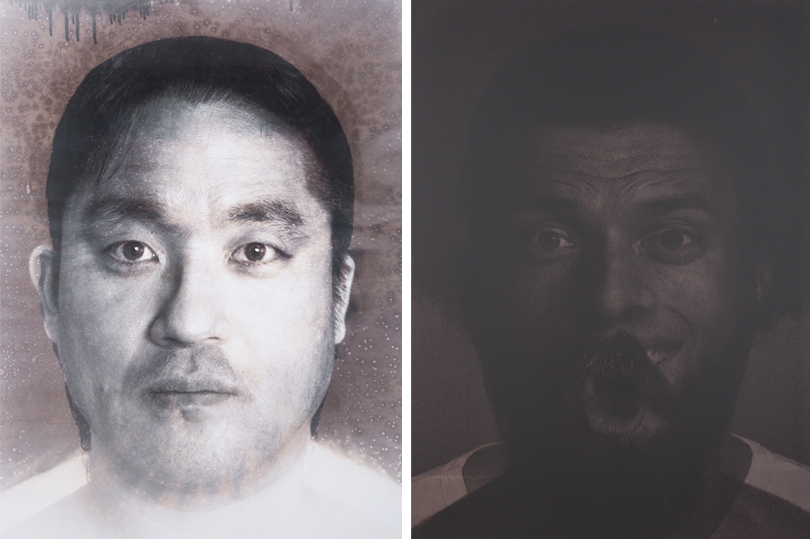
LEFT 〈Irrational recognition SG-06〉, Gelatin silver print, silk screen, 114×85cm, 2019 RIGHT 〈Irrational recognition BG-02〉, Gelatin silver print, silk screen, 114×85cm, 2019. Image provided by Incheon Art Platform.
At the time of the World Expo 1851, the photograph was able to ‘capture’ space-time with ‘precision’. The instantaneity became a subject of inquiry for the next twenty years, and people also began to study the ‘eproducibility’for the popularization of the photographic image. The artist’s portraits recall the experimentations that began when the early photograph was invented, such as Joseph Nicéphore Niepce (1765–833)’s photograph of a natural scene, called ‘points de vue’, captured through a makeshift camera obscura. He reminds the audience of such inventors of early photography and their battle with the image through photography. His photographs are not so much reproduced representation, but more of an image of fantasy and imagination, and an idea in that they reveal the inner image. The origin of the word ‘idea’comes from ‘idein’ which means to ‘see’. Through the illusory image that lets us see what we see, the artist aspires to capture the invisible inner gaze of ‘awareness’.
In fact, the figures used as the subject in his 'white portrait' and ‘black portrait’ are not important. The face was just used as a subject through which the changes can be detected. What’s important is that, whether the subject is himself, Buddha or an anonymous figure, they all become the same state once the image is bleached. When the image is faded, we don’t know what that figure is. The revealed image is a manifestation of our visualization and endowment of meaning; as a ‘human’, they’re all the same existence, just as how the heptapods perceived ‘human’ in the film 〈Arrival〉.
1)The title “But Now I Am Not So Sure I Believe in Beginnings and Endings” is a line by the main character ‘Louise’ in the film 〈Arrival〉 (2016) directed by Denis Villeneuve.
2)Chang, Ted.『Story about your life』 , trans. KIM Sanghoon (Elly, 2016), p. 208
※ This content was first published in 『2019 Incheon Art Platform Residency Program Cataloge』, and re-published here with the consent of Incheon Art Platform

Cheon Surim
Cheon Surim is the editor of the monthly magazine Photo Art. She was the program director of the 2017-2018 Seoul Photo Festival (Buk-Seoul Museum of Art), and is currently the director of the Curatorial Collective 'MELTINGPOT'.
-

-
 Critic / People - 11 Dec 2017
Koo Jeong A: Stories of an Ambiguous World Transforming

