
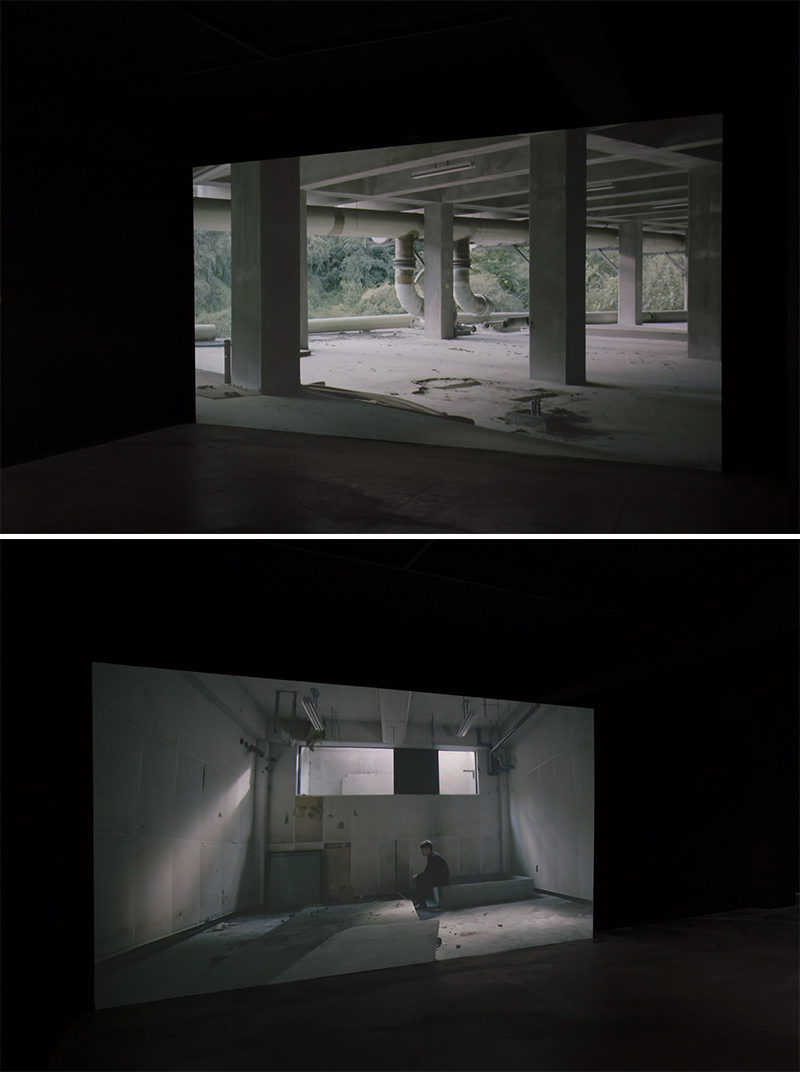
No One is There (2019), HD single-channel video, sound, 23min 25sec. Image provided by Incheon Art Platform.
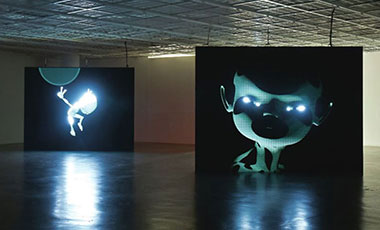
Visualizing senses is no easy task. Since sight is one of several senses that of equally distinct merits, such as touch, hearing, taste, smell, and synesthesia, it is nearly impossible to perfectly transition these senses into visual images. Nevertheless, recalling and summoning past experiences and the memories of them provide a way to activate other senses through sight. Even when we are not touching, tasting, smelling, or moving our bodies, what strikes the eyes could rekindle our senses. In this sense, Park Jihye’s video becomes a medium that allows one to sense a time that is other than the present by recording what she has seen, heard, and sensed. Such was the case with a Single-channel HD video, No One Is There (2019), presented at her previous show Space Willing N Dealing in 2019. The main subject for this video work was what used to be a sewage treatment plant, which is now closed and left unattended. The footage was imbued with visual and auditory devices that let you sense the various textures of the building’s walls, the movement of the wind, and the smell of the space, which you would have encountered in the space that is disconnected from everyday life and no longer functional. Led by the characters (ghosts) roaming about the space, the camera’s gazes scans through space, delivering the wind and the sound of the building’s surface and space, as well as the smell that has been accumulating for a while. A part of the video shows a man and a woman dancing the Waltz in an ambiguous and black vacuum-like space. There is an evident tension between as seen the close-up shots body parts in contact and the backdrop of their movement. At the same time, their Waltz is a symbolic gesture that keeps the physical and invisible spaces in balance. It contributes to the work by opening up this psychological space to the senses.
In 2020, Park Jihye participated in the Incheon Art Platform Residency Program. She explored the Dongil Textile building located in a neighborhood nearby the residence. This factory area was surrounded by a series of walls long enough to envelop the whole block. The building sat as it was built at a site that served as a remnant of the period of the industrialization era of the 1970s. The artist asked the company to navigate the inside of the building and archive the traces of time to be found, but permission to enter was denied. In the past, the factory, imbued with historical events, had been open for artists who were looking to collect its stories in independent films or documentaries. However, it no longer opened its door to outsiders. Prevented from entering, PARK nevertheless filmed the entire wall. She attempted to grapple with the skin that witnessed the time that must have been, along with researching various resources and following visible leads from the outside of the building. PARK’s distinct method of ‘recalling’ was applied in the beings inside that could not be proven directly anymore. Furthermore, the approach was aimed to transfer what was found into basic and tactile senses.
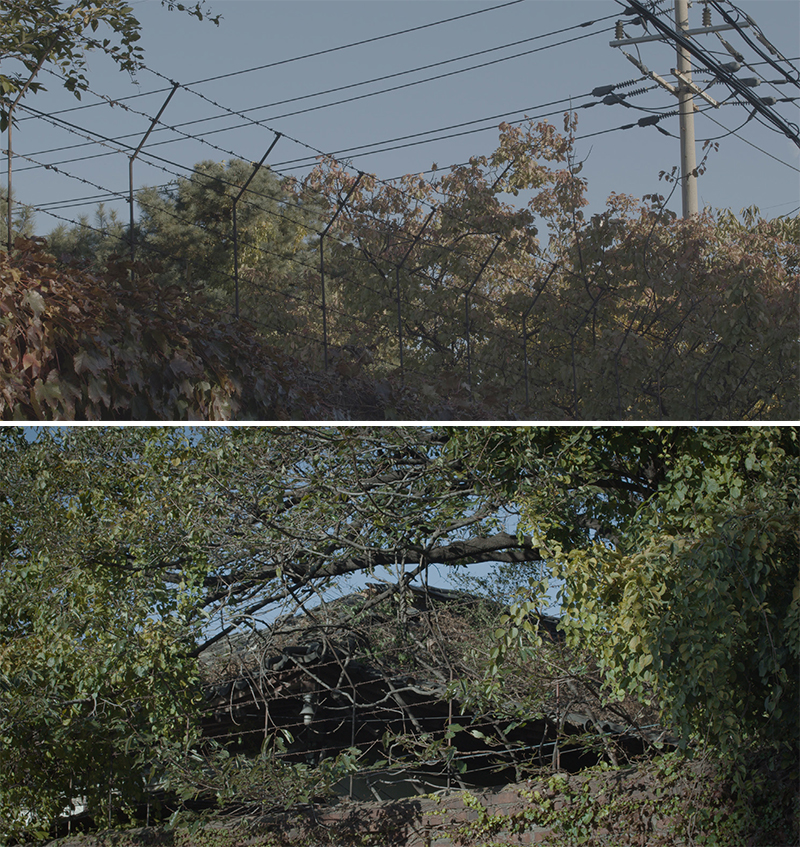
The Shadow (2021), 4K single-channel video, sound, 9min 58sec. Image provided by Incheon Art Platform.
As before, Park Jihye visualizes the texture of the surface by delicately filming the solid and rough surface of the wall. Her lens captures one surrounding wall and the landscape over the wall. At the same time, the artist collected, edited, and played the sound of the wind, birds, and occasional noise from the inside to spark the audience’s hearing. The narration by the woman runs through the video. It is a reorganized excerpt from Samuel BECKETT (1906–1989)’s The Unnamable (1953). The artist made two versions of this work. One of the outcomes deals with three elements evenly: image, sound, and text. A single object, the wall, is filmed to be fragmented and recombined. The completed work is based on the method of collage, which is also applied when dealing with the text. A selection of sentences from the book were weaved according to the artist’s choice and reproduced into a poem-like text. The phrases that are recited are arranged as subtitles on the video. Another version sequentially shows the scenes of the wall while time follows a linear order. Excerpts engage with the video, as in the other version, in a discontinuous manner with the narration. It seems that Park is experimenting with the combination of a linear enumeration of images and nonlinear text to generate different effects and emotions.
Samuel BECKETT, the author of the novel The Unnamable, which Park Jihye introduces in her video, is a well-known writer of the theater of the absurd. His writings sometimes repeat themselves without a beginning or an end, only to dissipate in vain. In this novel, the protagonist, with only the torso and with his arms and legs cut off, reminds himself of what he had encountered with his own eyes in order to define himself. However, sooner or later, he is caught doubting what he thinks he knows and ends up denying the reality of his existence, perceptions, and senses. Consequently, himself destructively defines himself and loses his subjectivity without a sense of his own existence. The protagonist’s attempt to define himself is similar to the method of recalling the past in Park Jihye’s video work. The narration begins with questions: “Where is now? When is now? Who is now?” It looks back upon the past, speaking for the confusion of the present that examines what we consider to be traces. We might believe that traces of the past deliver the information of existence, but in fact, anything other than the facts in front of you is bound to embody uncertainty, which is closer to hypothesis than conviction. The hesitation sometimes collides with the outside that seeks to erase or conceal the historical fact. Therefore, it also reminds us that the idea that Samuel BECKETT’s text invokes different senses, time and space, unlike the present through only sight and hearing is proven absurd. Nevertheless, Park Jihye’s video constantly offers clues, including archival records, footage, and images of Dongil Textile she has accumulated so far. The images before our eyes present the existence of Dongil Textile, confirming its being through the events and records of them from the past. They cling to the present time recorded by the artist or the backdrop configured with the wall and gardening, suggesting how the ‘then’ is reminded within the present time. Accordingly, Dongil Textile’s wall holds together the tension between the inside and the outside.
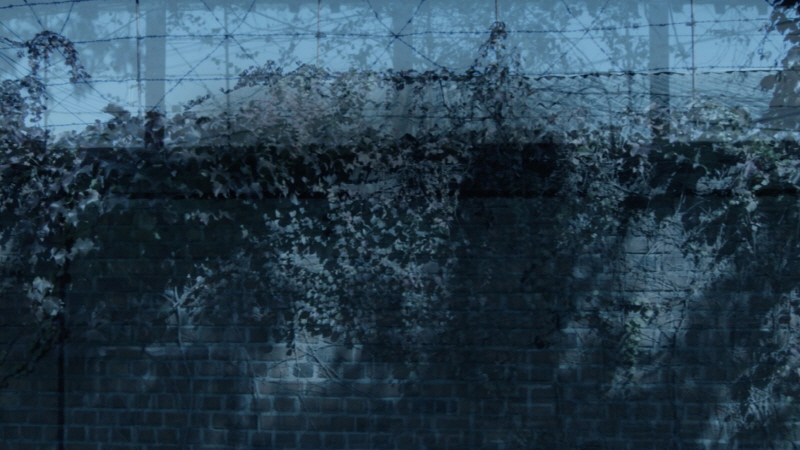
The Wall without a Name (2021), 4K single-channel video, sound, 12min 9sec. Image provided by Incheon Art Platform.
The wall in Park Jihye’s video work is no longer a solid barrier that forbids access. As countless images are superimposed and various sounds are added, the boundaries of the wall and the temporal division of the past and the present are gradually broken down. Before you know it, the space filmed by the artist is transformed into an invisible landscape. Events are reproduced as a certain type of image, but they are also erased repeatedly, while the sound creates an accidental medium among the mixed images or an atypical narrative as irrelevant collages. This means that documentary elements that indicate a specific place and time function as a medium of stimulus that embodies invisible and psychological tension, or appear as a mass of senses. Here, we look into the unique sensibility of the medium of video. It is not only a useful device that brings multiple pasts to the present to visualize sensations, but also makes it possible to confirm that it is eliciting another interesting phenomenon rather than confirming its substance. Like the last part of Samuel BECKETT’s words appropriated by Park, it may be that something will “slowly begin(*)” between reality and unreality.
(*) ...
And so the voice will
Or the story will, as if there is no problem
as if I am the problem, begin so slowly that it is not noticed.
From the narration of Samuel BECKETT’s
The Unnamable (1953)
※ This content was first published in 『2020 Incheon Art Platform Residency Program Catalogue』, and re-published here with the consent of Incheon Art Platform

In-sun Kim
KIM In-sun graduated from Ewha Womans University with a major in sculpture and received her master’s degree in Art History from Pratt Institute, New York. She worked as a curator at Alternative Space LOOP (1999), coordinator at Gwangju Biennale (2002) and Busan Biennale (2000) where she also worked as curator (2006) and producer (2012). And she worked as artistic director at Jeju Biennale(2020). Also, she has been Vice-Director of Kukje Gallery (2003–2004), Executive Secretary at Anyang Public Art Project (2005), Chief Curator at Daelim Museum (2006–2007), and Director of Interalia Art Company (2007–2009). Currently, she runs an art space called Space Willing N Dealing, introducing Korean artists while organizing exhibitions domestically and internationally.
-

-
 Critic / People - 11 Dec 2017
Koo Jeong A: Stories of an Ambiguous World Transforming

