
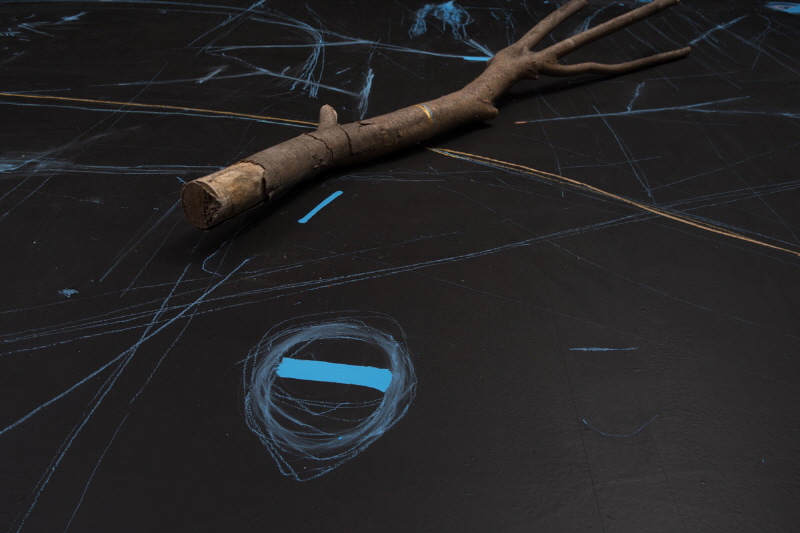
JWY.D.003.19 (detail), 2019, paint, oil pastel, medium, chalk, wood on vinyl sheet, variable dimensions.
Vocal étude, 2019, voice performing by Jiwon Yang, looped sound (5min 4sec.)
Image provided by Incheon Art Platform.
Seeds · small flowers · dry branches and stems · pebbles · traces of paint and prints · handwriting on paper in inkstick. These are the things laid out in YANG Jiwon’s space In an abstract form, they become dots · lines · matière · transformation · beings · gesture · leading subject · emotions · language, and letters. At a glance, they seem to be a combination of unrelated things. However, they, as a whole, act as letters and invoke ideas beyond meaning, sound, and feeling.
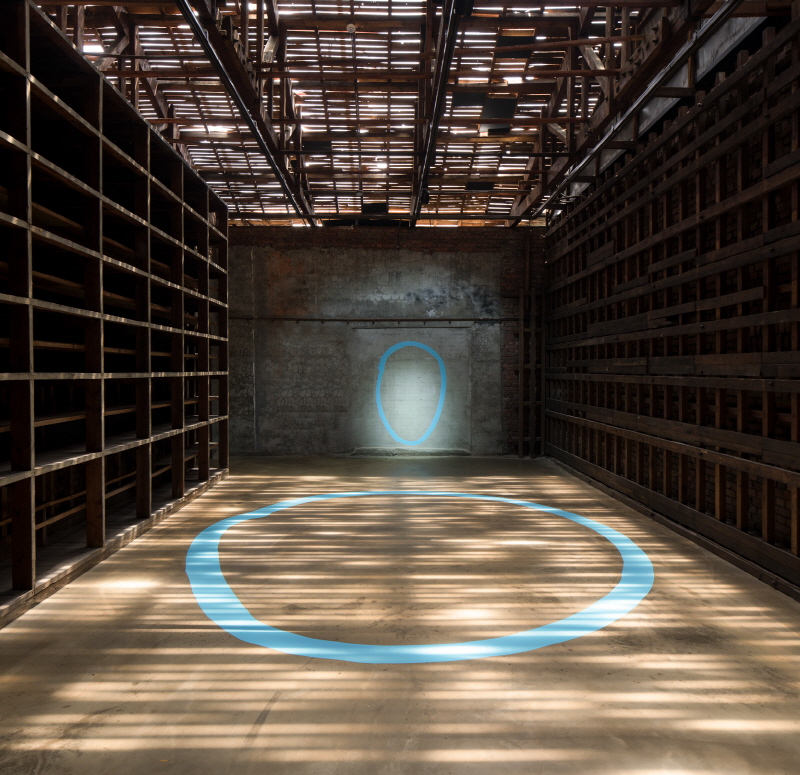
JWY.D.001.19 (floor), JWY.D.002.19 (wall), 2019, vinyl sheet, variable dimensions
Exhibition view of Moeum (SeMA Storage, Seoul, 2019)
Image provided by Incheon Art Platform.
Um · Am ·
A dot.
Seeds. Life is curled up in the dot of a seed. Though it looks dead, there is a potential life, compressed to a dot for the moment. The dot is not a geometric element. Rather, it is a physical point with texture and matter, and a biological point that embodies the complexities of the vital phenomenon.
Stones. A stone is bigger than a seed. In contrast to a dot, it is uneven and rough circle. The artist collects stones. Stones are not organisms, but she feels sorry for picking them up. Left untouched, the stones would have stayed where they were and experienced the changes of their surroundings, of the world. Time wears down the stones, changes them, making them look as if the stones had gone through vital life cycles. The bristly surface of the stone reminds one of an organism’s surface texture that became prickly towards the end of its life. For instance, the skin of the stem that once held grapes. Plants distorted as the moisture evaporated. The human body’s skin that ages like an old tree. All these textures, again, resembles the seed. Like the threshold of life and death, it is moist and dry at the same time. The artist’s concrete poem, “움툼 (pronounced in English as umm toom)” is a play on the Korean word for sprouting buds and the similarity in sound to the words, womb and tomb in English.
On the other hand, the unique matière of the mixed media, especially with sand in her art installation, is an abrupt assemblage of dots. Seemingly, it is like sounds thrown out and mingled, without a systematic order or syntax and morphology. In a sense, the ground evokes the dust of the primordial universe. A state where phonemes, the minimum unit of sounds, are just murmurings and mumbled up like static noise. A state prior to grammar and meaning without order or system within the words. This world of primitive sound prevails no hierarchy.
Dots and circles stand out from YANG’s drawing-character. Circles convey round sounds produced by the breath that came out of the vocal organs’ cross-section. The Umlaut (ö), frequently presented in her works, as befits its identity as a vowel mutation, is a journey and outcome of the change in sound where ‘o’ meets ‘e’.
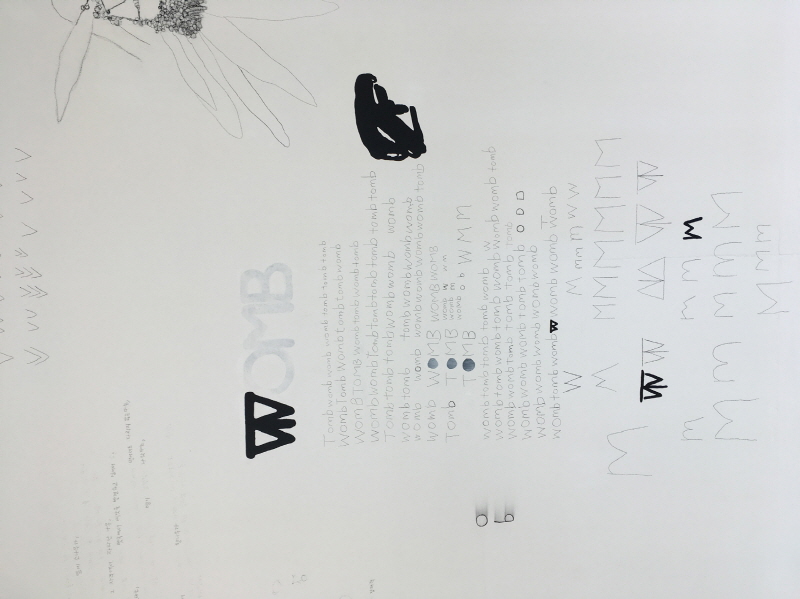
Growing Drawing (detail), 2018, conte, charcoal, acrylic, oil pastel on the wall, variable dimensions
Installation view of Growing Drawing (The Village Project, Seoul, 2018)
Image provided by Incheon Art Platform.
Tik ― Taat ―
Lines.
From dots grow lines. The floral arrangement of Ikebana, a Japanese flower arrangement, notates flowers and stems respectively in dots and lines in an abstract structure. Morse code, although the method of combination may differ, uses dots and lines as well.
Stems and branches look a lot like the strokes of letters. A stroke is a line, a combination of a dot or the cross-section of a pen and human gestures. This is how letters are made. Stems and branches sprout and stretch from the seed. This is how plants grow. They stretch, bend, and break.
Let’s take a look at Growing Drawing (The Village Project, Seoul, 2018), which took place at Donuimun Museum Village, Seoul. The title is a combination of the nature of letters and that of plants. Rather than accomplishing a practically functioning system of grammar and meaning, dots and lines form an assemblage through the principle of motion or the artist’s gestures. If there were anything that we might identify as grammatical, it would be the pattern of superimposed and intersected traces of physical movement such as motion and rotation of the body, pressure, and speed.
Click ― Clack ―
Change.
Change is the nature of life. Letters are written by the human body and react to their environment. In this sense, letters have a biological quality. YANG’s letters, more than any others, seem to be conscious of their responses to the human body. They are more sensitive when it comes to the vital nature with which the human body instills form. Vibrating within motion and sound, they tremble on their own.
What goes for handwriting applies to the typing produced by the typewriter. A typewriter is a machine with a unique mechanism that allows input of the keys and its output to take place simultaneously. Typing generated this way respond subtly yet intensely to the typing body. The concentration of the ink on the letters depends on the pressure of typing. Keys are at times shaky. Words may overlap amid functioning. Unlike the digital fonts sliding on a cold screen, the typing bear slight differences in their inscription, much like handwriting. The machine does not belong to an ideally flawless mechanism. Rather, it belongs to a physical world where intricate combinations of parts creak and squeak. Letters–either w, o, or m–are imprinted on the paper in variation depending on the conditions imposed by the typing body instead of merely repeating themselves. Click-Clack. Typing from a typewriter is like composing and improvising music all at once, producing primitive sounds.
A dot drawn from a letter contains moisture and dryness like a seed. Ink and ink stick, paint and colors are moist while they transit into letters by the body’s motions. Then, they dry with time. Pencils and Conte are solid to begin with. But their nature is closer to liquid when a mass of small particles is in motion. Picture an hourglass-countless solid particles of sand accumulate and flow like liquid. Mere trembling body gestures, smudged liquid or powders; This is what comes to view when you magnify the scale of a dot. It embodies life motion and materiality. Letters, since they were born as dots, are performing the primitive dance.
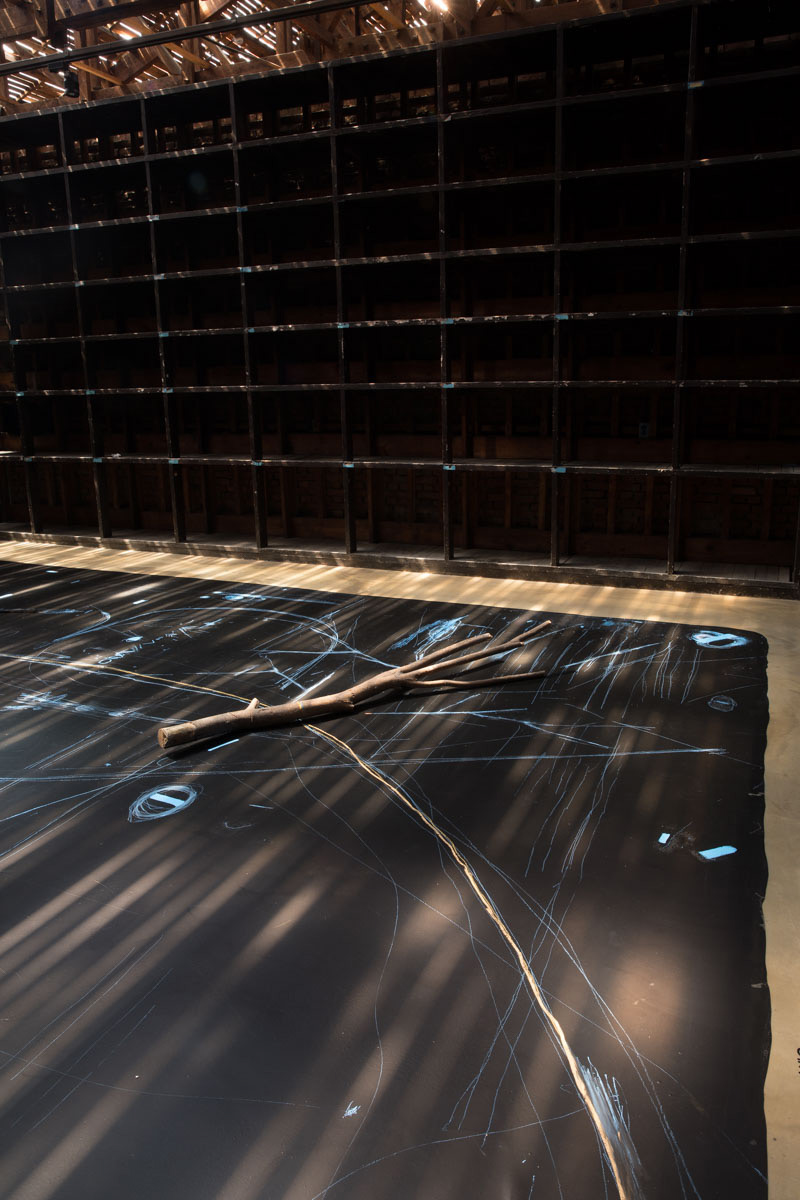
JWY.D.003.19 (detail), 2019, paint, oil pastel, medium, chalk, wood on vinyl sheet, variable dimensions.
Image provided by Incheon Art Platform.
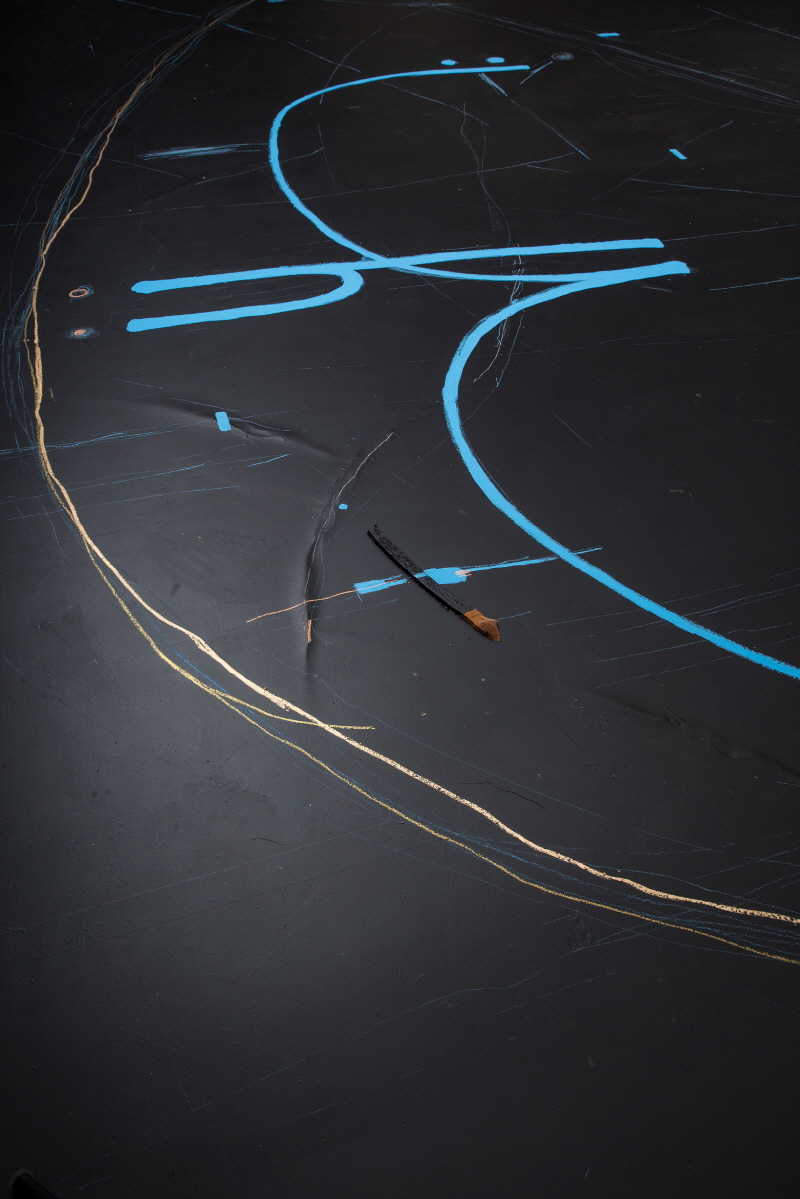
JWY.D.003.19 (detail), 2019, paint, oil pastel, medium, chalk, wood on vinyl sheet, variable dimensions.
Image provided by Incheon Art Platform.
From the Eyes of the Letters
Letters work as an active subject.
“Language belongs to humans, but also to itself. Language, inapt to humans, seems to have sorrow, sadness, and joy all for itself.” This excerpt is from The World of Silence (1948) by the philosopher Max PICARD (1888–1965), which YANG’s language and letters echo.
Once words are spatially materialized into letters, people have for a long time given magical meaning to their material existence. Letters of many language families were considered sacred as they embody the spirit of their etymological families. Oddly combined words, as in talismans, were believed to house miraculous effects and energy. Letters are seemingly considered to exercise power over people’s minds. It feels as though the letters are individual beings, demanding and declaring for themselves. They invoke such mysterious workings to the human heart.
Letters and language hold potential that is more than the function of simple communication and exchange of information. They are not derivative to a purpose but are imbued with ample emotions and mysteries. The Japanese poet Shuntaro TANIKAWA (1931–) said the following in his prose “Poet and Space”. “When we say the word ‘sky’, do we simply use this to distinguish it from items, let’s say, a desk or a leaf, or a car? Surely not. In the word ‘sky’ lies a sense of a substance that is beyond the word-bigger, less identifiable, something more sensual.”
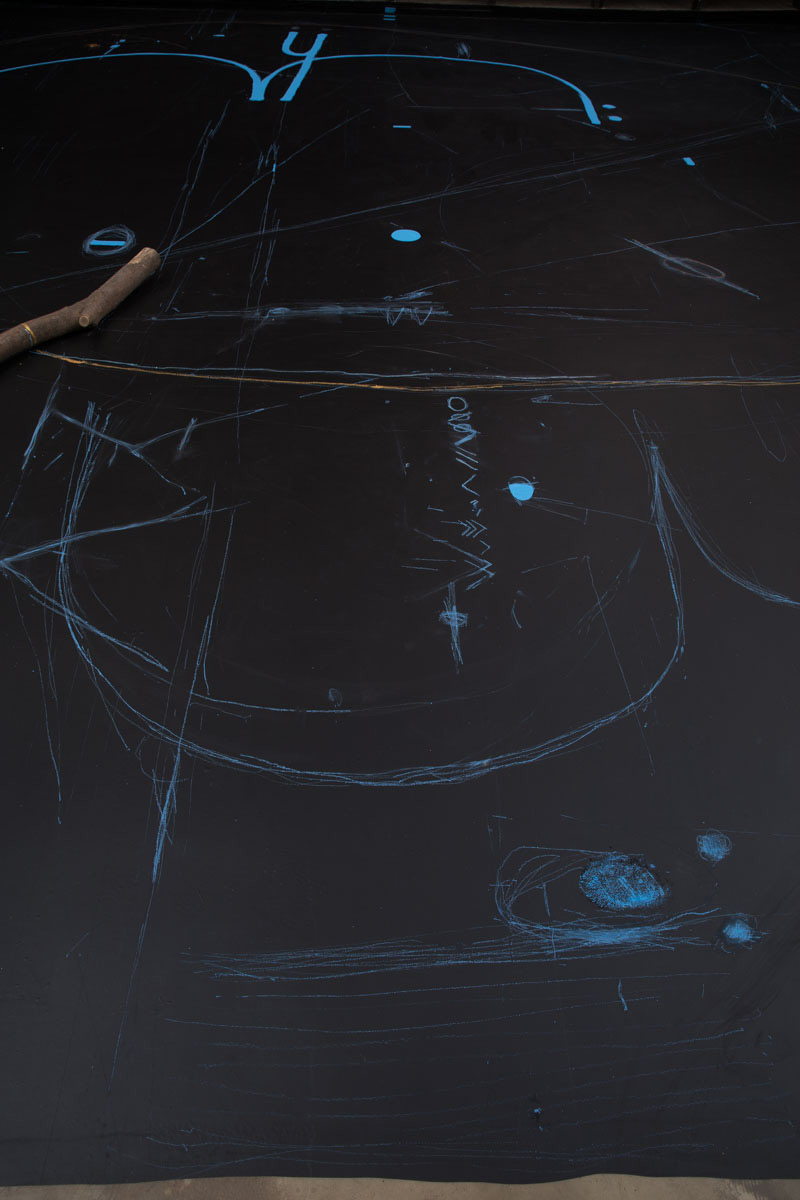
JWY.D.003.19 (detail), 2019, paint, oil pastel, medium, chalk, wood on vinyl sheet, variable dimensions.
Image provided by Incheon Art Platform.
Drawing-poem
YANG’s works are in touch with what poems have been doing to language and letters. It is a poetically materialized gesture beyond functional writing. To perceive and bring back the primitive life from words and letters, and the mystique no longer within reach. She does with acts of drawing what poets have done with words. I used to wonder how Friedrich Wilhelm NIETZSCHE (1844–1900), who used to be an exceptional philologist, started such a perilously poetic and prophetic writing. Had he perhaps witnessed the physiology of the ancient language? Had he not returned to the primitive era and seen the gesture of the language before it started serving exclusively as functional means under the pretext of rationalism? Once he had, language would not have found its way back.
Is there a way to justify the way we treat language and letters? Have there been accomplishments at the price of gross abuse? Rationality tolerates disrespect to what does not have a name nor shape. It may make up what we know as everyday life, but this life would be drained and deficient without going beyond the consideration of practicality and resourcefulness. It was poems that appeased the exhausted language and letters. There are artists to whom letters tremble themselves for, echoing speech as if to a medium or a shaman. Let us call the task of said persons ‘Drawing–poem’.
※ This content was first published in 『2020 Incheon Art Platform Residency Program Catalogue』, and re-published here with the consent of Incheon Art Platform

Jiwon Yu
Jiwon YU is a director at Institute of Typography & Culture, a graphic designer and typography researcher. She studied Visual Design at Seoul National University and studied typography at Hochschule für Grafik und Buchkunst Leipzig as an Art Scholar of the German Academic Exchange Service (DAAD). YU has worked as a designer at Minumsa pubishing group, a researcher at Sandoll Communications, a curator for the 2013 International Typography Biennale Typo Festival, and as an adjunct professor in the Department of Visual Design, Hongik University, Seoul. She seeks to work across disciplines. YU’s books include The Typographic Landscape (Seoul: Eulyoo Publishing, 2019) and Newton’s Atelier (Seoul: Minumsa publishing group, 2020), coauthored with Physicist Professor KIM Sangwook.
-

-
 Critic / People - 11 Dec 2017
Koo Jeong A: Stories of an Ambiguous World Transforming

