
Dear artist Dew Kim,
Please forgive my discourtesy of addressing this letter to you, because the exact recipient of this letter is “Huh, Need-you,” your friend, lover, and double. I would like to talk to you about Huh as if speaking behind his back.
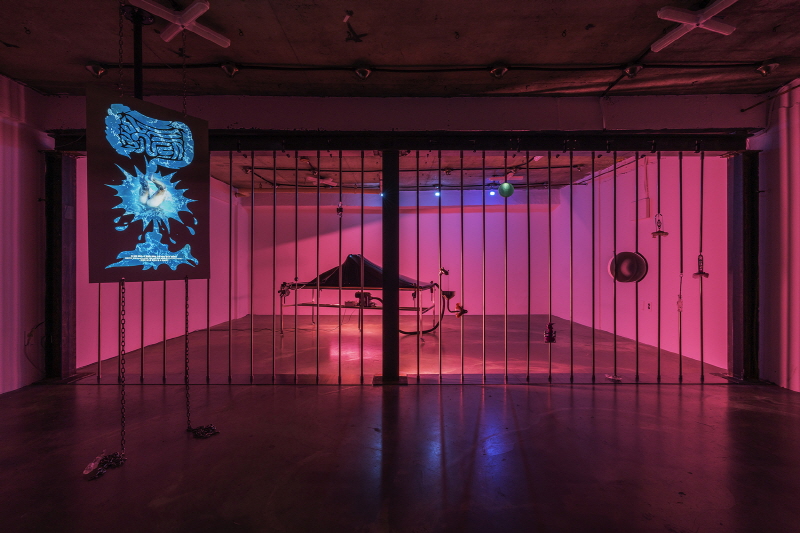
Installation view of the exhibition Dear Fear, 2020, out_sight, Seoul. Courtesy of the artist
While you are still sometimes confused with Huh, I feel like Huh’s identity and artistic view were most distinctly revealed in the exhibition Dear Fear held at out_sight in 2020. To be honest, as more artists who focus on their gender identity emerge—I wish I could say like mushrooms popping up after rain, but it would be more accurate to say just here and there around the Seoul art scene—I was on the precipice of getting slightly bored of the works that played with gay community culture and symbols and starting to think that it was about time that more radical works on sexuality were introduced. I don’t know if it’s my narrow perspective talking, but I think Dear Fear was one of the few more radical exhibitions.
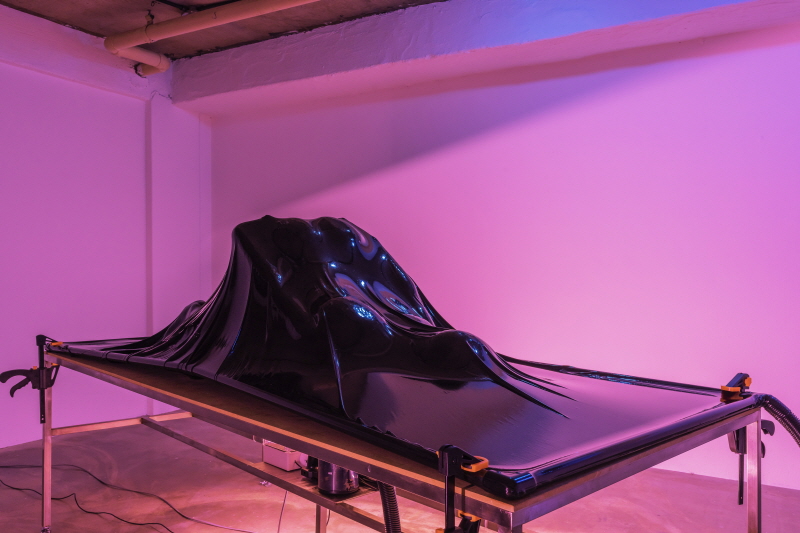
The Object, 2020, latex sheet, stainless steel, vacuum machine, 220x100x130 cm. Courtesy of the artist
The first exclamation point in Dear Fear was the intense lighting, accompanied by a perfectly staged series of installations. I felt on my skin the solid formative foundation and the shudderingly intense desire for spatial control possessed by this unknown artist Huh, Need-you. The installed works were adorable yet creepy, and in particular, The Object, which repeatedly inflated in its bed, felt as though it was trying to inscribe the viewers’ bodies with a kind of tension on the verge of explosion. Before I knew it, I found myself gaping in front of the video How to Become a True Post-Human, convinced by its half-jokingly professed words of wisdom. The mumbling, milky anus-alien was also cute, but the anal plug from which streams of newly conceived stars poured out really hit me. It was like a black hole that could grant humanity access to a whole new universe. The pleasures and desires we deem “normal” are obviously flexible and alterable, and I have no doubt that the new kind of humans—post-humans—are those willing to take adventures. Amen.
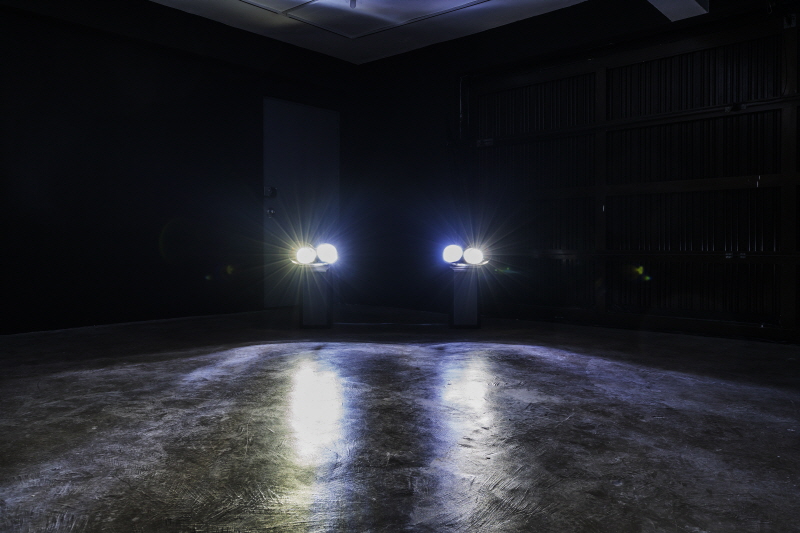
Ceremony, 2020, automotive headlamps, speakers, human body detector, sound work (8'20"), dimensions variable. Courtesy of the artist
The work that affected me deeper than any other work in the exhibition was Ceremony, the record of a play—though it was hard to tell whether it was a play or an actual kidnapping. Narratives on BDSM as a deviant, perversive expression of sexuality are bound to be reproduced in some abstract form through aesthetic formalization or take on other symbols and metaphors rooted in its tradition, but this work conveyed through vivid and visceral language the desires and fears of masochists and the inexplicable pleasure that the moment of such a division brings. When talking about BDSM as the most stigmatized sexual identity, sadists and masochists usually emphasize the fact that “BDSM is safe, consensual play.” But the narrator in Ceremony confesses about the perilously narrow gap between real danger and longed-for fantasy, openly sharing the absolute entanglement of fear and jouissance.
In the recent exhibition When the Water Blushed, Huh managed to boldly bring his religion-associated autobiographical narrative and the BDSM motif directly face to face. His story as a pastor’s son who felt internally conflicted and oppressed within the boundaries of Christianity is a familiar one, but I think the book of autobiographical essays When the Water Blushed is a treasure of grave weight, containing another dimension of intimacy and reflection. The essays explain in detail how the religious and masochist tendencies embodied by Huh began to come together as one body, undergoing heteromorphic inflation. Asceticism, crosses, and other religious auras and motifs are quite common in Western artworks that deal with masochism, but it occurred to me how rarely these motifs are presented not as a metaphor, a detour, or an accidental encounter, but as something that has sprouted from the artist’s own body like one’s left and right hands or a pair of lungs. It would not be an overstatement to say that the long history of Western oil paintings is also, in fact, a history of pictures painted in the ecstasy of discovering sensuality in biblical stories. If this were not the case, the practice of martyrdom and penance itself wouldn’t be far from such a sensuality as your book discussed.. After all, hasn’t epiphany always been another name for the ecstasy felt on the verge of death?
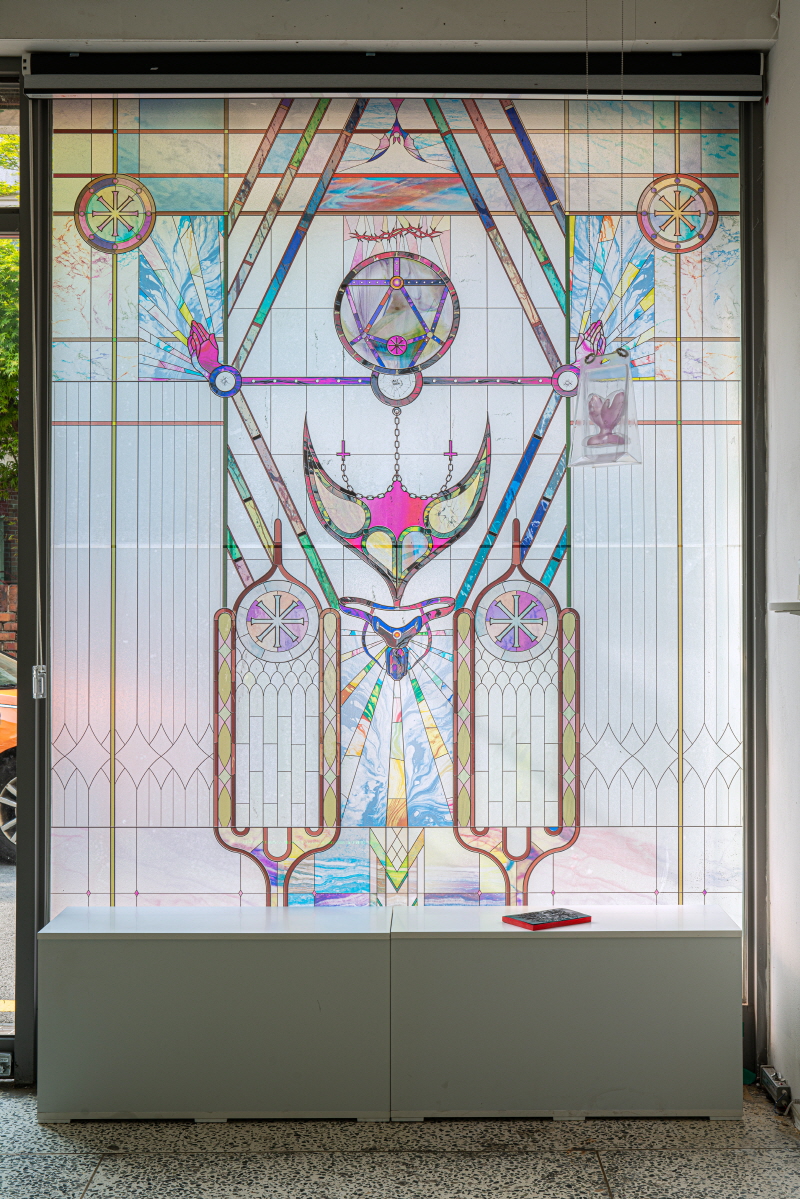
Masochist-Christ, 2021, digital print on clear adhesive vinyl sheets, 225x171cm. Courtesy of the artist
But to introduce a boy, a pastor’s kid who reads a children’s illustrated bible, getting off to scenes like Abraham attempting to kill Isaac as an offering on the altar or Joseph being taken into slavery! Though, I can see how Joseph’s story could have such an effect. In the Queer Bible Commentary, recently translated into Korean, there is a passage that highlights how Joseph is understood in the Islamic tradition (apparently, Joseph appears in the Quran as “Yusuf”). Even in Jewish tradition, Joseph is said to take after his mother’s grace and beauty:
“Joseph is the darling, a pretty boy . . . his father’s pet . . . the rabbis say he painted his eyes and walked with a mincing step. Showing off the coat of many colors, which old Jacob made him. Twirling, hugging himself. He was a young Hebrew Narcissus. No wonder his brothers hated him.1)
Some of Joseph’s aspects reminded me of you (more than Huh). I alternated between crying and laughing as I finished reading the book, and took in a deep breath when it quoted Friedrich Nietzsche from Twilight of the Idols: “Pain that doesn’t kill me makes me stronger.”
In fact, Nietzsche saw Christianity as the opponent of everything Dionysian, claiming it the most ascetic oppression, a decadence ridden with fear and pity. (In unnecessary elaboration, Nietzsche also deems the practice and secularization of Christianity as different entities.) Looking at the beautiful Gothic cathedral-style stained-glass mosaic made of S&M equipment, I was reminded once again of how sensually close religion, asceticism, and masochism are. Nietzsche bases his life on something else, and in doing so, argues that religion, binding him to reality, is a form of illness: “A life clear, cold, careful, aware, without instinct, in resistance to the instincts, was itself just a sickness, another sickness. 2)
Huh’s Dionysian festival has probably only just begun. I can only look forward to the many festivals and much love to come from Huh beyond the cute blasphemy and shamanic formats as Christian antitheses.
Jinshil, late summer of 2021
[Footnote]
1) Deryn Guest et al., ed., The Queer Bible Commentary. London: SCM Press, 2006. (Korean translation by the Queer Bible Commentary translation and publication committee. Seoul: Korea Institute of Rainbow Theology, 2021, 107).
2) Friedrich Nietzsche, “Gözen-Dämmerung,” Nietzsche Werke, Kritische Gesamtausgabe, vol. 15. Translated by Sung Young Baek. Seoul: Chaeksesang, 2005, 95.
※ This content was first published in 『2021 MMCA Goyang Residency Program Catalogue』, and re-published here with the consent of MMCA Goyang.

Jinshil LEE
LEE Jinshil majored in politics, studied German contemporary philosophy in graduate school and received a master’s degree with an emphasis on language theory of Walter Benjamin. She has been an art critic since 2013 and organized exhibitions beginning with “Read My Lips” (co-curated with Sung Ji Eun) in 2017, then “Salim” (2018), “Mirrors of Mirrors of Mirrors”, and “Between the lines” (co-curated with Agrafa Society, 2019). She made up an editorial and curatorial collective named Agrafa Society and published a webzine “SEMINAR”, conducting experimental research and various forms of the editorial and curatoiral with her colleagues in order to expand the terrain of visual culture and art criticism based on feminism. She won SeMA-HANA Art Criticism Award in 2019.
-

-
 Critic / People - 11 Dec 2017
Koo Jeong A: Stories of an Ambiguous World Transforming

