
Artist Bae Yoon Hwan’s new painting Next Stop Is Where You Are (2021) consists of three canvases that depict different common subway scenes. Each of the scenes appears to be a component of an omnibus or an image that extends into an unseen larger composition. Among the three paintings, the left scene captures the interior of a subway train, crowded as if during morning rush hour. Face masks, which became a mandatory part of life last year, visualize the psychological distance between the people, while the expressions on the exposed parts of their faces and their gestures reveal their blatant distrust of one another. From the center of the crowd, which is depicted in black and white, a man with a flower emerges. No mask hides the bright smile on his face as he looks down at the flower in his hand. As if having appeared out of thin air into this real-world scene, the flower is bright and colorful, but it is alone in the center of the black-and-white composition. The man is beginning to regain his original color, absorbing the light emanated by the flower, while the people, either indifferent, looking away, or side-eyeing him, seem more uncomfortable with the fact that he is not wearing a mask than amazed at this surreal sight. After all, in the eyes of the others, the man may be just another bothersome individual who has deviated from social guidelines by living in blissful ignorance of his contemporary environment.
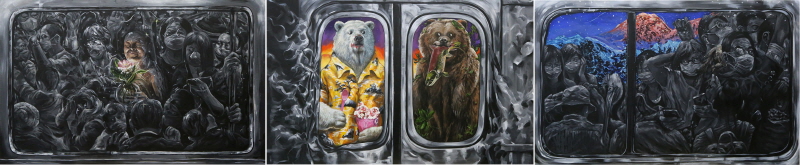
Next stop is where You Are, 2021, Acrylic on canvas, 73x117cm. Courtesy of the artist
The canvas in the middle captures a subway door from within the car. Two bears in full color stand side by side outside the door, contrasting with the achromatic crowd inside. Glancing at each other, the white and brown bears are depicted in a contradictory manner. The white one is wearing a yellow t-shirt with an island design and eating Baskin-Robbins strawberry cheesecake-flavored ice cream with a spoon, red sauce smeared all over its mouth. The brown bear, framed by its own window, holds a salmon in its mouth and is covered in tree leaves, as if it has been rolling around in the woods. This painting more clearly defines the border between the interior and exterior of the train, which was rather ambiguous in the first painting. Looking closely at the first canvas, one can see that the view of the outside of the train seems incongruous with the crowded interior; there is also a circular image in the upper right corner that, according to the artist, is “the back of a running wildebeest.” In the second canvas, the use of color more distinctly separates the exterior of the subway car from the interior.
The third painting also depicts the crowded interior of a subway train, but the outside view in the background of the frame is that of a natural landscape. Once again, the crowd is achromatic, contrasting with the red and green mountains and the sky outside that could depict either dawn or midnight. Oddly enough, there is a bird—a crane of sorts—among the groups of people who are either heading toward the door to get off at the next stop, sitting in the seats, or fixated on their mobile phones, unaware of their surroundings. No one in the scene is paying attention to the random presence of this animal. The heterogeneous being blends into its environment with no sense of incongruity like a “hidden picture” puzzle—perhaps because it is not distinguished by color as in the previous painting, or maybe because it is surrounded by people who are genuinely disinterested in anything beyond the sense of discomfort.
The crowds of people in face masks that form the overall atmosphere of this work address the reality of the pandemic that still prevails across the globe. The flower and human figures, interior and exterior of the subway train, chromatic and achromatic colors, and scenes of nature and society draw boundaries as visual mechanisms, recalling a statement by Bae about wanting to move on from the personal experience-based narratives he previously pursued. The artist once said that he wanted to produce paintings from a more macro perspective so that the images alone can form empathy. He went on to mention that he likes the forests painted by David Hockney, probably because Hockney’s landscapes can be perceived as “paintings for painting’s sake” that do not require a tedious explanation of the artist’s personal experiences. Bae was clearly taken by the established master artist’s enormous landscapes, whose power leave viewers simply gazing, inspired. This is why Bae’s new work intends to reduce the use of text and textualized images that revolve around his personal experiences to make way for visual symbols. He also aims to prompt viewers to ruminate on their position within the current crisis with him, rather than telling viewers a personal story.
Until now, Bae has used text as much as images in his artwork. His texts, composed of dry yet powerful sentences akin to the short and rough lines of his drawings, communicate personal narratives. He typically divided short, novel-like narratives derived from his daily life and experiences into several scene units, or drew or installed them in series to make animations. Such scenes mostly consist of vibrant, squirming characters composed of thick and intensely rough lines. As Bae’s characters (each with an assigned role) would be depicted and imbued with a story within a directed scene, Bae’s rather unrefined and cynical tales would entwine to fill the finished frames with vitality. In comparison, the aforementioned Next Stop Is Where You Are and other works Bae has been producing since 2021 hint at an attempt to visualize various kinds of senses.
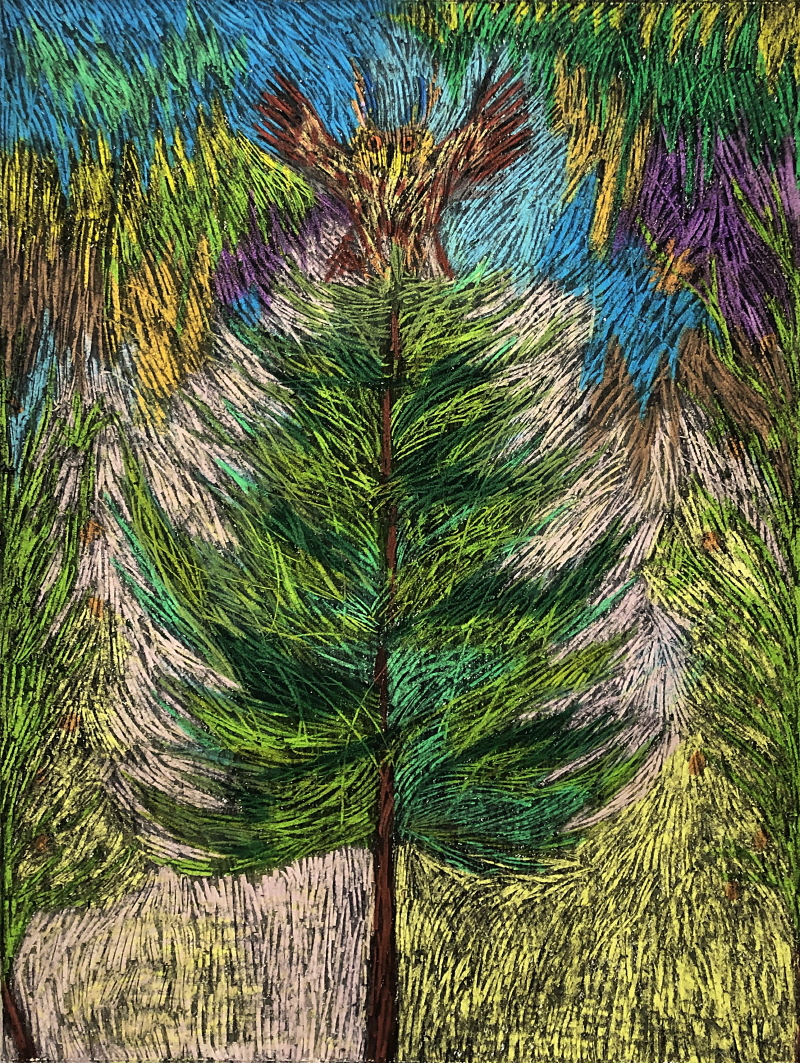
Needle leaf tree, Sharp Owl, 2021, Oil pastel on paper, 119x74cm. Courtesy of the artist
“When I see the sharp leaves of coniferous trees, squirrel fur, hedgehog spines or bat wings, I immediately associate them with sharp edges or the cries of a crow or a magpie. The cry of cicadas is like an anomalous electronic sound, and it feels less like a specific line and more like a jumble of lines. The wide, round shape of broad leaves is associated with things like the enchanting movement and flying motion of a bumblebee, the shape of a chubby bear, or a cumulus cloud.”—Bae Yoon Hwan, “Artist’s Notes”
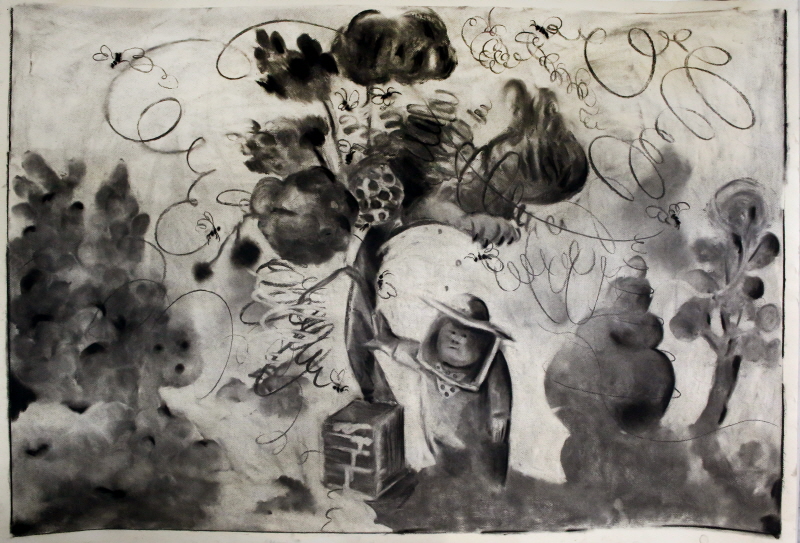
Bumblebee, 2021, Charcoal on paper, 74x110cm. Courtesy of the artist.
Hence, in producing his recent drawings, Bae has devoted all of his senses to certain subjects rather than narrative descriptions. As he explains in his “Artist’s Notes,” he selects different materials and methods for each of his subjects depending on the sound the subject makes, its appearance, and its physical movement. For example, he covers the frame with short lines in Needle leaf tree, Sharp Owl (2021, oil pastel on paper, 119x74cm) depicting the thin, pointy needles of the tree and the feathers and wings covering the owl’s body as if they are swaying in the air. Needle leaf tree, Bat, Magpie (2021, oil pastel on paper, 76.5 x 57 cm) was evidently created as a result of the artist’s preoccupation with the birds’ nervous chirps and flutters and the pointy shape of the coniferous needles. Bumblebee (2021, charcoal on paper, 74 x 110 cm) captures the busy, looping motion of bumblebees and a beekeeper attempting to attend to them. Here, the charcoal seems to have been meticulously rubbed down for an enhanced dull and soft feel. The artist’s new style of drawing, as a choice to fully enjoy the senses conjured by his subjects, is likely to continue. Today, the once granted concept of “ordinary life” is growing more and more implausible as the times demand a re-recognition of individuality and of the various phenomena and interactions that occur between individuals. In this sense, Bae’s recent works convey the powerful message that an artist is someone who is always willing to try different methodologies, make a difference, and fight the encroaching achromaticity.
※ This content was first published in 『2021 MMCA Goyang Residency Program Catalogue』, and re-published here with the consent of MMCA Goyang.

In-sun Kim
KIM In-sun graduated from Ewha Womans University with a major in sculpture and received her master’s degree in Art History from Pratt Institute, New York. She worked as a curator at Alternative Space LOOP (1999), coordinator at Gwangju Biennale (2002) and Busan Biennale (2000) where she also worked as curator (2006) and producer (2012). And she worked as artistic director at Jeju Biennale(2020). Also, she has been Vice-Director of Kukje Gallery (2003–2004), Executive Secretary at Anyang Public Art Project (2005), Chief Curator at Daelim Museum (2006–2007), and Director of Interalia Art Company (2007–2009). Currently, she runs an art space called Space Willing N Dealing, introducing Korean artists while organizing exhibitions domestically and internationally.
-

-
 Critic / People - 11 Dec 2017
Koo Jeong A: Stories of an Ambiguous World Transforming

