
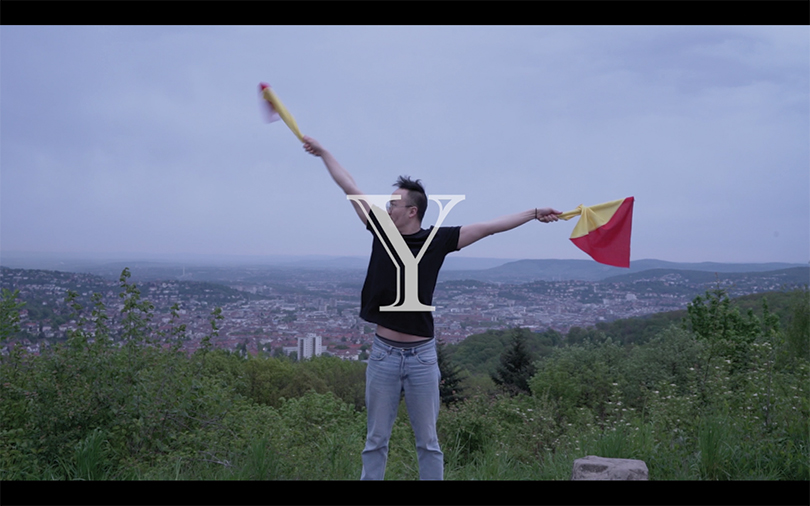
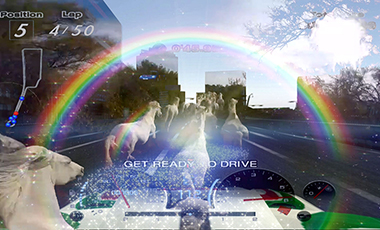
DEAR MUM; From up High to Far Away, on the Flat Between 0 and 1, 2019, video installation, 14’ 56’’. Courtesy of the artist
| BK | With what you were just talking about in terms of the “relationship between me and society . . .”,
it seems like I’m trying very hard to separate myself from the standard that I have to “follow” or the need to be socialized, you know? |
| BS | Like, “The real ‘me’ is here, and the social ‘me’ is there”— that sort of thing? |
| BK | No, I don’t think I accept the latter. |
The performance works that Bangjoo Kim have been creating since 2017 may be diverse in their materials and techniques, but they remain consistent about “rules.” Kim approaches rules as a kind of substantive action that can be obsessively repeated over a long period of time (as in A Teleportation Through Two Chairs, I Don’t Have a Problem with Berlin Because I’m Not Late Also I Am Invited 1), or For the Buzzer Beater2) ), transposed (as in A Gentle Struggle3) or To Move Horizontally in a Vertical Manner 4) ), and sometimes overlapped (as in DEAR MUM; From up High to Far Away, on the Flat Between 0 and 1 5) ). In these performative works, what enables the materialization of the abstraction of rules is the artist’s own body. Kim’s body instantiates the specific rules applied to him as it moves across public spaces. What is noteworthy here is the way that the rules of performance that Kim applies to himself deliberately go against the social rules held or alluded to by the “locality” where his performances take place. He may go mountain climbing on a road, which is ordinarily seen as a place for moving with both feet on the ground (To Move Horizontally in a Vertical Manner), or he may move atop chairs while adamantly refusing to touch the ground (Teleportation). His acts of deliberate transposition may be read as a kind of critique of or resistance to the social rules signified by public settings, or an argument for personal autonomy (Lee Kwanhoon et al. 2020 6) ). What makes this reading seem somewhat romanticized, however, is the fact that most of the personal rules that the artist instantiates through his body continue for some time even after they have revealed their “societal” nature. The “surplus labor” imposed on the artistic body contains within it a kind of clash, as Kim seeks to achieve an ultimate “self-collapse” through overcompliance to his own rules. His intent to reach self-collapse through self-compliance is found not only in works like Glass Joe: Stunning Training #1 7)—in which his own rules cause him to literally strike his own face—but also in such seemingly sedate works as For the Buzzer Beater and Teleportation.
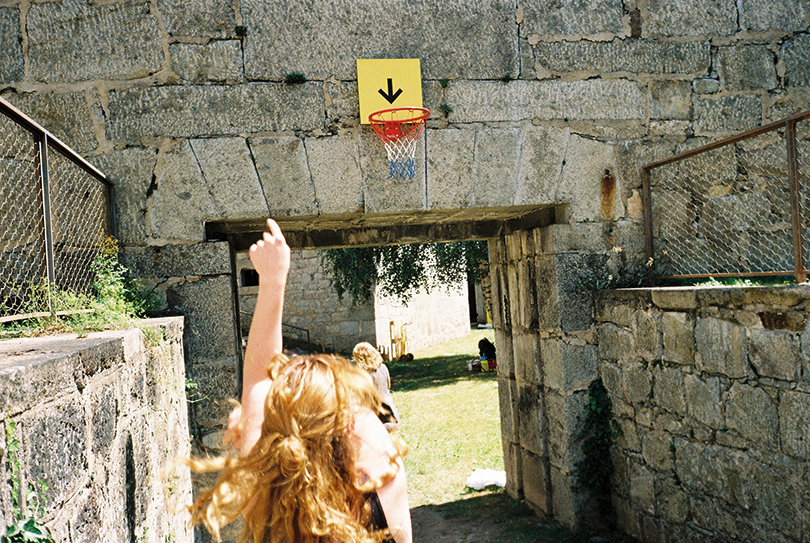
For The Buzzer Beater, 2018, video installation, 9’ 34’’. Courtesy of the artist
For the Buzzer Beater is an installation work that combines a video that shows Kim traveling from his studio in Stuttgart, Germany, to the exhibition venue in the Italian commune of Franzensfeste while obeying the dribbling rules of basketball, along with the hoop that appears in the later part of the video. In the work, the artist happens across a basketball, which he picks up and starts to dribble. After traveling a distance of 1,300 kilometers, crossing national borders and dribbling all the while, he stands before the hoop in the gallery and takes a shot, a tense expression on his face. Sure enough, the ball bounces off of the hoop, at which point the video ends. Replaying on a loop next to the “real” backboard and hoop from the video, the video repeatedly attests to how diligently the artist obeyed his own rules for this long, unseen journey, and how the journey ended not in cheers and glory, but in failure. A similar kind of theme appears in Teleportation, with the artist’s body moving over a long distance while repeatedly executing a simple rule. The “semantic consummation” that might justify this borderline self-mortifying practice never takes place in this work as well. Beneath the endlessly looping video, the remains of the chair that accompanied the artist from Stuttgart to Berlin—dismantled for the purpose of ascending the gallery staircase—is the only piece of evidence to prove the “reality” of the situation in the work. Neither For the Buzzer Beater nor Teleportation answers the ultimate question of “why?”—instead, they merely exaggerate the artist’s “self-compliant reality,” where he remains consistently isolated and adrift, as though in a state of teleportation. This stands in clear contrast with the way he deliberately omits or dilutes objective indicators (the names and addresses of his starting and ending points, clocks positioned in public places) that would allow him to concretely specify the time and place in which his movements occurred while editing the work, as well as the external elements that could halt or impede his personal performance.
| BS | When you’re performing your personal rules, you do so within social settings. Weren’t there moments when the rules couldn’t be observed because of that? Whether it was by accident or because of societal constraints. For instance, you might have accidentally let the ball go when you were dribbling, or the light might have changed when you were halfway across the crosswalk on your chairs. Maybe you got into arguments with members of the public. Why were those parts left on the cutting room floor? |
| BX | There was just one incident that I stopped during filming: I was on a train, and someone came over the PA system and said, “Restrain yourself.” But I didn’t think that was important. The agent behind the action continued. In other words, movement occurred due to a change in space and time—within the rules. The important thing was the act of observing the rules, and I think that’s why I edited the rest out. |
| BS | Was it critical to show the performer obeying the rules? |
| BX | That’s right. |
The affinity between Kim’s works and the early performance pieces of Bruce Nauman, which Jean-Charles Massera referred to as “dancing with laws” (Lepecki, 2014, p. 62) 8) , comes into clearer focus when the focal point of analysis is shifted away from gestures of resistance toward society, and toward the direction of Kim’s excessive self-compliance to the ends of self-destruction. From the standpoint of 2021, when the canonization of Fluxus artists has become complete and many contemporary artists use “performance” as their main expressive medium, it may be all too simple a strategy to invoke Nauman again in critically examining a young contemporary artist’s work. Yet it is impossible to overlook the instant narrowing of the spatial and temporal gap—much like a “teleportation”—between a white male artist who lived in New York in the late 1960s and an Asian male artist living in Stuttgart in the late 2010s. For instance, Kim’s Teleportation appears to be an expansion across time and space of the attitude and critical awareness of Nauman’s Walking in an Exaggerated Manner around the Perimeter of a Square (1967–68); For the Buzzer Beater seems to do the same for Nauman’s Bouncing Two Balls between the Floor and the Ceiling with Changing Rhythms (1967–68), and Glass Joe for his Bouncing Balls (1969). Like Nauman, Kim plays a dual role, serving as his own choreographer/rule-maker and his own performer/rule-follower, and he has continued to focus his work on solipsistic self-withdrawal toward the complete elimination of the social aspect.
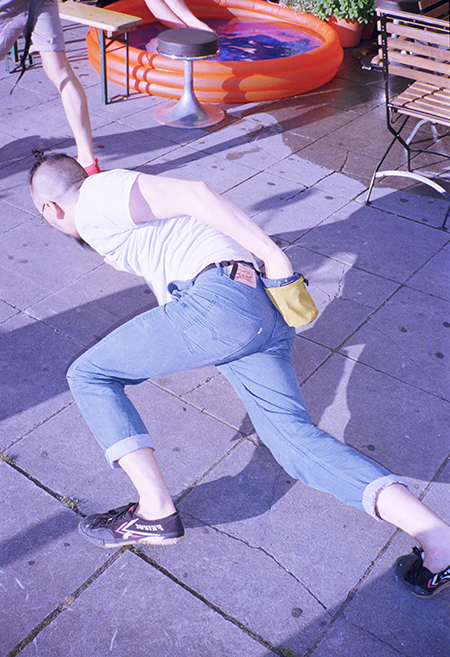
To Move Horizontally in a Vertical Manner, 2019, performance, video installation. Courtesy of the artist
In his essay “Masculinity, solipsism, choreography: Bruce Nauman, Juan Dominguez, Xavier Le Roy,” André Lepecki notes the modern, masculine, solipsistic, and homosocial nature of the origins of the “choreographic” (Lepecki, p.66). He makes the fascinating argument that Nauman, with his strategy of taking to extremes the dichotomy between the Cartesian idea of the isolated “dialogue with the self” as the only means of achieving truth on one hand, and the compliant body that perfectly performs the resulting rules on the other, creates moments that implode masculine subjectivity “as solipsistic subjectivity reaches a critical point of total saturation” (Lepecki, p.79). The ironic result is that Nauman’s choreography/performance then achieves the potential for a “radical opening of thought and being” (Lepecki, p.89). Lepecki’s insights into Nauman’s work emerge from an original interpretation of “solipsism” as described by Wittgenstein in the Tractatus Logico-Philosophicus, 9) which Lepecki proposes expanding to a “notion of methodological solipsism that disrupts notions of absolute seclusion” (Lepecki, p.92). This is why the affinity, in telecommunication terms, between Nauman and Kim remains valid even when Kim’s performance work is explained in terms of the “methodological solipsism” through which Lepecki interprets Nauman.
The world as it relates to solipsism is typically seen as something completely subjective in relation to the perceiver; on this basis, it is posited as something in opposition to the “objective world” beyond the subject. In Wittgenstein’s version of solipsism, the opposition between the two is rendered as ambiguous. This appears clearly in proposition 5.64 of the Tractatus, where Wittgenstein writes, “Here we see that solipsism strictly carried out coincides with pure realism. The I in solipsism shrinks to an extensionless point and there remains the reality coordinated with it.” Lepecki writes that this conclusion may be reached because “[in] Wittgenstein, both the linguistic ‘I’ and the world (onto-)logically participate of the other,” and accordingly “the continuum I–language–world necessarily contains, and is contained by, the I–language–world of the other” (Lepecki, 90) Thus, there are moments in which the strictly constructed solipsistic world makes the leap toward “pure realism” (Lepecki, 91) as its scope is adjusted to the linguistic limits of the “self.” Along these lines, we may reconsider why Kim’s performance videos have so exclusively emphasized a “self-compliant reality.” Might Kim actually be attempting to deconstruct his own modern subjectivity through the somewhat ironic approach of “self-excess,” just as Nauman did?

A Gentle Struggle, 2018, video installation, 2' 21". Courtesy of the artist
| BK | At that point, I decided to just break the flow and stop. I spent a really long time thinking about what that decision was. . . . While coming here today, it suddenly occurred to me. There were so many ways I could have stopped. . . . Maybe I wanted to increase the entropy and create something within which I was included. |
| BS | What is it that you want to destroy by increasing the entropy? Is it the existing social system? Some perceptual system? |
| BK | What I described as “increasing entropy” isn’t about trying to bring everything down. . . . Maybe one needs to erase things in order to visualize what can be found at transitional points or those boundaries. . . . I considered the things that need to be disposed of so they can be brought closer to the state that I’m seeking. [. . .] So this is something that I’ve been thinking about recently. I’ve held the belief that for “me” to perceive “me,” it is ironically subjectivity that I need to escape. If I can do that, then the thing called “me” can be a bit . . . I’m not sure if I can use the term “precious” for this entropy. The flow of my being . . . I think I sense that things like that might be expressed. |
For male artists living in today’s post-#MeToo, post-#BlackLivesMatter era, deconstructing the “modern,” “masculine,” and “subjective” is inevitably a more urgent task in comparison with the urge to deconstruct modernity in Nauman’s era (the 1960s). Kim’s grim performance of self-destruction is something that many young male artists find themselves obliged to pass through in order to position themselves within the currents of contemporary art. This may be the steep “participation fee” that contemporary art imposes upon artists as an institution that continuously recalibrates its identity. Perhaps we can say that Kim’s strategy of “methodological solipsism” has succeeded to some extent with its attempts at the painful deconstruction of the subject that reaches the point of obsessively inflicting blows on the artist’s own face. And if Kim can be presumed to have witnessed, however briefly, the potential for a “radical opening of thought and being,” perhaps this has enabled a new type of design for him. Explaining the decision he made to “suspend particular programs/rules” during his first solo exhibition (Don’t) Look at It (2020) 10) at Project Space Sarubia, Kim said that it related to a new concept of “a state in which I was included” (interview with the artist, June 15, 2021). Interestingly, this description of an ambiguous state connected with the faint and peculiar sensations I experienced as both a friend of Kim and a viewer seeing You Can’t Put Out This Fire (2021) 11) in person early this year.
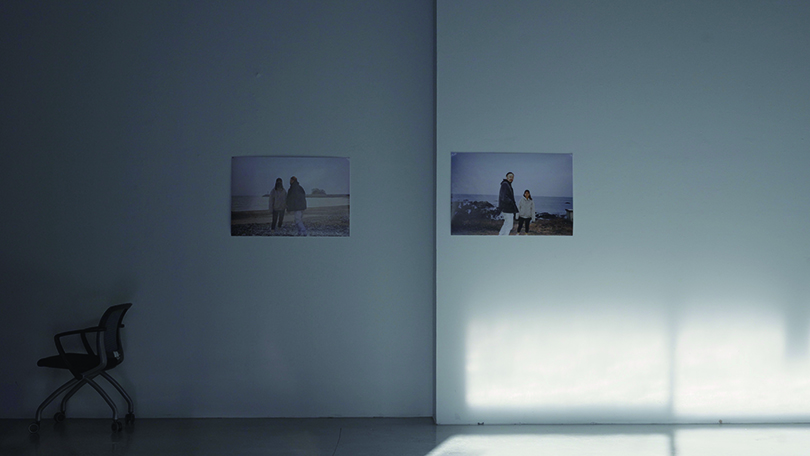
You Can't Put Out This Fire, 2021, performance video (14 hours), books, photographs, 6 partition walls with wheels, dimensions variable. Courtesy of the artist
Taking into account viewer interaction, Kim used two projectors to show the video in You Can’t Put Out This Fire, which recorded his longitudinal journey across the Korean Peninsula to view “yesterday’s sunset” and “today’s sunrise” in the shortest amount of time possible. The work also included records of his long-distance communication with Dutch-based artist Hyomin Kwon has he prepared for the journey, along with sound accompaniments during his travels. Other than two documentary photographs, iconic images of Kim himself are entirely absent. It was around four in the afternoon when I visited the gallery; faint rays of winter sunlight entered through the large show window, periodically obscuring the image projected on the wall. This act of allowing the sunlight to erase the evidence of his travels, rather than putting some sort of screen in place, seemed to me a declaration that Kim had finally resolved to believe that the world of the “other” does in fact exist at this moment, even when we cannot see it in front of us, and that by extension we continue to exist in relation to others even when that world of otherness obscures any trace of us.
*Interview with the artist (June 15, 2021, in Buam-dong, Jongno-gu, Seoul)
[Footnote]
1) Kim, Bangjoo. “A Teleportation Through Two Chairs, I Don’t Have a Problem with Berlin Because I’ m not Late Also I Am Invited”. 2017. Performance video and installation. 11 min 02 sec.
2) Kim, Bangjoo. “For the Buzzer Beater”. 2018. Performance video and installation. 9 min 34 sec.
3) Kim, Bangjoo. “A Gentle Struggle”. 2018. Single-channel video. 2 min 21 sec.
4) Kim, Bangjoo. “To Move Horizontally in a Vertical Manner”. 2019. Performance video and installation. 29 min 07 sec.
5) Kim, Bangjoo. “DEAR MUM; From up High to Far Away, on the Flat Between 0 and 1”. 2019. Performance video and installation. 14 min 56 sec.
6) Lee, Kwanhoon., Mun, Soyeong., Hwang, Sinwon. 2020. “(Don’t) Look at It Exhibition Introduction”. Project Space Sarubia
(http://sarubia.org/200)
7) Kim, Bangjoo. “Glass Joe: Stunning Training#1”. 2018. Single-channel video. 7 min 31 sec.
8)Lepecki, André. 2006. Exhausting Dance: Performance and the Politics of Movement. New York: Routledge. p.62.
9) Park, Jeong-Il. 2004. “Wittgenstein’s Tractatus Logico-Philosophicus Annotated”. Seoul National University Institute of Philosophy. (https://m.terms.naver.com/list.naver?cid=41908&categoryId=41937&so=st4.asc)
10) (Don’t) Look at It. 2020. Exhibition. Project Space Sarubia.
11) You Can’t Put Out This Fire. 2021. Exhibition. Incheon Art Platform Warehouse Gallery.
[References]
1)Park, Jeong-Il. 2004. “Wittgenstein’s Tractatus Logico-Philosophicus Annotated,” Seoul National University Institute of Philosophy. (https://m.terms.naver.com/list.naver?cid=41908&categoryId=41937&so=st4.asc)
2)Lee, Kwanhoon., Mun, Soyeong., & Hwang, Sinwon. 2020. “(Don’t) Look at It Exhibition Introduction,” Project Space Sarubia
(http://sarubia.org/200)
3)Bryant, Levi. 2011. The Democracy of Objects. Ann Arbor: Open Humanities Press.
4)Lepecki, André. 2006. Exhausting Dance: Performance and the Politics of Movement. New York: Routledge.
5)Levine, Caroline. 2015. Forms: Whole, Rhythm, Hierarchy, Network. Princeton: Princeton University Press.
※ This content was first published in 『2021 MMCA Goyang Residency Program Catalogue』, and re-published here with the consent of MMCA Goyang.

Bittnarie Shin
Filmmaker/Dramaturg/Artistic Researcher. Bittnarie intervenes across diverse time-based artistic practices, questioning variations of individual time experience in relation to the scale variance of objects. She wrote and directed multiple short films, most notably 〈In Passing〉(2017), 〈Our Day Will Come〉(2016) and 〈Touch〉(2015), and dramaturged 〈Schumi〉(Play, 2021), 〈You cannot disinvite X-being〉(Contemporary Dance, 2021) and 〈Queering Voice〉(Performance, 2021).
-

-
 Critic / People - 11 Dec 2017
Koo Jeong A: Stories of an Ambiguous World Transforming

