
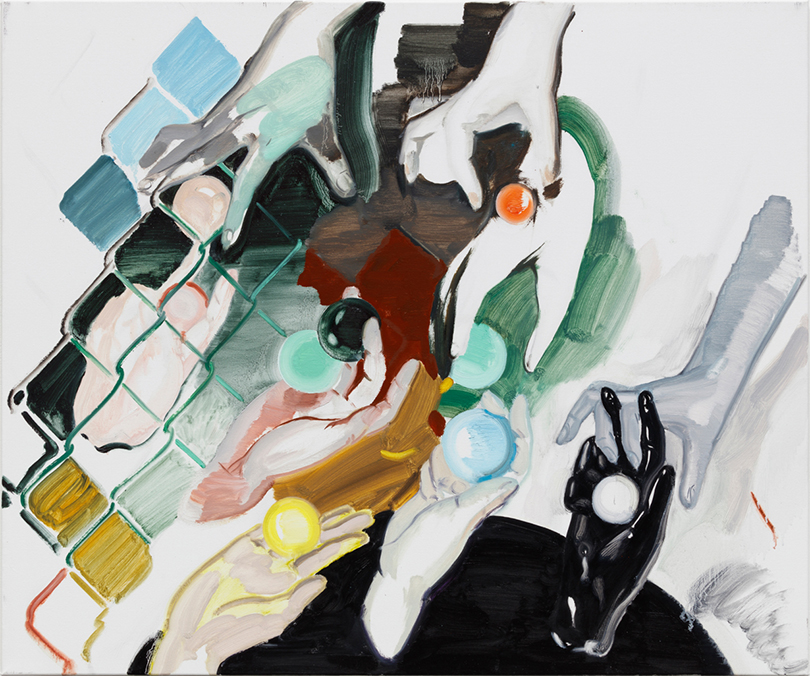
ball and hand, 2017, oil on canvas, 72.7×60.6cm. Courtesy of the artist
What would it be like if our dreams had a shape? The question that occurred to me first when seeing Sodam Lim’s painting was about the shape of a dream. The landscape in her work looks like a place I have never seen before, and I soon came to realize that it was unreal. Furthermore, it feels like her work tickles the fingertips although I am looking at it with my eyes. It makes me feel like I am walking in the air, floating away from the ground just like in my dreams. Lim has painted moments of disparate senses that we often experience in our everyday lives, but are difficult to define clearly. These are the moments of tension, familiar and unfamiliar at the same time. In other words, moments that everyone may have felt but rarely come to us. This little fragment, which can be compared to an afterimage from a visual aspect, wanders around our body and comes up suddenly and abruptly. Let’s call it a ‘sensory memory.’
In such moments summoned from the senses owned by time and space like the past or in dreams getting away from our reality/present, the artist takes photographs first. It is an attempt to store the moment happening right now, in other words the senses of the “present.” Roland Barthes was interested in keeping a journal as a way of writing a ‘novel of the present.’2) A journal here is a piece of writing listing the things taking place before our eyes at the very moment in the form of a note. As the journal was a starting point for Roland Barthes to write a novel of the present, photography becomes a beginning point for painting. But for her, photography is only a trigger ‘for starting a painting’ rather than catching ‘for representation.’ The following process is a natural flow, more focusing on the sense of the paintbrush. What has always been important to the artist is how to paint rather than what to paint. Therefore, once the stroke of a brush begins it turns into the first emotional impulse, in other words, the “internal landscape,” while forgetting what kind of recreation (realistic landscape) it started from. In this way, Lim’s work becomes a catalyst for evoking the sensory memory, attempting to embody the ‘sense of the present.’
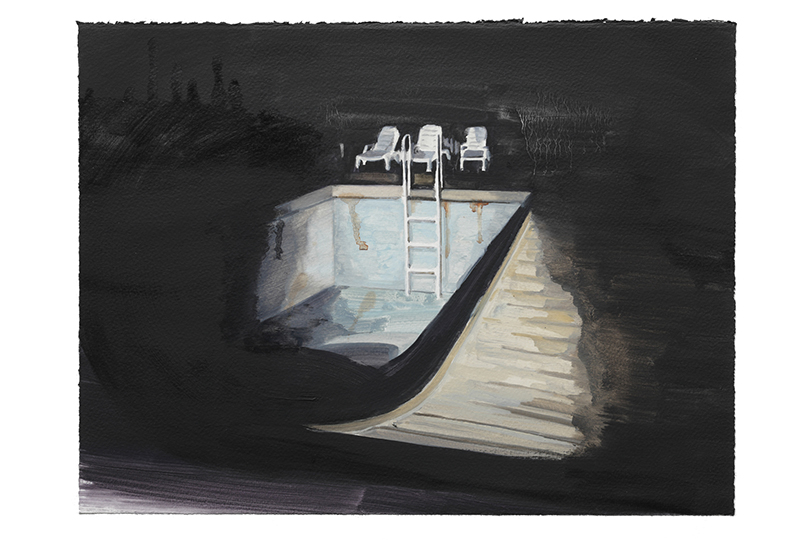
After Holiday, 2012, oil on paper, 28×38 cm. Courtesy of the artist
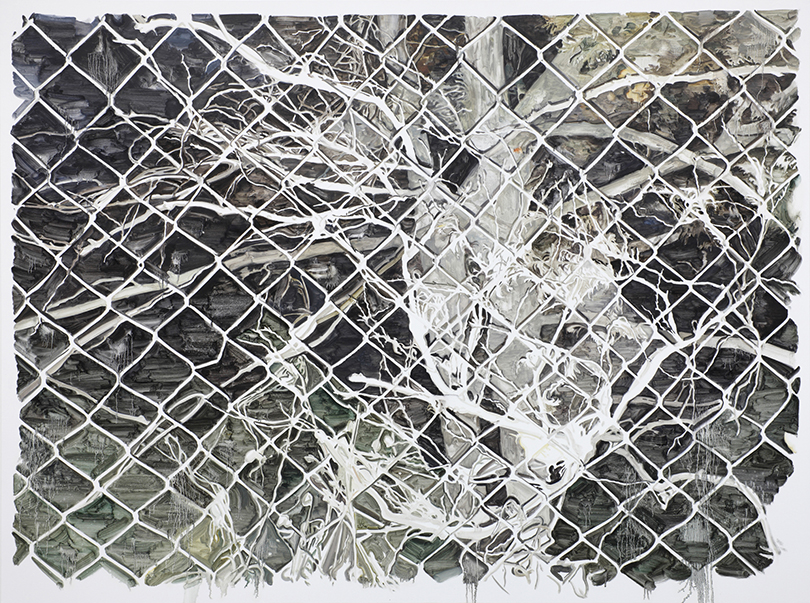
Borderline, 2014, oil on canvas, 151×202 cm. Courtesy of the artist
When it comes to her artworks, in the series Eclipse and Eclipse-, which she showcased from 2011 to 2015, approximately when she began her career as an artist, a kind of emotional consistency is seen. Lim reflects emotions (so-called nostalgia that can be substituted for the ambiguity of emotions) in her work by portraying the following: something whose shape is not perfect in After Holiday (2012), which paints an empty pool with no water and people; something that exists in the shade or darkness in The Cat (2011) and Sunset (2013); things that will soon disappear in Fire on the Flowers (2012) and Remains (2015). This is the way Lim takes a detour through the medium of the body and reconstructs the object through memory. Since the time of painting is different from that of existence, and is completed by coming and going between photography, memory and canvas dozens of times, faded colors, ambiguous objects as well as images without explanation are the natural outcome. In Lim’s paintings originating from the emotional sphere, maintaining the sense of stepping back is always important. This sign is seen in many parts of her work. Since 2016, following her work Borderline (2014), the main element in her work has been the wire mesh—this object, a barrier to prevent the external influx and outflow as well as a means of keeping a safe distance—, is in line with Lim’s attitude of being afraid of a direct contact with certain objects, emotions and moments and of suggesting just looking beyond. It is consistent in the titles of her 5 solo exhibitions: In the Shade (2020); Shape of Memories (2018); The Bird and the Cage (2016), Eclipse (2015); Rainforest (2011). Her world comes to us not clearly, but vividly while keeping a distance, being hidden somewhere, like songs heard from a distance.
Meanwhile, taking her solo exhibition titled The Bird and the Cage in 2016 held at Onground 2 as a point of departure, she began to establish her own world of art in which ceramics and paintings are combined. It may appear to be a fairly big change from the two-dimensional to the three-dimensional, but we should not forget that both are material mediums presupposing the sense of the hands. Lim’s work circulating between 2D (painting) to 3D (ceramics) seems to be completed as visual output, but what is important above all in this process is the tactile experience. Ceramics primarily functions as a medium of storage for a sense of memory as photography does, but furthermore, it functions as an independent entity (unlike photography). Whereas painting expresses senses in a taxidermied state (so to speak, as a past form and an illusion), ceramics can be more existential in that it exists in a state of open possibility in which active spatial arrangement and coordination are allowed. Although classical painting was about drawing an object and creating an illusion by drawing scenes, her work cannot be the ‘scene’ because it is based on the manifestation of the senses. As a result, Lim concentrates on managing a stage without backgrounds as well as a mental space more actively through works such as Tea Time Drawing (2019, Soshoroom) and In the Shade (2021). And it reminds me of a beautiful phrase: “The rhythms, movements, gestures, timing—all these happened at the same time and became a harmonious play.”3)
shelf, 2018, 192✕145cm, oil on canvas. Courtesy of the artist.
Lim’s work is a Wunderkammer (a cabinet of curiosities) full of crystals of senses. It is not only a showcase of memory formed in the process of interaction with the world, but a symbol of time and space of mind.4) The artist says she has looked back while dealing with subjects not unfolding before the eyes for a long time. Her work allows observers to see the things that are not in front of the eyes by putting them back before the eyes. In this way the sense (of the past) is brought back (to the present) and completes the work (of the future).
Back to the first question, it may take the form of one of the sensory souvenirs in the cabinet managed by Lim, if dreams were to have a shape. It will be up to each individual, whether one is willing to open it or not without knowing beforehand what will be presented.
[Footnote]]
1) The title of this essay “Ball and Hand” is adopted from the painting Ball and Hand (2018) that Lim painted, recalling the sense of touching the ball in a performance she participated in.
2) For this form of writing, refer to the following book: Barthes, Roland. Incidents, translated by Hee-kun Lim, Photonet, 2014.
3) Berger, John et al., Over to You, translated by Hae-kyung Shin, Youlhwadang, 2021, p.5.
4) Kyung hee Youn, Wunderkammer: A Cabinet of Poetry, Dream, Stone, Forest, Bread and Image, Moonji Publishing Co, 2021, p.19.
※ This content was first published in 『2021 SeMA Nanji Residency Program Catalogue』, and re-published here with the consent of SeMA Nanji Residency.

Jihyun Shin
In her undergraduate and graduate days Jihyun Shin studied art theory. Her main topic of research was an exploration of the sustainability of traditional media in the age of new media, and she has continued this interest in her activities through curatings and writings. Exhibitions she has curated include: 10 Pictures (2020, WESS), 3×3: Painting and Sculpture (2018, Audio Visual Pavilion); Post-Pictures (2015, Gallery175); Eun Chun’s solo exhibition Floor (2019, SeMA Storage); EunjooRho’s solo exhibition Walking-Aside (2019, Space Willing N Dealing).
-

-
 Critic / People - 11 Dec 2017
Koo Jeong A: Stories of an Ambiguous World Transforming

