
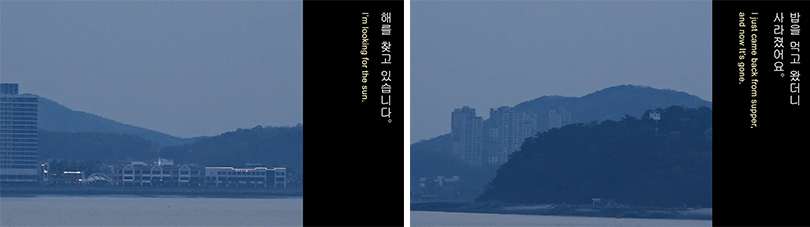
The Setting Sun and Everything That Isn’t the Setting Sun, 2020, HD single-channel video, 11min. Image provided by Incheon Art Platform.
One September day, when the heat had barely gone, I met KIM Hyeyeon in a worn-down concrete building where orange sunlight came in, obliquely. It was in Yeonhui-dong, where the exhibition Facing the Faceless (Artlabban, Seoul, 2020) was held with two other artists. Wherever you were, what would have been a somewhat war-like summer with the pandemic of the controversial year 2020, saying, the Anthropocene will change and such with the COVID-19 virus as the turning point, was just passing by ever so slowly. After being seated in front of the screen playing the new work, The Setting Sun and Everything that is not the Setting Sun (2020), repeatedly, the artist handed me a picnic drink that was inside a juice box in an old refrigerator, which also happened to be a prop of the exhibition. Sitting on a wooden bench in front of the screen, with a small rectangular juice box in hand, we watched the rising and the setting sun footage of while taking the bus and the subway whilst the COVID-19 virus was spreading. In an era when a pandemic had hit, a time when you must restrain from going outside, afraid of contact with other people, the artist set out to film after reading a phrase on a stone under the BANG Jeong-hwan’s statue. This phrase can be seen in a flash at the beginning of the video. The stone stated, “No matter what happens, regardless of how hard and absurd life has become, let us look at the rising sun in the morning and the setting sun in the evening”. As the artist had filmed the pleasant people waving hands with their backs towards the greenery on top of the Han River Bridge in Take Care (2019), also in this journey of following the sun, her camera follows along the passing time on the shaking transport. However time flows on Earth, the sun rises and falls. Suspending gravity like an anchor at our tiptoes, we too, see the sun. Everyday.
KIM’s works are questions that promote more questions. They are works of art in forms of questions. She dismantles the incomprehensible grammars of the world, edits the frames and asks, “This is how I see it. Is it familiar to you, too? Did you know we were playing this game?” This is how the artist works: Break down the rules of the game invented without one’s consent, then pick up just the frames and rebuild it.
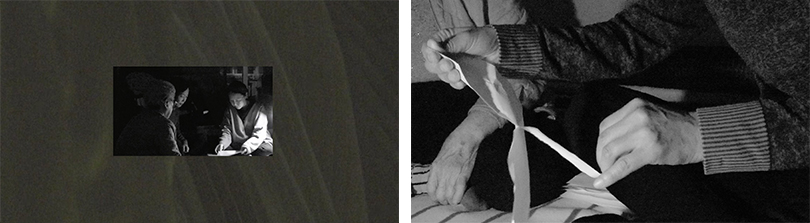
Room for Breathing, Only, 2020, HD single-channel video, 4 min. Image provided by Incheon Art Platform.
In the black and white film, Room for Breathing, Only (2020), a family fiddles with paper, indifferently, then rips it apart, rolls it in between two palms and makes it into a ball. The rule is to not speak and express your own feelings by changing the physical form of the paper, only. As a matter of fact, would a verbal conversation with the family be understood better or bring about a remarkably better result than the while spent crumpling and tearing the paper in silence? Usually, who, within the family, is picking up usable information amidst the vortex of the complex rule of language we share, and also, after the conversation, as though quietly filtering sand with a sifter at a river, sifting out gold that way? In the explanation of the work, the artist wrote, “suffocation when I open my mother’s text, and not being able to say it to my mother” like an apology. However, as computers can speak only in binary numbers, the room where you can only communicate through the two-dimensional object, the paper, is peaceful within the silence. Our conversation where channels are drastically reduced, having lost all the vowels, consonants, nouns and adverbs, is more equal and comfortable than you’d think.
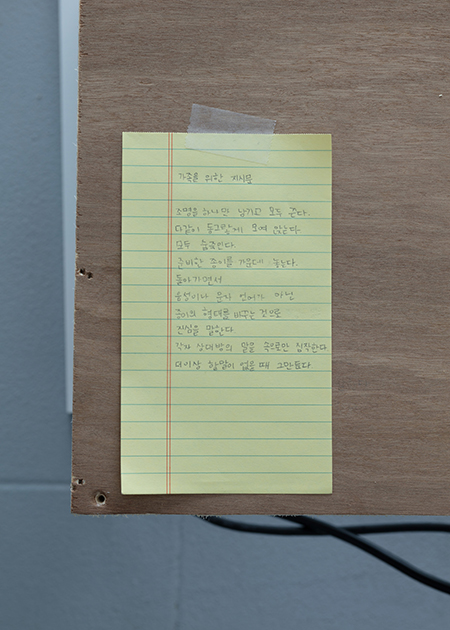
Instruction for Room for Sleeping, Only, 2020, Pencil on notepad, 17×9cm. Image provided by Incheon Art Platform.
Instructions usually appear in KIM’s work. There is no other consolation to viewers who would have become confused, faced with the charming yet difficult contemporary art.
The instructions repeat, show the same date, time, and cardinal points, but the view of the video’s day and night, and the announcement in the bus is changing. According to the instruction, the game in play changes, someone is eliminated, ends, and then starts over. That’s how games are. When there is a rule, you can rely on it.
The artist asks, again, the secret method of being able to barely hold on to the world, without having to slip off or disappear like the parts that have broken away from an engine’s centrifugal force. Should we keep an even distance between us? Should we try putting fluffy cotton wool between our bodies, unpleasant, running down with sweat? It is the rule which the artist had presented in The Running Rectangle (2011) and The Soft Warm-up: Summer version (2018). How can we negotiate in order to survive, you, your way, and I, my way. When I look at KIM’s works, the fact that the planets and stars are eternally practicing purposeless duties; drifting apart and coming close, securing their places within solemn law, and the fact that humans having the ability to discover this, have constantly pursued ways to live naturally suddenly feels close. Why is it that, like how water flows from top to bottom, we cannot live effortlessly? If there is a rule in the world, why is it that, to me, it is made in ways that are totally unrelatable? What will happen to me if I stop this action?
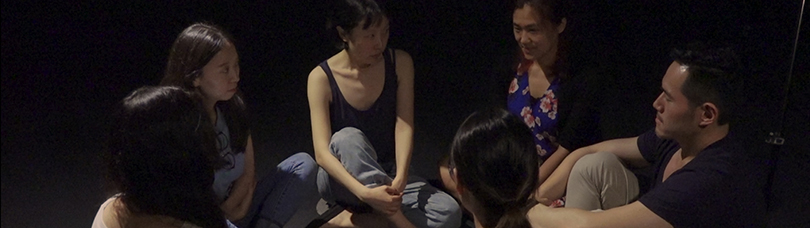
Air Cake, 2018, 2 channel HD video, 6 min 26 sec. Image provided by Incheon Art Platform.
KIM’s question goes as far as seeking mute negotiation over oxygen. People gathered in Air Cake (2018) follow the rule that no more than two are allowed to breathe at the same time. They observe each other’s breath, carefully examine faces, breathe in and breathe out. After a short silence of the hastily exhaled breath, someone else breathes in hurriedly. Not long after, two at a time, people are eliminated and quietly leave. In the end, just the two who have held their breaths in turn, looking at each other’s eyes, without any conversation, even, remain. As though gulping for air after coming up above the surface of the water, with a sound of deep breath, the screen blacks out. KIM’s experiment doesn’t aim to show the tragedy of common land. No matter how air is the most common resource in the world, what if I were to live and you to die, or you to live and I to die. What if the moment we greed over one more breath, the moment we make a single mistake in this timing game, we both were to die.
A long, long time ago, I thought of carrying a post-it note. What would happen if I walked around with a pack of post-it, wrote “your bag is nice,” when seeing a stylish woman, or “I like that animation, too” to a person who is wearing a T-shirt with a cartoon character, which not many people know, and hand it to them? What would it be like, if I were to unexpectedly talk to a stranger that way? Only, with a compliment written on a piece of paper, and not vocal language. However, it eventually ended up being merely an idea. It is because you cannot fight against the rule which we have agreed upon in silence that if you talk to a stranger, you are a missionary of some sort of pseudo-religion or an insane person. Even afterwards, whenever I saw someone who had matched their scarves with their socks, perfectly, in a bus, I would intermittently be seethed with a desire to hand over a note, all of a sudden, but that was it.
KIM Hyeyeon’s works are the forgotten questions of people. They are experiments in which questions have gained form. KIM’s question quietly crosses over the time of humans, riddled with mystery and filled with outcries, playing this imaginary rule as a game. Serious as if, when we were little, we would suddenly fall dead had we stepped on a line in a crosswalk, and as if we mustn’t touch the floor since it has become completely covered with lava.
※ This content was first published in 『2020 Incheon Art Platform Residency Program Catalogue』, and re-published here with the consent of Incheon Art Platform.

HEO Seromi
HEO Seromi is a writer, representative of language education company, Speak Easy, and has written How Not To Be Fooled By My Own Language (Seoul: Hyeonamsa, 2019). She mainly writes about bilingualism and foreign language education for adults, and her educational principles are rooted on genders and cultural approach on comparative linguistics.
-

-
 Critic / People - 11 Dec 2017
Koo Jeong A: Stories of an Ambiguous World Transforming

