
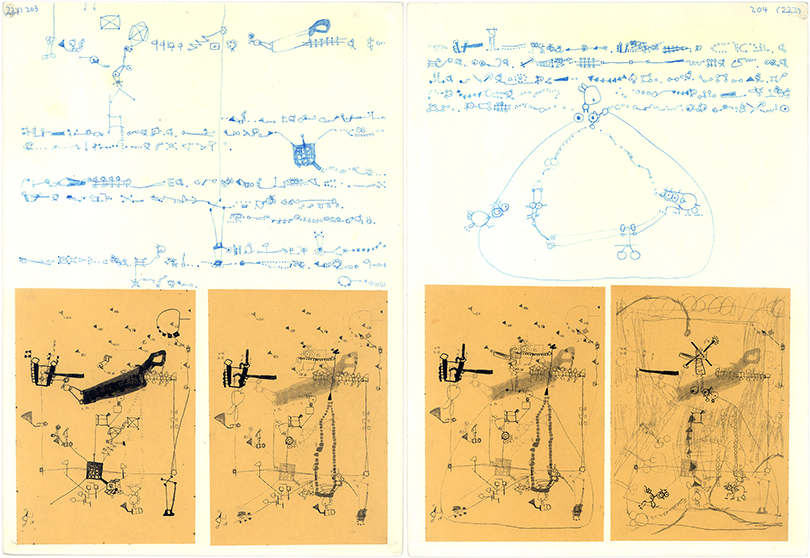
Tokki Book, 2002, drawing on paper, 36x27cm. Courtesy of the artist.
23 years have passed since Haksoon Hong began to keep records of circles in 1998, and he is still working on it. Subtle differences in form between circles that Hong accidentally found in consecutive drawings were enough to arouse his curiosity. The artist defines these characteristics as ‘one circle has one core’ to solidify the existence of each circle. And it becomes the identity of the circles. Individual ones that are given identities start to form a similar group. “Close circles became friends,” says Hong. Favorable objects are involved in the creation voluntarily through deconstruction, disassembly, combination, selection, application and connection. The essential property that ‘one circle has one core’ is still maintained, but circles are now intertwined with each other. They begin to communicate while exchanging shapes as humans use language while coming and going. As they become alive during the course of communication, they now need names. The artist calls the first thing that appeared in the circle ‘Tokki.’ In fact, it has no connection with the characteristics of a Tokki (rabbit) that we commonly know; Hong just borrowed the letters for a while to give it a name. These living things with names do not move as the artist intended any longer. Each has an independent direction according to its own moves. What the artist does is just observe and record in a contemplative manner. These records have become a book of approximately 20000 pages and are still in the process of being kept. This is the starting point of Wink Tokki as well as ‘Tokki Language,’ the blueprint of Wink Tokki Drawing.
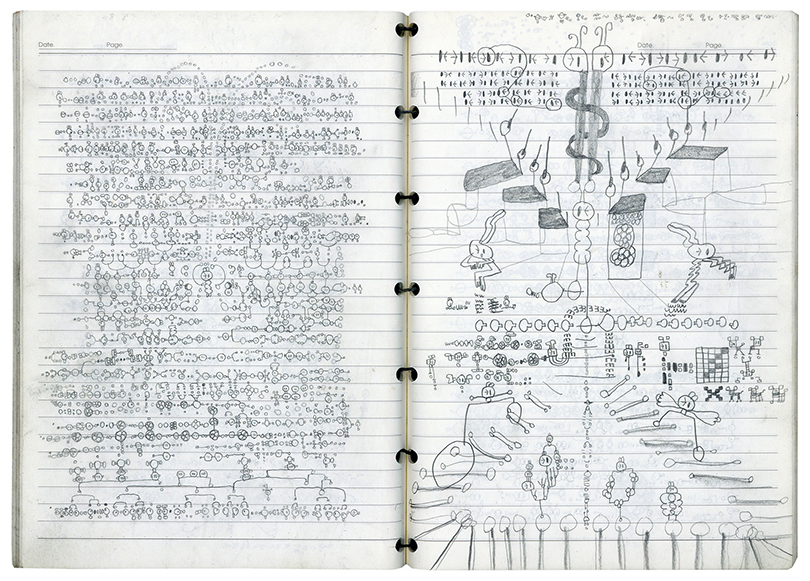
Tokki Book, 2015, drawing on paper, 36x27cm. Courtesy of the artist.
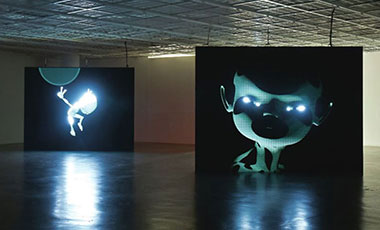
In Wink Tokki Drawing, there exist a variety of views of the world: Deer Forest, Alpaca World, Friends from All the Universe and Squirrel Residents Center. Each piece of work is interconnected in a complex way. The world composed of the Tokki language cannot exist alone. The works that can approach the Tokki language closely, thanks to the help of the artist, include cartoons and video animations. Since the layers that the artist intentionally piled up include a narrative structure, we can read the flow. If a layer is randomly taken from here, it becomes the beginning, middle and end of another view of the world, leading to the beginning of a new narrative. Overlapping layers are actually recorded and interconnected in the artist’s 20000-page book. Through the work, Hong does not ‘record the things that really happened in reality,’ but ‘tells the things that could possibly happen, in other words, those that are possible according to the law of probability or necessity.1)
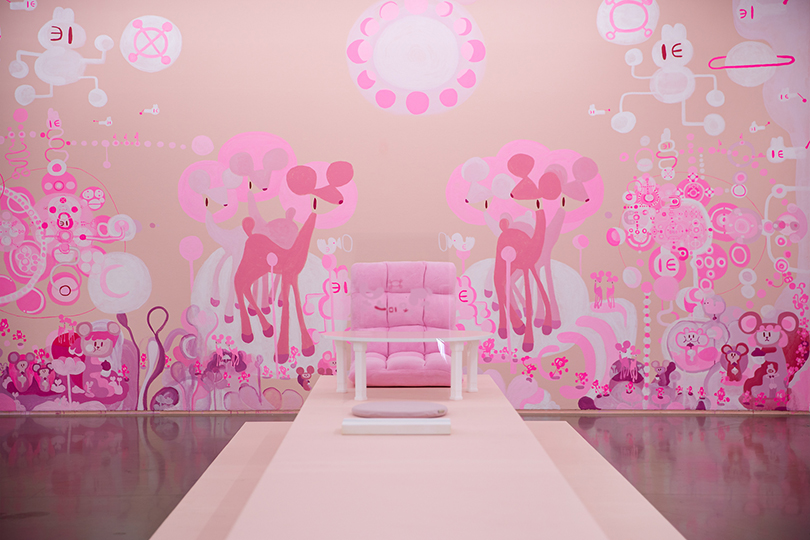
Wink Tokki & Deer Forest, 2021, wall-painting, 7000x3000cm. Courtesy of the artist.
“Why would I draw if I can express just in words?”, said Hong during the interview. Sometimes we cannot find letters to substitute for an object even though we perceive its existence. While we list words that we know by a rule of thumb, the essence disappears, leaving universality behind. Sadly, at times, the essence changes when we are fully willing to interpret, sticking to an intellectual tradition. My answer to the question “What kind of attitude do we need when seeing the artwork?” would be “to experience” in artist Haksoon Hong’s work at least. Through experience, viewers may accept the work intuitively or encounter varying viewpoints and duration, like in Cezanne’s apples. The key point I want to make here is that the work should not be understood on a formal level while being regarded as an object of analysis. When touched by Eros, anyone can have the qualities to be a poet. When reaching the state of spiritual fullness, beauty is born as a natural consequence. I have no doubt that works will act as a good midwife to viewers if the world of the artist is approached not as an object of interpretation, but as an erotic experience.
[Footnote]
1) Thesis, What Does a Poet Do? Probability, Necessity and Possibility in the 9th Chapter of Aristotle’s Poetics, Pan-Korean Philosophical Society, 2016.
※ This content was first published in 『2021 SeMA Nanji Residency Program Catalogue』, and re-published here with the consent of SeMA Nanji Residency.

Sujung Oh
Sujung Oh currently serves as the head of the independent design/art studio, ‘grewon’, which designs ‘Framework' required for study/research/work and produces 'Internal Content' on art, aesthetics, philosophy, and literature. She also runs communities based in Seoul and New York.
-

-
 Critic / People - 11 Dec 2017
Koo Jeong A: Stories of an Ambiguous World Transforming

