
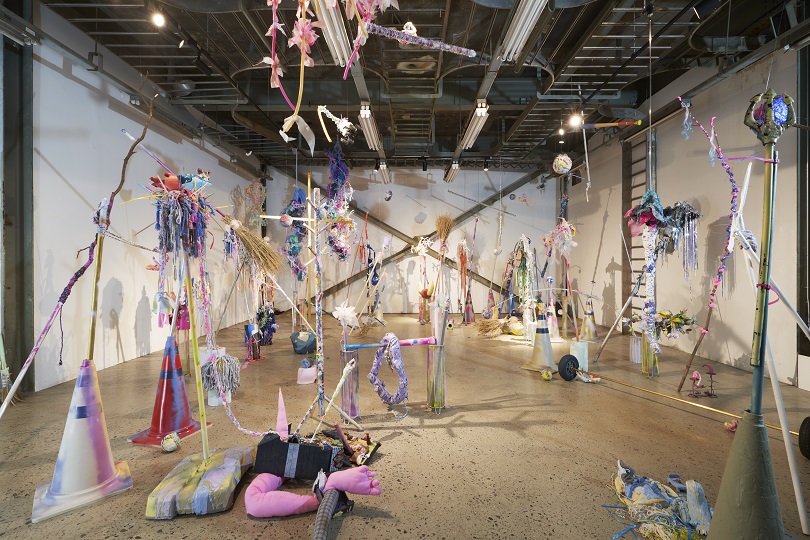
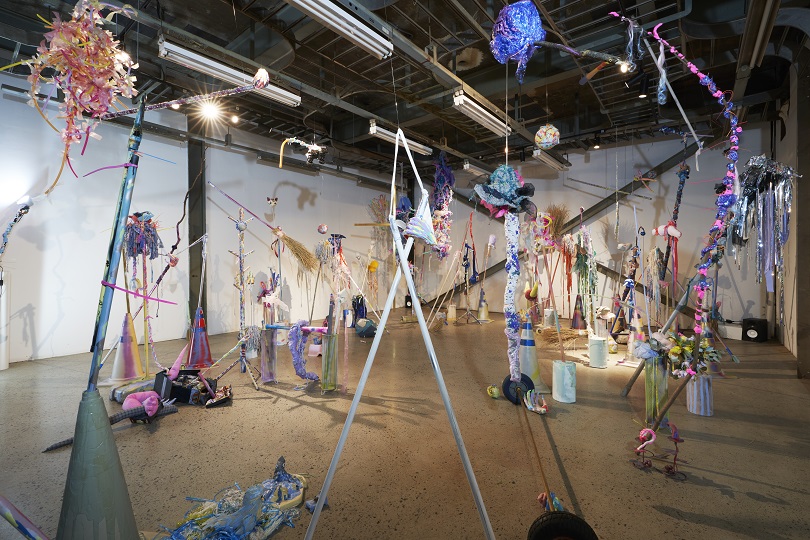
Relaxed Hurricane_ Swinging 2021, 2021, Installation, Variable size. Image courtesy of the artist.
Haeju: I heard that you’re working on Swinging 2021: Relaxed Hurricane, which is connected to your solo exhibition from 2018, Swinging. Let’s discuss this series.
Hannah: I wanted to make a group or state that was loose but had potential for change. I believe that people who have tried or are trying some changes in their lives are in this state. It is impossible to forecast the direction or speed of a hurricane, and it travels around in an unpredictable state, regardless of whether it contains hail, rain, or wind. The title also conveys some ambiguity and conceives of a desire for power, far-reaching influence, although it is at a standstill at the very moment.
Haeju: I think the word ‘relaxed’ means ‘yet to come.’ The hurricane that will grow stronger or bigger.
Hannah: Or it may just fade away.
Haeju: Regarding the format of the work, I heard you differentiated it from Swinging by organizing rotating arrays and adding new versions of music. In particular, why did you construct a rotating installation on the ceiling? Is it a device to highlight the potential of its power?
Hannah: In Swinging the works were standing upright on their own. My intention was to relieve these simple and strong conventions this time. Standing straight up by oneself is a burden. It is difficult for a person and also an object or artwork without functionality to stand by itself. In other words, building a standing statue is challenging. Relieving that condition frees the form of the artwork and allows for an irresponsible shape.
Haeju: An irresponsible shape?
Hannah: Since it does not have to stand, it can be in any shape. It can be hung or installed free of gravity. Here, I necessarily used the word ‘responsible’ because standing upright indicates a physical state but also can symbolize ‘independence.’ Any random posture is fine, so it can even stand horizontally in the air, instead of vertically.
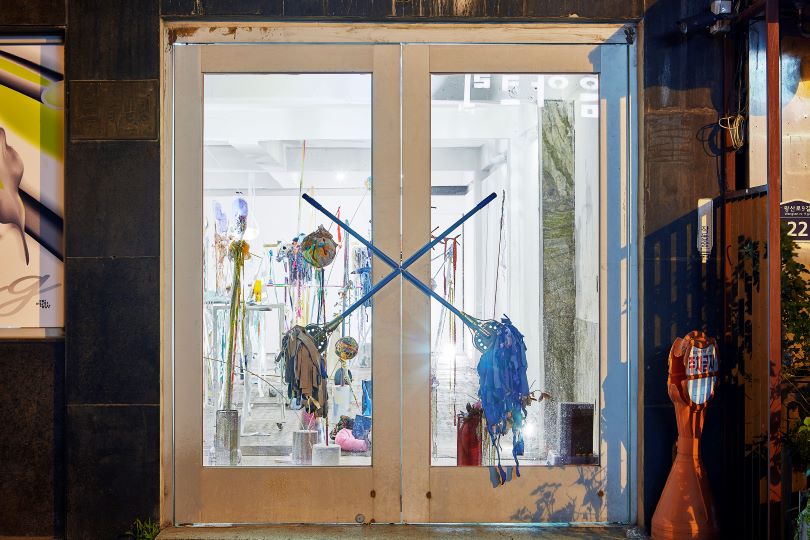

Swinging, 2018, Installation, Variable size. Image courtesy of the artist.
Haejoo: How much of the exhibition Swinging was reapplied in this project?
Hannah: About fifty to sixty percent. Forty percent was reused intact, about ten to twenty percent was remade because some elements were damaged, and the rest was made anew.
Haeju: In general, an artistic practice establishes a fixed form as an exhibition and is mostly maintained even when it is reintroduced and adapted to the exhibition’s context and space. Of course your installation contains many elements, but it is unique in that it is not reproduced, rather it is made into a new version to match the present time point. Is this because you have a special position regarding this practice?
Hannah: The format of this work was ‘protesters should reflect the zeitgeist.’ So, it may be different from the representations in other projects. I kept thinking that it would be a lie if the protesters did not reflect the zeitgeist at the moment.
Haeju: If so, you may change and evolve to different aspects and positions in the future. Were there other works from the past that were recalled like this?
Hannah: Not yet. Once I created a work on animal rights that had been reintroduced in another exhibition, but the form hardly changed because the message was the same. However, Swinging cannot avoid variation whenever it is remade, because, from the first place, it involves the underdogs, diverse opinions, ideas, and the desire to change.
Haeju: Swinging portrayed dynamic protesters marching in one direction with a firm belief in change. Did you plant a specific message in this version as well?
Hannah: Not quite. When organizing Swinging, I delicately added specific elements into each work, but because this project could not have a specific message, that eventually changed its formation. It is a shortcoming but also a signature of this work that only a few characters are claiming something specific. Perhaps it is a state that hesitates to advocate for certain change or even hesitates the act of advocating itself. It is frustrating, but this is my state reflected in the work. I believe it is also important to frankly disclose this state of hesitancy although it does advocate something.
Haeju: While it expresses the state of a standstill, there is a variation in the use of material. Variation of material and format is a significant change.
Hannah: I came to consider the fragility of an artwork that cannot be reused after a show. Thinking about the changes that enable sustainability and repairability of an artwork, I experimented with artwork maintenance materials like Tarbender that fixes wrinkles as if they were frozen, and clay with about half the solidity of ceramics. Meanwhile from Swinging, some parts like colored clay were unexpectedly well-preserved. Some works I put great effort into were ruined and some were surprisingly well-preserved, so I plan to strengthen the use of those materials.
Haeju: Along with the thoughts on artwork sustainability, the context of this series is the transformation of existence, but preservation is emphasized in terms of material.
Hannah: I’m swinging in between wanting and not wanting to preserve, because preservation hinders me from moving onto the next project. If this series continues, I wish at least about 1 to 5 works of season 1 persist to the end.
Haeju: I don’t think the material itself would change that easily. Do you expect that many would vanish?
Hannah: Considering its value for preservation, I am still doubtful of whether I want to maintain it in the future.
Haeju: So, this is a work that ages with the artist, and in terms of time, its scale is pretty grand.
Hannah: In terms of a political stance, there is a compulsion that an artist has to be even more progressive than progressive. That is how I have thought and learned about the way an artist exists. This practice projects my determination to hold on to that principle, even when my belief as an ordinary person does not necessarily agree with it. Swinging represented the protesters demanding for change. After the first version that embodied my experience at Seoul Plaza denouncing the administration, I implied a dissatisfaction with changes during the next administration and how I became a different person living an ordinary life. Certainly, this state involves some sort of skepticism but resists easily being swept away. This state of fogginess is expressed in a hurricane.
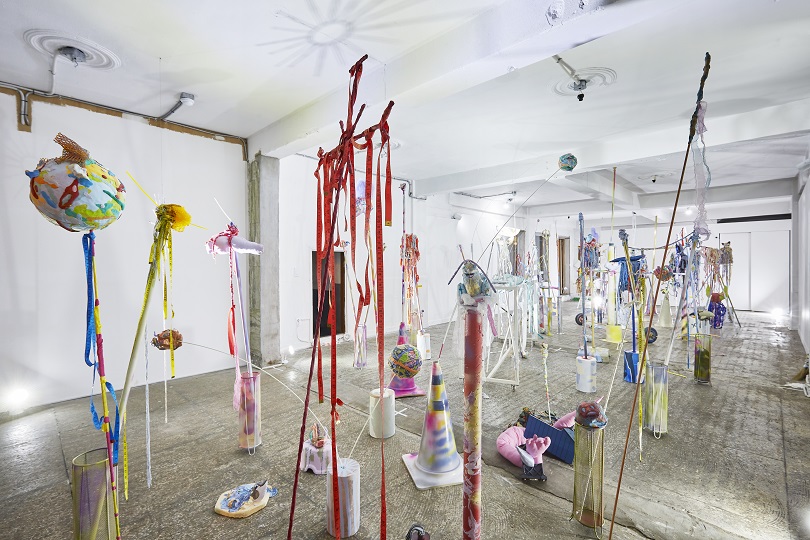
Swinging, 2018, Installation, Variable size. Image courtesy of the artist.
Haeju: Fabrics are used very often in your work and I heard you’re exploring various ways of treating fabric.
Hannah: People easily associate fabric with stitching, but I try to demonstrate diverse methods such as using a fine stitch, or allowing the thread to come loose. There are also weavings and knots that make tight clusters. This can be seen as a form of social symbolism. Weavings should consist of identical grain, but depending on how it is tied, a knot can never be undone even if the fabric is different. These aspects are what I feel thrilled about. I love knots more than any other technique, and I also admire drapes that fall below a tight knot. It matches my personality and language that prefers a group of underdogs over one individual. In that context, what I find fascinating about a tie is its various patterns, not that it is a symbol for masculinity. I find it interesting when an object with elements like knots and drapes is tied with different fabrics.
Haeju: Did you also establish some symbolism in the texture or color of the fabric you chose? Or did you choose them more spontaneously? It looks like there are certain colors of fabric that are used more often, like a painter’s favorite paint.
Hannah: I’d say I choose the colors like how I make a drawing. However, I don’t use hemp since it radically shifts the nuance. Rather, I prefer fabrics with gloss. The color palette is based on sky blue and evolves to light green or pink sky, and the rest is selected to match. Occasionally, I use colors like orange to add uniqueness. Sometimes I see a chic black artwork in my dream and try to recreate it, but eventually end up adding one blue ribbon on it. That’s how it works.
Haeju: It reminds me of your drawing practices that transform the character of Alice into many different forms and colors.
Hannah: I always proceed with my drawing practice like that, and the result is reflected in the colors of the actual output. But this year, I heavily explored materiality and forms.
Haeju: The mindset towards material, or energy exchange between the artist and material must have changed a lot as you adopted more sustainable materials. For example, being more cautious about deciding the shape of an artwork or just acknowledging that what is done is done.
Hannah: I’m still battling in that exchange, and I should keep fighting. (Laugh) One of my strengths is an inability to imitate even a good example, but I make my own way as I play with and lose to new trials and materials.
Haeju: And it will keep changing as we get older.
Hannah: No one can define me. (Laugh)
※ This content was first published in 『2021 SeMA Nanji Residency Program Catalogue』, and re-published here with the consent of SeMA Nanji Residency.

Haeju Kim
Haeju Kim is a curator. She is Artistic director of Busan Biennale 2022.
-

-
 Critic / People - 11 Dec 2017
Koo Jeong A: Stories of an Ambiguous World Transforming

