
A film’s pre-production process is somewhat similar to its post-production stage in that it pre-visualizes a film that is yet to be seen and reconstructs preceding references. The Squatter Settlements in Space is a fictional film that has not yet been made. It underscores the imagination of the sci-fi genre, which purposefully redistributes the power that distinguishes the past and present. The pitch deck document, a critical project by artist Jungwoo Lee and curator and producer Shinjae Kim, outlines the film’s motif, background, atmosphere, sound, and cast, while previewing the multi-dimensional sequence of the latent future in light of the extraterrestrials of the past and present. The film remains an unrealized possibility and probes what kind of future it will draw closer.
1. Introduction: Too Many Yesterdays, Not Enough Tomorrows 1)
Is there any other appropriate time than now to call it a global crisis? Among disasters arising simultaneously all over the world - natural, man-made, and infectious - it is getting more difficult to imagine the future. Unlike cinematic clichés, disasters do not introduce themselves in dramatic ambush. Rather, they gradually threaten the today, only little by little. A life struck by disasters does not destroy the world all at once but from the vulnerable and invisible axis of the system. If reality has drawn close to its darkest future, how can one trace the shadows of different futures?
S.S.S notices the future that is often excluded in between the optimistic prospect that science still can save us and the recreational consumption of post-apocalypse universes. Why are some futures empowered while others are not? The film features an alien-ness that is already built within reality as well as the future that is based on an imminent space-time to re-draw a future being pushed aside at this moment.

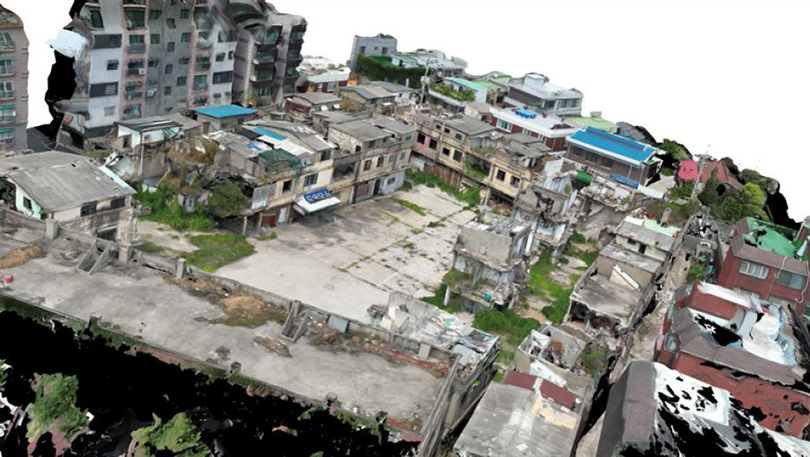
29-24 Sungui-dong, Nam-gu, Incheon. Metashape 3D Space Photoscan model. Image courtesy of the artist.
2. Squatter Settlements in Space
Squatter settlements have many names: unauthorized settlements, shantytowns, slums, etc. The names reflect the social status of its residents and whether its formation has been sanctioned. As agrarian civilisation made way to the industrial society, urban expansion through development and economic growth proceeded in a way that inevitably caused mass-production of the urban poor. The explosive growth of the urban population drove the city’s lower-class citizens to psychological and geographical margins, effectively isolating them. Those who could not afford to leave the economic foundation the city provided lingered about the city, creating squatter settlements. However, these regions also have been over-developed with countless apartment complexes flooding these sites and obliterating the traces of the past.
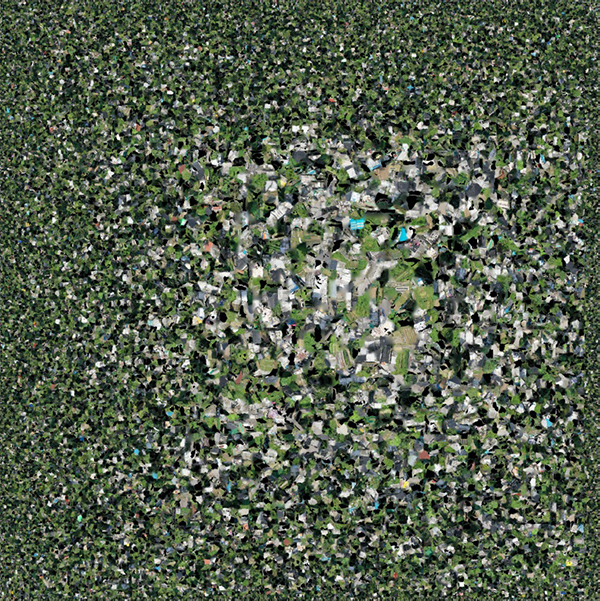
478 Yangjae-daero, Gangnam-gu, Seoul. Metashape 3D Space Photoscan Texture. Image courtesy of the artist.
Metropolitan areas, including Seoul, are like a Gomoku board 2) with no room left for another stone piece. If development persists in this limited space, how far could the concept of squatter settlements and residents expand in the future city? Developmentalism attempts an expansion to space, citing environmental issues of earth and its future growth engine as excuses. The media informs us that we only have so long to wait until the migration to Mars begins while Space X rockets and Mars Probe launch was being aired live. As if the new days would unfold shortly right in front of our eyes. However, instead of such newness, this project focuses on the future that repeats itself, the space and people excluded by developmentalism for the sake of growth, and features the squatter settlement that will be established somewhere in the future.
3. Again, to the Moon
With NASA as its center, the Artemis Program attempts to send a man on the moon after 52 years. The purpose is not merely to explore the moon like the previous endeavor. It is a long-term initiative that involves building the Lunar outpost to send a man to Mars and a Lunar Orbital Platform-Gateway that communicates with the Lunar outpost.
The concept of Terraforming, suggested by American science fiction writer Jack Williamson in his book Collision Orbit in 1942, is looking to be made real. Deceased theoretical physicist Stephen Hawking also argued that humankind will face extinction unless we start a colony on another planet to replace earth, which is confronted with myriads of limitations such as climate change, infectious diseases, overpopulation, and potential asteroid collisions. Lately, many countries besides America – European countries, India, Japan – and even private enterprises are embarking on space programs. On the other hand, China acquired the technologies from Russia to push forward with its rise-in-outer space agenda. The space race has been rekindled reminding us of the Cold War between America and the Soviet Union: a déjà vu of the imperialist colonial war as if the competition of space development is imminent.
4. Structure:Tidal locking
Tidal locking is the phenomenon where a satellite’s cycles of revolution and rotation are synced. This is the reason why the moon and the earth revolve around with the same sides facing each other, and we call the moon’s face towards earth the front of the moon. A person never gets to face the moon's backside from earth, and in reverse, the earth gives the illusion that it is fixed at one spot from the moon’s perspective. The phenomenon of tidal locking is caused by the gravitational interaction between two celestial bodies with different masses. In other words, when they are close to each other, a satellite with a smaller mass revolves around the other satellite with a bigger mass due to gravity. This is similar to a subordinate relationship created by power imbalance.
S.S.S questions the subordinate relationship of power that resembles the tidal locking between the earth and the moon, and the film is structured in a similar manner. It explores how gravity works around the space-time we live in and whether the working of those powers could bend or change in any way. Supposedly, the present and the future revolve around each other, like a planet and its satellite. Based on this premise, the film will pioneer the back of an uncertain future and reset the gravity between the present and future.
5. Tone and Style_Déjà Vu
Déjà vu is a French word meaning ‘already seen,’ referring to a delusion or illusion that one feels like he has already experienced a situation.
News outlet presents new events or accidents that occur every day as the past events accumulate on top of one another endlessly, making it difficult to discern which has happened yesterday, this morning, or just now. A young man died of an accident that took place at Guui Station, multiple calamities broke out at labor sites in one day, the Hangang River bridge collapsed in one morning 20 years ago, and the building fell over a bus recently, to cite a few
The sense of déjà vu is not about the actual experience, but more in the lines of emotional reactions like despair, anger, and grief. This bizarre déjà vu might come from a state that is hard to grasp wherein the actual problem and its cause come after prolonged and endless repetition and accumulation. This project compiles like a montage of events. The images are subtly connected and chained together although the exact causal relationships are not identified. The instant association of Metropolis (1927) with Blade Runner (1982) leads to an enormous tomb, like the burial site of the Gaya period.
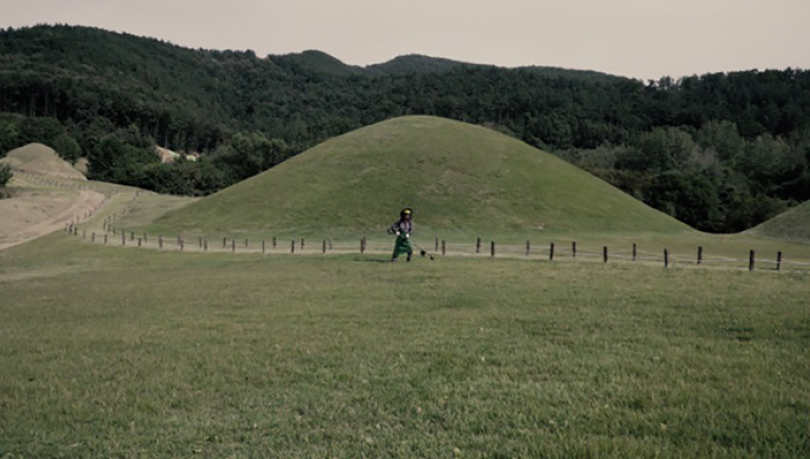
The Golden Age of Grave Robbing (2019). Image courtesy of the artist.
6. Pre-production & Future
The production design of the pre-production process focuses on establishing an appropriate visual style that corresponds to the film's intention. A production designer interprets and analyzes the intention of a scenario or the director to create a visual blueprint. Like a floor plan in architecture, it proposes the overall concept, tone, style, space, people, costumes, makeup, graphics, props, and specifically, sequence, scenes, and images of each cut, which functions like the building's floor, hallway, and rooms. It is the pre-visualization of a virtual film that has not been made yet. It consists of preexisting images. A film that does not exist in flesh is constructed with images collated from various means.
S.S.S is a virtual film that is finalized at the stage of pre-production. It is also a map of something that will come be portrayed in the near future. The notion of the pre- implies a possibility yet to be realized and accompanies potential uncertainty which stays unhinged. The process of pre-production unfolds a future that is created by potential possibilities of the past and the future, while resembling the temporality of the future.
7. Scouting
The biggest portion of this project is location scouting, or in other words, finding an appropriate space for virtual squatter settlements of the near future. Finding a space does not simply mean physical discovery of a location that accommodates the film’s requirements. It does not have to be an actual space. It could be the moon, Mars, an online platform, website, or virtual space like a metaverse. The concept of a future space in this project goes beyond the physical space and location, and encompasses an expanded meaning.
The process of anticipating and designing a virtual squatter settlement is similar to tracing the history that real ones. Most of the large squatter settlements around Seoul have been formed as a result of the expansion and development of the city. Guryong Village, for instance, still remains a squatter settlement and is in the middle of controversy due to its sizable prospective economic value after development. Also, Gangnam has played a crucial role as an outpost of Korea’s transition into an industrialized state after its development. Speculation of a future squatter settlement involves a place that will be an outpost for development like Gangnam. The root of land hunting and competitive development that took place around the deserted Gangnam of the past may unfold in the same manner on the backside of the moon or Mars. And yet, it is undecided whether this scouting will be after the land or the people who belong in space.
8. Native & Squatter
The main characters of this project are largely from two groups. One is the natives, in a general sense, who have been settled in the region, and the other is the people who had to form a squatter settlement because they had nowhere else to live. However, these two groups will not appear in the project as actors or narrators. The film is about their stories, but by detour such as demonstrating how they occupy the land along with the traces of deprivation rather than resorting to conventional approaches of plays.
9. Music: Audible Frequency
In October 1957, the world's first artificial satellite Sputnik launched into the earth’s orbit. The signal of Sputnik orbiting every 96 minutes was the first sound outside of the earth that man has ever heard. Any amateur radio operator could receive the frequency, and this regular signal, along with the hope for space travel, influenced the development of electronic music in both America and the Soviet Union.
Introduced by NASA for Halloween Day in 2020, the list of Sinister Sounds of the Solar System included the sounds from the black hole at the center of the Galaxy observed by NASA’s Chandra X-Ray Observatory, Marsquake measured by NASA’s Mars InSight lander, NASA satellite’s recording of the solar winds, and signals from Jupiter’s ionosphere when the space probe “Juno” passed by Jupiter in its fourth journey. Although sound waves are not transmitted in the vacuum of space, NASA converted observed light or radio signals into audible frequencies that humans can hear. Ultimately, these are not the sound of space, but the sound of humans that reverberated back to the senders. The converted sounds are made into several variations to be used throughout the film’s sound design including its music score.
10. Outpost
Known as the first Chinese science fiction novel, the unfinished novel Lunar Colony (月球殖民地小说) was published from 1904 to 1905 in the magazine Illustrated Fiction (绣像小说). The protagonist of this novel travels the whole world on a hot-air balloon and finally reaches the moon to establish a utopia. Inspired by this piece, Chinese intellectuals dreamed of stepping further from a mere space expedition to colonization. Recently, the Chinese manned spaceship Shenzhou-12 carried astronauts to the Tianhe core module of the Chinese space station, stepping closer to their goal of sending a man to the moon.
In 2019, Chinese spacecraft Chang’e 4 first landed on the far side of the moon, on the South Pole Aitken Basin. Including its landing site, each spot on the moon has earned Chinese names, including Tianjin(天河), Zhinyu(織女), Hegu(河鼓), and Mons Tai. Meaning “Jade Rabbit,” the Yutu-1 rover measured the ground using a lunar-penetrating radar. Shackleton crater of Aitken Basin is not much affected by the extreme temperature gap on the surface of the moon because it is under a permanent shadow, which makes it an ideal site for a potential lunar outpost.
11. After Future, Future of Future
Films or novels about dystopia in the past often present alternative imaginations by projecting realistic problems into the future. However, current post-apocalypse universes are patternizing the images of disasters and catastrophes by repeating themselves like a cliché, reproducing a grim picture of the future. Particularly, disaster SF movies that portray a pessimistic reality in fatal situations such as climate change, infectious disease, and polarization reflect social insecurity and horror, while emphasizing survivalism and sacrifice of individuals. However, some disasters are not visible as is the case in reality, and SF novels and films embody an awareness and limitations of the world we live in all the while portraying the future.
The issues we face are within the mundane experiences while entangled with more complex layers of problems. In order to perceive reality with accuracy, we need an ability of abstraction to obtain a macroscopic view of the network that forms today’s world while exploring what is beyond our experience. If science fiction is associated with the imagination that subversively reorganizes the powers that form the past and present, the remaining issue is what kind of future we are to salvage between the past and present. S.S.S is a proposal of a method for examining the precarious present and the future. The pre-production of it will come to be multi-dimensional sequences of the latent future.
[Footnote]
1) Too Many Yesterdays, Not Enough Tomorrows’ is the title of a short story from: N. K. Jemisin, 'How Long ‘til Black Future Month?', translated by Nakyoung Lee, Minumin/Goldenbough, 2020, pp. 487-503.
2) I compare it to Gomoku instead of Go, because, while Go competes by space occupation in a limited space, Gomoku is very simple and cannot proceed anymore when there is no more spot to put a stone.
※ This content was first published in 『2021 SeMA Nanji Residency Program Catalogue』, and re-published here with the consent of SeMA Nanji Residency. See details in this link.

Shinjae Kim
Shinjae Kim is a curator and producer based in Seoul and her main focus revolves around engaging with realities and translating material and senses through multidisciplinary approaches and curatorial practices. She has worked for the Seoul Mediacity Biennale, MMCA’s Film and Video, and other festivals and exhibitions, and continues to pursue projects that create dialogue and context through intersection of visual art, film, and performance. Recently, her concentration has been on weaving various questions and interventions with sensibility, tech, and infrastructure.
-

-
 Critic / People - 11 Dec 2017
Koo Jeong A: Stories of an Ambiguous World Transforming

