
Alicja Kwade’s first solo show in Seoul, consisting of 35 recent works plus an entirely new series, is a joint venture by two of the city’s international galleries, König Galerie and Pace Gallery.
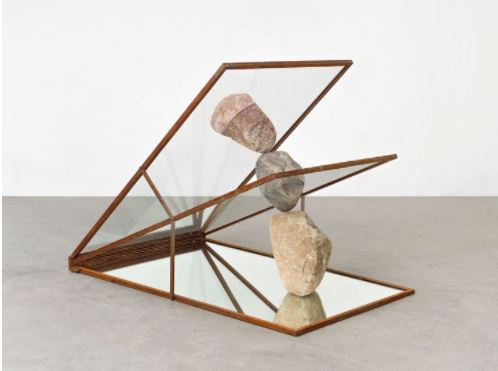
Alicja Kwade, Multi-Teller (20) (Orgel) (2018). Polished stainless steel pipes, concrete, macauba balls. 155 x 119 x 180 cm. Courtesy König.
The exhibition's title, Sometimes I Prefer to Sit on a Chair on the Earth Surrounded by Universes, is split between the two spaces.
König Seoul takes the first half, Sometimes I Prefer to Sit on a Chair on the Earth:a sentence that is embodied in Siège du Monde (2021): a wooden seat under which rests a planet-like marbled orb, whose striking colours range from maroon to white.
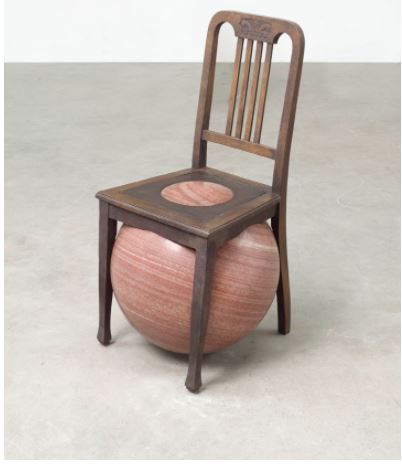
Alicja Kwade, Siège du Monde (2021). Bronze. 75 x 49 x 49 cm. Courtesy the artist and König Galerie.
It would seem that this orb, which gently bursts through the chair's seat, is the earth per the show's title—even if it is missing the blues and greens so characteristic of the planet as we know it, and seems more akin to Mars.
Does this marble sphere represent another version of the world in a parallel universe? And who is this 'I' who prefers to sit on a chair on the earth? Questions like these amplify a sense of curiosity about where the artist is taking us.
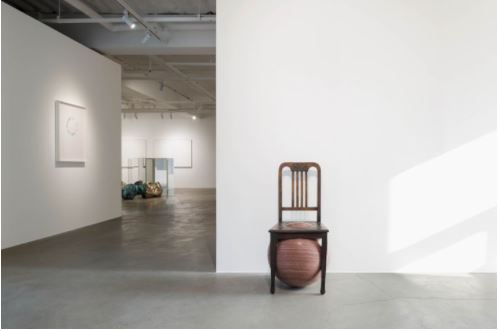
Exhibition view: Alicja Kwade, Sometimes I Prefer to Sit on a Chair on the Earth, König Seoul (10 December 2021–22 January 2022). Courtesy the artist and König Galerie. Photo: Cheonho Ahn.
In the middle of the gallery, the sculptural work Duodecuple Be-Hide (2021) confirms that this is an exhibition—a space—that one cannot know entirely, since all of its elements signify a kind of motion.
Twelve stones form a circle on the floor with double-sided rectangular mirrors standing between each of them. There are three types of stone: sandstone, granite, and bronze, the latter alternating between a green and gold patina.
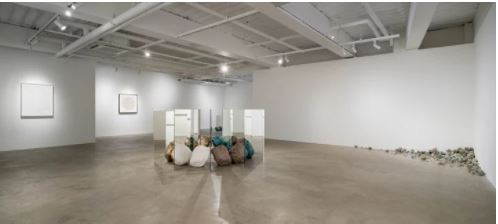
Exhibition view: Alicja Kwade, Sometimes I Prefer to Sit on a Chair on the Earth, König, Seoul (10 December 2021–22 January 2022). Courtesy the artist and König Galerie. Photo: Cheonho Ahn.
Due to the reflective feedback of these mirror interventions, viewers cannot see all of the stones at any one point, but they can observe the variables that emanate from a complete yet fully unknowable composition.
Kwade's focus on the multiplicity of space in Duodecuple Be-Hide leads to an examination of time in the new 'Entropie' series (2021), in which watch hands are assembled onto paper.
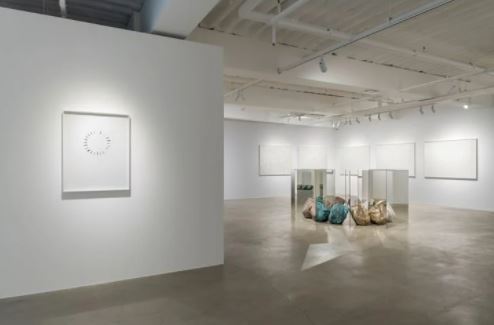
Exhibition view: Alicja Kwade, Sometimes I Prefer to Sit on a Chair on the Earth, König, Seoul (10 December 2021–22 January 2022). Courtesy the artist and König Galerie. Photo: Cheonho Ahn.
Each work expresses a specific period of time, with more watch hands incorporated into works expressing longer periods, as in Entropie (71 days 12 hours), in which the hands form concentric circles, while more free arrangements see hands bump into each other in Entropie (98 days 15 hours).
In a world that tends to make order out of its absence (or at least tries to), Kwade observes countless earthly phenomena and places them in the context of their entropic chaos.
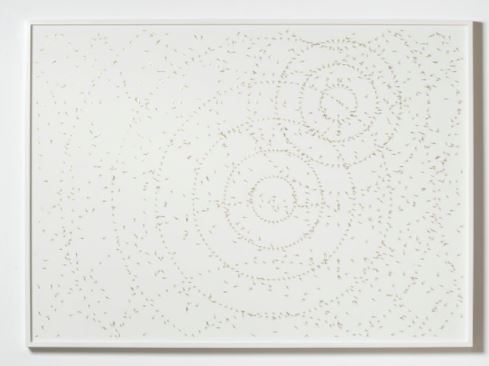
Alicja Kwade, Entropie (71 days 12 hours) (2021). Watch hand, papier-mâché on paper. 107 x 147 cm; 109 x 148.5 x 5 cm. Courtesy the artist and König Galerie. Photo: Cheonho Ahn.
※ This article was originally published in OCULA, and reposted under authority of OCULA
※ Click to Read the Original Article : https://ocula.com/magazine/insights/alicja-kwade-seoul/

Sujin Jung
-

-
 Report / Features - 31 Aug 2017
Preview of 2017 Biennales in Korea : Seoul Biennale of Architecture and Urbanism, Gwangju Design Biennale, Busan Sea Art Festival, Jeju Biennale

