
Venue: Audio Visual Pavilion
Press release
Floor Plan Cabinet began as a simple idea of aggregating curator’s exhibition floor plans. In the nascent stage of project planning in the early 2011, the project resembled more of a research or a book-writing. This exhibition started with the following passage delivered to the artists, Jiyoung Yoon, Kiljong Park, MeeNa Park & Sasa[44] and Moonsick Gang.
When we were first exploring the idea of a floor plan exhibition, we decided to tentatively call the project “1:1 Diagram” which was adopted from Sulki Choi’s artwork titled Sharp Color TV 13 N M-150. Using a motif from Jorge Borges’ novel, designer Sulki Choi produced a television that displays nothing but information on itself. Unfortunately, “1:1 Diagram” was abandoned at the planning stage in 2011 due to lack of budget and opportunity to hold the exhibition. It was also raised that there was no longer a need to think about the format of floor plans while a number of hurdles were anticipated in gathering floor plans of past exhibitions. However, floor plans continued to spark interest among exhibition managers for several possible reasons which can be boiled down to three points.
Firstly, unlike an architectural floor plan, an exhibition floor plan contains information on not only physical space but also the time and “the speaker (the artist)”: an exhibition floor plan embraces multiple voices. The exhibition space of any artist, regardless of being dead or alive, is ultimately determined and confirmed only after the opening of the exhibition. This means a floor plan, from the perspective of an exhibition manager, always involves certain amount of uncertainty and ambiguity. Although an artist usually makes the final decisions for floor planning, artist’s artwork itself carries uncertainty and thus a floor plan oftentimes becomes impractical once any prediction reflected in the plan turns out not to be realized. At a planning stage, a floor plan employs actions of filling up an empty space. Here, the overarching assumption is that the space will be vacated again for a later event, unless it is for a permanent exhibition. A multiple set of voices flock in and out like a tide.
Secondly, although a floor plan may become inoperable, it takes a rather definitive and logical form. The power of a hard copy of a floor plan is that it gives the rare opportunity for people to physically hold a piece of paper which has become an action that hardly takes place these days. The physical paper contains information such as space, title, captions and route for visitors. In other words, the purpose of a floor plan drawn on a handout or leaflet is to propose and forecast footsteps of visitors navigating through the exhibition, albeit this proposal or forecast may be reverted. Both the strength and vulnerability of a paper takes effect as being held by visitors who have entered into the exhibition space.
Thirdly, while the first two points are related to the past and present of an exhibition, a floor plan also takes an interesting role after the exhibition has ended. Photographic recordings provide information on what and how artworks were displayed. A floor plan, on the other hand, is the only documentation that gives an overall snapshot of the event at a bird’s eye view. This rare type of recording lets us have a truly comprehensive understanding of an event, including which artworks were exhibited at which place as well as when and where the event took place. Visitors have the discretion to either skip a few artworks or go against the proposed viewing order. Nevertheless, a floor plan is undoubtedly an optimal means to keep recordings of an exhibition from 10 years or 100 years ago.
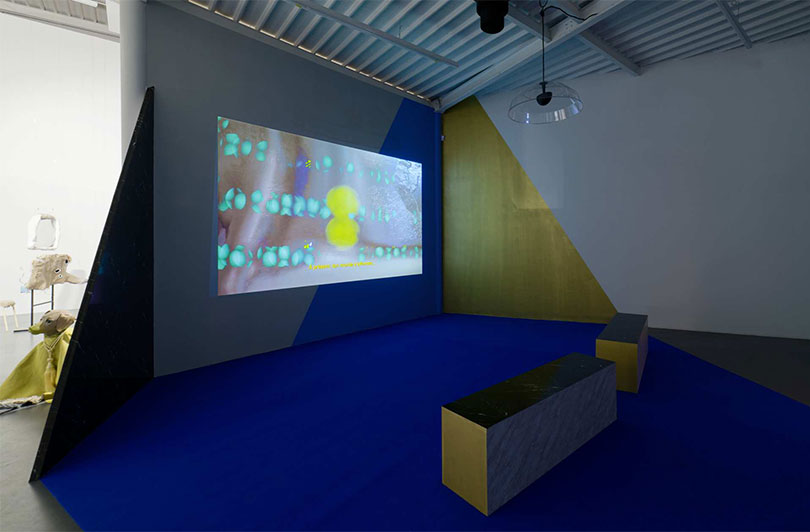
In Floor Plan Cabinet, floor plan could either be a tool to see a snapshot of the exhibition space in a single page or a way to keep recordings of an exhibition for artists. The reality of the complete exhibition only exists in either a video clip of an interview or an image. What remains and can be encountered in the present are physical materials only. Kiljong Park has experience of building equipment for exhibition venue or boxes for keeping architects and designers’ floor plans. A floor plan to him is a tangible action plan, feasibility and a manual. Jiyoung Yoon, a sculptor and video artist, says that she has a keen interest in ex-ante and ex-post recordings as well as documentations on the preparatory process of exhibitions. She highlighted that the fact that her four pieces of artwork became a new tool that can be opened up and viewed in a new format other than their existing formats of book or sculpture reminds her of a “quest for knowledge.” MeeNa Park & Sasa[44] have been accumulating and archiving a vast volume of various recordings. They see a floor plan as a converted version of the choices for their next steps. Moonsick Gang produced the Floor Plan Cabinet booklet, graphic designs and his artwork as a designer for this exhibition. What will these artists’ floor plans, as a tool for prospect not retrospect, show us? With a floor plan, you can view an exhibition at one glance. However, the same floor plan also teaches us, at least those of us who have entered in the exhibition space, that nothing can be really seen with a bird’s eye view but everything must be taken in one at a time.
-

-
 Event Calendar / What’s On - 08 Mar 2019
Hakgojae Gallery, 《Kim Ho-deuk》

