In the history of the emergence of modern art in Korea, national policies?in particular, the move to establish diverse infrastructure and spaces for art?played a prominent role. Even during a time of rapid change, the newly established government of Korea organized state-run exhibitions. In the 1980s, in step with preparations for the 1988 Seoul Olympics, the Gwacheon site of the National Museum of Modern and Contemporary Art opened. In the 1990s, in the midst of Korea’s continuing sociocultural transformation, alternative spaces and artist-in-residence programs came about. This article examines the development of contemporary art in Korea in relation to the changing forms of the country’s state-managed arts infrastructure.
Few capital cities in Asia are better organised than Seoul when it comes to facilitating the passage of visitors through the many large specialised art museums. Arts precincts are spread around the city, some even staffed by street-based guides handing out local maps. Constant expansion often means making hard choices. Beyond Seoul yet more destinations beckon.
As part of an ambitious policy to instil socio-cultural change in South Korea the government built a monumental 34,990 square-metre modern art museum on a gigantic site in Gwacheon, Gyeonggi Province to create a national facility that would satisfy foreign audiences arriving for the 1988 Seoul Olympic Games. In the middle of the new Museum of Modern and Contemporary Art (MMCA), Nam June Paik’s The More The Better was installed, funded by the Olympic budget. In the same year, the Seoul Museum of Art opened in one of the old edifices of Gyeonghigung Palace. It became clear that the hosting of international sports events like the 1988 Seoul Olympic and the 2002 Korea-Japan World Cup was deeply entwined with the changes in arts policy.
As domestic politics became democratised in the 1990s, the system, style and field of the arts sector began to rapidly diversify. After 30 years of centralisation, the system of local autonomy was revived with the empowerment of local governments, leading to the emergence of numerous art museums in cities and prefectures across the country. One of the first museums to benefit from this local funding was the Gwangju Museum of Art, which opened in 1992 in time for the momentous opening of the 1st Gwangju Biennale in 1995. Currently, there are about twenty municipal and provincial art museums, but the competition between local governments to attract funding for new art museums still continues.
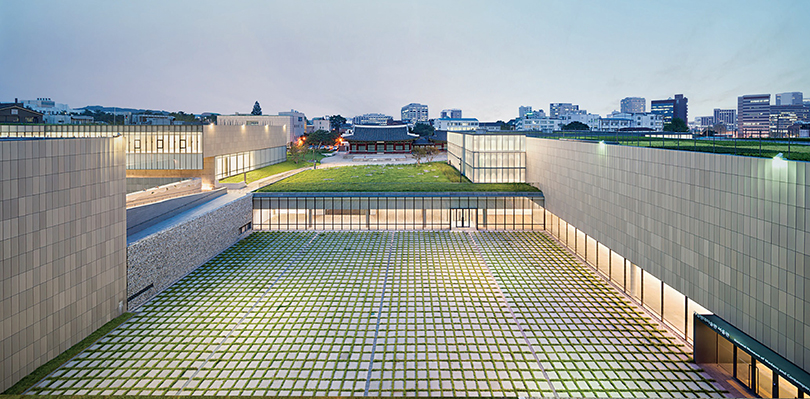 New building for the Museum of Modern and Contemporary Art, Seoul, opened 2014 ⓒ MMCA
In the 1990s, South Korea’s economic expansion experienced the highs and lows of capitalism, resulting in the IMF crisis in December 1997, which increasingly accelerated the indiscriminate inflow of neo-liberalism and a polarisation in the economy which surfaced in the art scene in the early 2000s. One outcome of this polarisation was a vigorous investment in art from the national and local governments as well as private enterprise. The Korean Culture and Art Foundation evolved into Arts Council Korea and launched as a corporation. The Arts Council Korea initiated an artist support program in five areas, including visual arts.
Arko Art Center at Daehak-ro, Seoul, an impressive administrative hub and exhibition venue, is administered by the Council. In March 2015, a rare and epic exhibition was seen there; Curated for the Venice Biennale of Architecture, Crow’s Eye View: the Korean Peninsula, boldly crossed the peninsula’s North-South divide with an architect’s view of the history of the architecture and civic apparatus of the two cities Seoul and Pyongyang.1) Editor’s note: Significant because access for South Koreans to research material on North Korea is normally restricted. The exhibition received the Venice Biennale’s Golden Lion Award: http://www.dezeen.com/2014/06/06/ korean-pavilion-mass-studies-north-south-venice-architecture-biennale-2014/. Towards the end of the “time of the IMF” the MMCA became caught up in a dispute as to whether it needed to have an annexe in the middle of downtown Seoul. This dispute lasted almost a decade and was finally resolved in 2009.
1) Editor’s note: Significant because access for South Koreans to research material on North Korea is normally restricted. The exhibition received the Venice Biennale’s Golden Lion Award:
http://www.dezeen.com/2014/06/06/korean-pavilion-mass-studies-north-south-venice-architecture-biennale-2014/
In the meantime, the Seoul Museum of Art was remodelled and relocated to the former Supreme Court building near the centre of Seoul. The grand private museum Leeum, Samsung Museum of Art opened in the outer suburb of Hannam-dong, Seoul in 2004, with an agenda to show and collect traditional Korean art as well as contemporary Korean and international art. Following Samsung’s example, other major companies established private art museums and foundations.
On the other side of the polarisation, alternative spaces were created by artists who, predicting the influx of power and capital to the art world, were interested in establishing an autonomous space away from the domination of corporations. In the space of one year (1999), four different alternative spaces opened. Bahc Yiso, the artist, critic and art educator, who had already opened the alternative space, Minor Injury, in New York, in 1985, was part of the new generation of artists and theorists who studied abroad (including in the United States, Germany and China), returning after the mid 1990s to forge new pathways for contemporary art criticism via an alternative art system. Art Ssamzie Art Space, Insa Art Space and Alternative Space Bandi (Busan) became the platform for young artists in the 2000s.
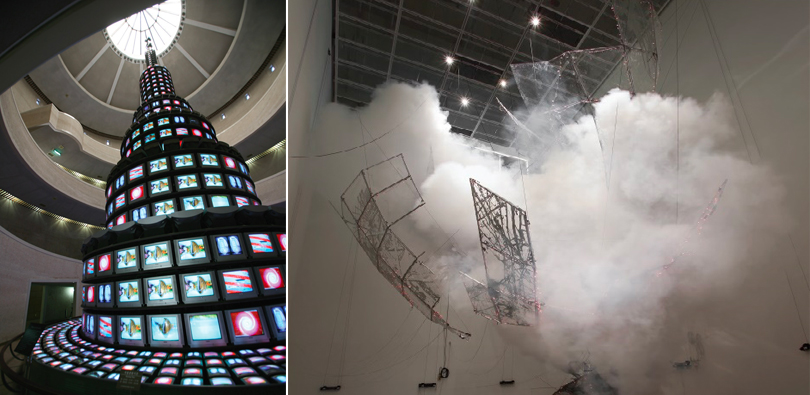 Left) Nam June Paik, The More and The Better, 1988, installation view, National Museum of Modern and Contemporary Art, Gwacheon ⓒ NMMCA
 Right) Lee Bul, Aubade III, 2014, aluminium and stainless-steel structure, polycarbonate sheet, metallized film, LED lights, electrical wiring, fog machine. Work commissioned for the Inaugural MMCA Hyundai Motor Series of major new works by prominent Korean artists ⓒ Lee Bul. Photo: Jeon Byung-cheol. Courtesy National Museum of Modern and Contemporary Art, Korea
The alternative space scene has diminished since 2010, and a number of spaces have closed altogether. Many affiliated members have left to take up directorial positions at major museums. In 2014, Park Chan-kyong, the former leader of Art Space Pool, curated Ghosts, Spies and Grandmothers at Seoul Museum of Art, whose director, Kim Hong-hee is the former director of Ssamzie Art Space. A great number of artists from the alternative spaces participated in this exhibition with artworks that projected the “shadows” of modern Asian history in the era of the Cold War. This exhibition highlighted a shift from the alternative space towards the mainstream system, perhaps indicating that the alternative space was to be consigned to history. Nevertheless, some of the art spaces are still going. Impressively, the phrase on the web page of Art Space Pool reads: “the pride of the Pool is the presentation of alternatives in productivity by the artists themselves, which is still valid.” The fact is that solidarity of artists has sustained the vitality of the art scene. This is exemplified by the diversity of Korean contemporary art history and associated fields, especially when government support did not function properly.
In October 2013, the MMCA in Seoul opened after the long discursive process. The old 1970s red brick Defence Security Command building over the road from the Gyeongbokgung Palace, (with all the symbolism that this implies), was transformed by architect Mihn Hyunjun into a massive public facility including 12,000 square metres of exhibition space, a dedicated Archive Centre and many other facilities, incorporating the ancient tradition of courtyard spaces to provide tranquillity for the visitor and a sense of belonging to a great and enduring culture. Its location in the very centre of the art precinct surrounded by art galleries and private museums is an extra bonus for visitors. Recent exhibitions include two monumental installation pieces by Lee Bul, Aubade III and Civitas Solis II. The MMCA Seoul will show the Australia-Korea exchange exhibition New Romance: Art and the Posthuman from September.
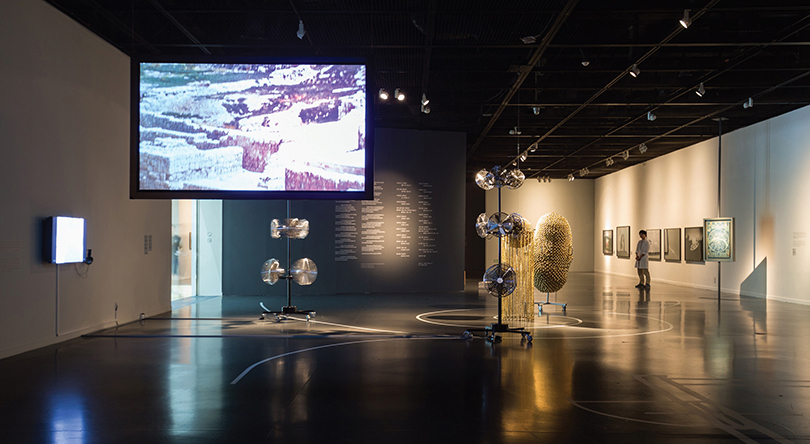 SeMA Biennale Mediacity Seoul: Ghosts, Spies and Grandmothers, 2014, installation view ⓒ Seoul Museum of Art
In the last ten years, public and governmental residency programs have rapidly increased and are regarded as the successors to the alternative spaces. Competition among young artists is intense for the twenty art residency programs administered by national, provincial and municipal governments, to provide work spaces and living accommodation for young artists. They periodically put on exhibitions and most offer their residents publishing opportunities. The MMCA operates the Changdong Studio and Goyang Studio; in 2009, Gyeonggi Creation Centre, Incheon Art Platform as well as nine spaces in Seoul emerged. The well-equipped Nanji Space on the outskirts of the city is run by the Seoul Museum of Art and accommodates dozens of residents, some from overseas, in six monthly rotations.
Most of the national museums in Korea are reliant on government funds. There were significant funding increases after 2000 but there is some uncertainty as to how long this will last, following the controversy over the matter of the incorporation of the MMCA, which started before the opening of MMCA, Seoul. There is a saying, that state power should not “interfere” in art but provide “support”. In reality it would be hard to maintain both notions properly. The art system and policy of Korea is rapidly changing and accompanied by relentless challenges and struggles.
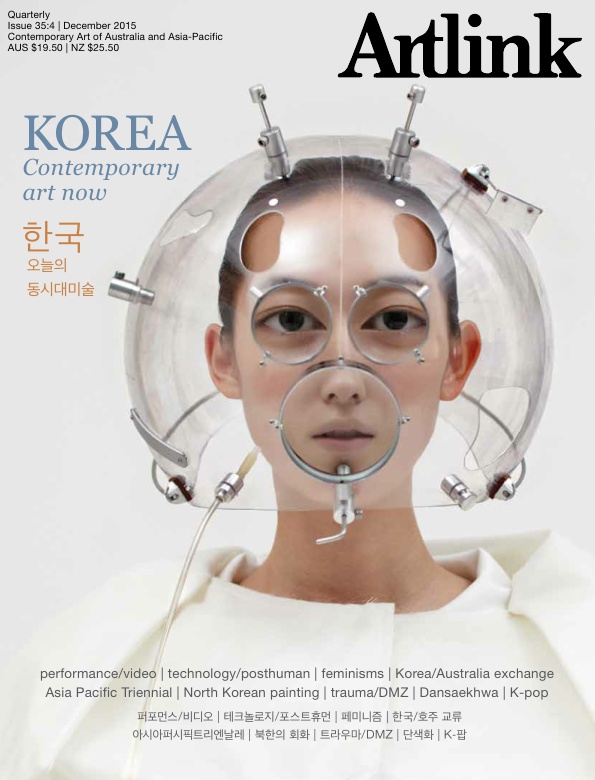
※ This article is published as part of a collaboration between Artlink magazine and Korean Arts Management Service. It first appeared in Artlink's special bilingual issue KOREA contemporary art now,V.35:4, Dec. 2015 for which KAMS provided advisory and translation services. Copyright the author and Artlink.
Kim Inhye / Curator at the National Museum of Modern and Contemporary Art
Curator at the National Museum of Modern and Contemporary Art since 2002. Exhibitions she has curated include Realism in Asian Art (2009), Tell Me Tell Me: Australian and Korean Art 1976-2011 (2011), Deoksugung Project (2012), Mandala: A Retrospective of Park Hyunki 1942-2000 (2015).
-

-
 Focus / Features - 26 Dec 2017
Reviewing Overseas Visual Arts Support in Korea (2) : International Residency Programs in Korea, Current Status and Suggestions

